


An opinion on Wastewater-Based Epidemiological Monitoring (WBEM) with Clinical Diagnostic Test (CDT) for detecting high-prevalence areas of community COVID-19 Infections
- PMID: 36320818
- PMCID: PMC9612100
- DOI: 10.1016/j.coesh.2022.100396
An opinion on Wastewater-Based Epidemiological Monitoring (WBEM) with Clinical Diagnostic Test (CDT) for detecting high-prevalence areas of community COVID-19 Infections
Abstract
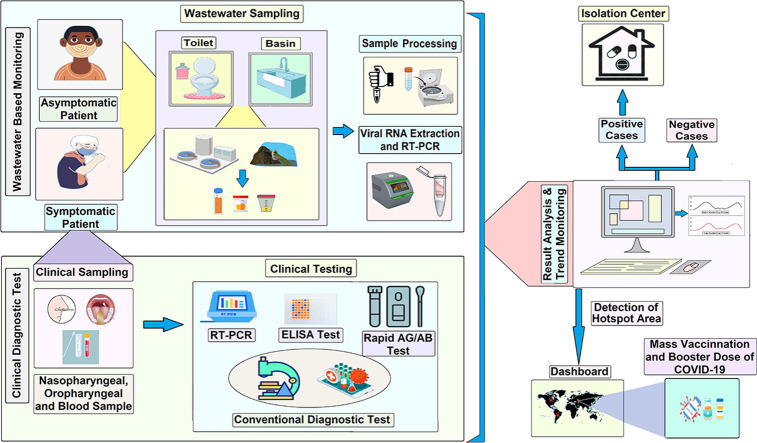
Wastewater-Based Epidemiological Monitoring (WBEM) is an efficient surveillance tool during the COVID-19 pandemic as it meets all requirements of a complete monitoring system including early warning, tracking the current trend, prevalence of the disease, detection of genetic diversity as well asthe up-surging SARS-CoV-2 new variants with mutations from the wastewater samples. Subsequently, Clinical Diagnostic Test is widely acknowledged as the global gold standard method for disease monitoring, despite several drawbacks such as high diagnosis cost, reporting bias, and the difficulty of tracking asymptomatic patients (silent spreaders of the COVID-19 infection who manifest nosymptoms of the disease). In this current reviewand opinion-based study, we first propose a combined approach) for detecting COVID-19 infection in communities using wastewater and clinical sample testing, which may be feasible and effective as an emerging public health tool for the long-term nationwide surveillance system. The viral concentrations in wastewater samples can be used as indicatorsto monitor ongoing SARS-CoV-2 trends, predict asymptomatic carriers, and detect COVID-19 hotspot areas, while clinical sampleshelp in detecting mostlysymptomaticindividuals for isolating positive cases in communities and validate WBEM protocol for mass vaccination including booster doses for COVID-19.
Keywords: Booster doses; Clinical Diagnostic Test; Genetic diversity; Mass vaccination; New variants and mutations; SARS-CoV-2; Wastewater-Based Epidemiological Monitoring.
© 2022 The Author(s).
Conflict of interest statement
The authors declare that they have no known competing financial interests or personal relationships that could have appeared to influence the work reported in this paper.
Figures
References
-
- Islam M.A., Al Marzan A., Islam M.S., Sultana S., Parvej M.I., Hossain M.S., Amin M.T., Hossain F.E., Barek M.A., Hossen M.S., et al. Sex-specific epidemiological and clinical characteristics of COVID-19 patients in the southeast region of Bangladesh. medRxiv. 2021
-
- Sakib M.M.H., Nishat A.A., Islam M.T., Uddin M.A.R., Iqbal M.S., Hossen F.F.B., Ahmed M.I., Bashir M.S., Hossain T., Tohura U.S., et al. Computational screening of 645 antiviral peptides against the receptor-binding domain of the spike protein in SARS-CoV-2. Comput Biol Med. 2021:104759. - PMC - PubMed
-
- Hossain M, Huq TS, Rahman A, Islam MA,Tabassum SN,Hasan KN,Khaleque A, Sadique A, Hossain MS, Bahadur NM, et al.:Novel mutations identified from whole-genome sequencing of SARS-CoV-2 isolated from Noakhali, Bangladesh. Research Square 2021.
Publication types
LinkOut - more resources
Full Text Sources
Miscellaneous