


Socio-Demographic, Health, and Transport-Related Factors Affecting the COVID-19 Outbreak in Myanmar: A Cross-Sectional Study
- PMID: 36320974
- PMCID: PMC9616012
- DOI: 10.7759/cureus.29693
Socio-Demographic, Health, and Transport-Related Factors Affecting the COVID-19 Outbreak in Myanmar: A Cross-Sectional Study
Abstract
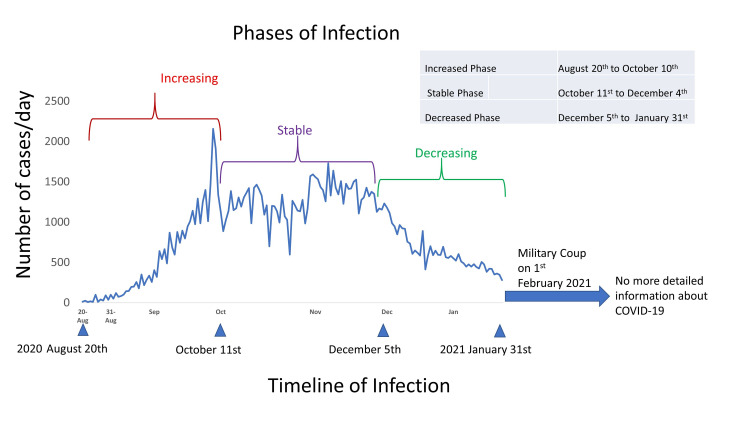
Introduction The coronavirus disease 2019 (COVID-19) pandemic is a worldwide threat in many aspects, making developing countries with scarce primary health care and medical services more vulnerable. Evaluation of the relationship between the COVID-19 pandemic, sociodemographic variables, and medical services provides useful information to take countermeasures to stop the infection spread and could mitigate the damage. Therefore, this study investigated the relationship between the spread of COVID-19 and sociodemographic variables, medical services, and the transportation system in Myanmar. Methodology This study was a cross-sectional study and was conducted using data on COVID-19 cases from August 20, 2020 to January 31, 2021 in Myanmar. We evaluated the association between the COVID-19 cases and 13 independent variables that were sociodemographic, medical services, and transportation system factors using simple linear regression analysis and multiple linear regression analysis in three phases (increasing (from August 20th to October 10th), stable (from October 11st to December 4th) and decreasing phases (from December 5th to January 31st)) on the infection timeline. Results It was found that the population density was parallelly associated with COVID-19 cases. On the other hand, among the medical services factors, the number of doctors was parallelly associated with COVID-19 cases and the number of nurses was inversely related to COVID-19 cases. Conclusions The result indicated that a high population density area was a risk factor for the increase of COVID-19 cases. This supported the worldwide countermeasures to deal with the spread of the infection, such as social distancing, banning large gatherings, working from home, and implementing quarantine procedures for suspected individuals to reduce person-to-person contact. Finally, at least in Myanmar, employing a large number of nurses could reduce the emergence of new COVID-19 cases. We believe that our study can make valuable contributions to tackling future epidemics like COVID-19 not only in Myanmar but also in other developing countries. This article was previously presented as an abstract at the 91st conference of The Japanese Society for Hygiene (JSH ) on March 08, 2021.
Keywords: contagion; covid 19 retro; covid-19; developing countries; infection control measures; myanmar.
Copyright © 2022, Aung et al.
Conflict of interest statement
The authors have declared that no competing interests exist.
Figures
References
-
- WHO Coronavirus (COVID-19) Dashboard | WHO Coronavirus (COVID-19) Dashboard With Vaccination Data. [ Jul; 2022 ]. https://covid19.who.int https://covid19.who.int
LinkOut - more resources
Full Text Sources