


Trace-level detection of sulfonamide antibiotics using quaternary ammonium polymeric ionic liquid-based effervescence-enhanced dispersive solid-phase extraction followed by LC-DAD analysis in environmental waters
- PMID: 36321111
- PMCID: PMC9580476
- DOI: 10.1039/d2ra02488h
Trace-level detection of sulfonamide antibiotics using quaternary ammonium polymeric ionic liquid-based effervescence-enhanced dispersive solid-phase extraction followed by LC-DAD analysis in environmental waters
Abstract
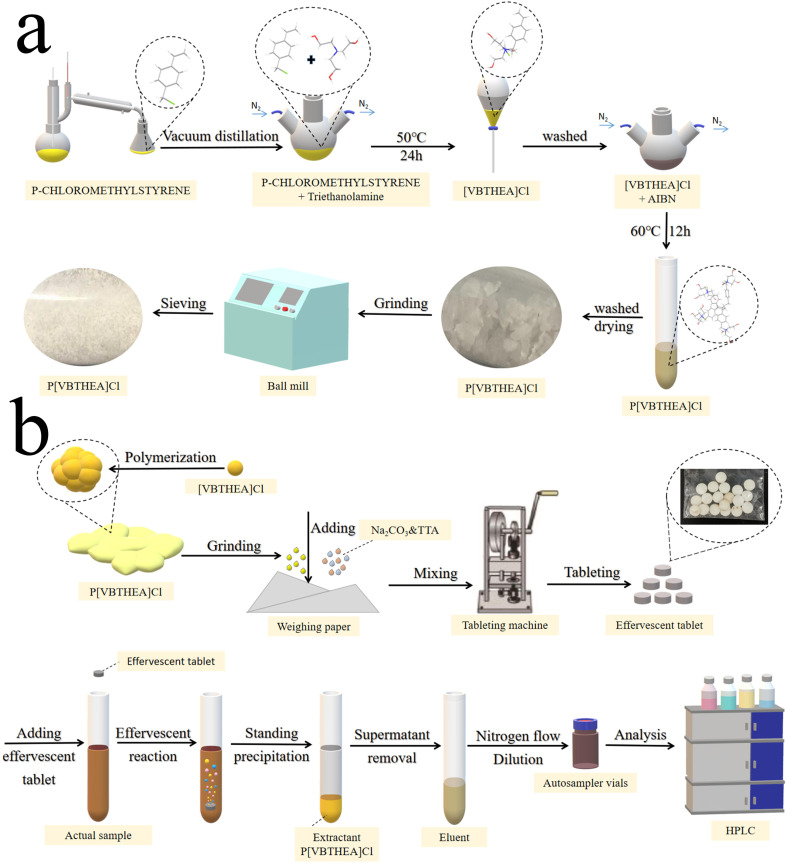
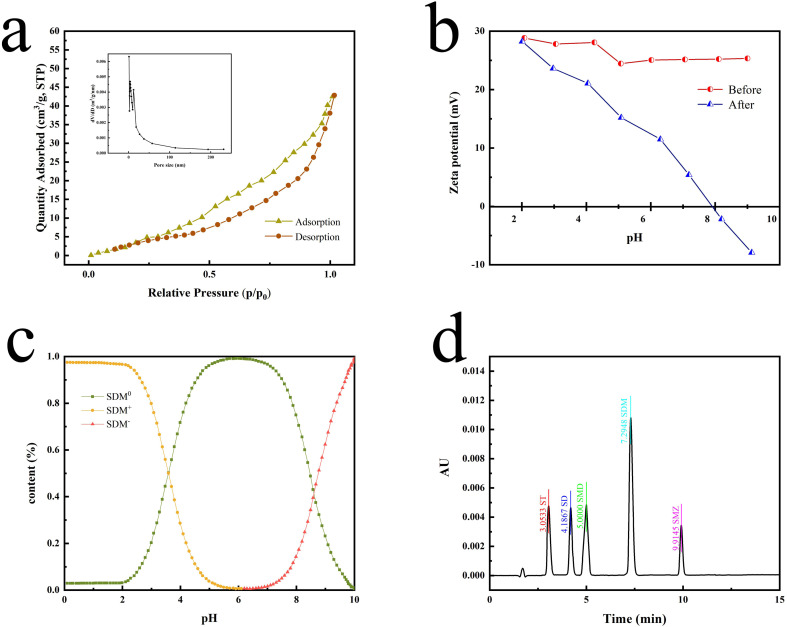
Conventional ionic liquids possess several disadvantages, such as high viscosity, difficult sampling/retrieval, and great loss in aqueous solution, limiting their wide applications in the pretreatment field. To solve these drawbacks, we synthesized a quaternary ammonium polymeric ionic liquid (PIL) and pressed it into an effervescent tablet for developing an effervescence-enhanced dispersive solid-phase extraction method (QAP-EDSE). The pressed effervescent tablet was composed of PIL as an extractant, tartaric acid as an acidic source, NaHCO3 as an alkaline source, and water-soluble starch as a filler, respectively. Under the CO2-driven dispersion, the QAP-EDSE method integrated rapid enrichment, extraction, and dispersion into one synchronous step. Employing the one-factor-at-a-time approach, several important variables were optimized as follows: 200 mg of P[VBTHEA]Cl as sorbent, 400 μL of acetone as elution solvent, 5 min of elution, solution pH 9.0, and 1 : 1.25 molar ratio of alkaline to acidic sources. Combining LC-DAD analysis, this proposed approach offered the limits of detection as low as 0.11-0.31 μg L-1 and satisfactory recoveries of 81.40-102.62% for five sulfonamides (SAs) in environmental waters. The lower relative standard deviations (1.9-6.7%) evidenced the higher intraday and interday experimental precision by this method. Overall, the newly developed method is environmentally benign, time-saving, and easy to operate with low detection limit and high recovery and thus shows excellent prospects in the trace-level detection of SAs in environmental waters.
This journal is © The Royal Society of Chemistry.
Conflict of interest statement
The authors declare no conflict of interest.
Figures




References
-
- Fan Y. Zeng G. Ma X. Effects of prepolymerization on surface molecularly imprinted polymer for rapid separation and analysis of sulfonamides in water. J. Colloid Interface Sci. 2020;571:21–29. - PubMed
-
- Gao Y. Liang T. Sun P. Guo Y. Determination of five sulfonamides in water by high performance liquid chromatography combined with ionic liquid liquid-liquid microextraction. Am. J. Appl. Chem. 2020;8:89–93.
-
- Ng K. T. Rapp-Wright H. Egli M. Hartmann A. Steele J. C. Sosa-Hernández J. E. Melchor-Martínez E. M. Jacobs M. White B. Regan F. High-throughput multi-residue quantification of contaminants of emerging concern in wastewaters enabled using direct injection liquid chromatography-tandem mass spectrometry. J. Hazard. Mater. 2020;398:122933. - PMC - PubMed
-
- Felis E. Kalka J. Sochacki A. Kowalska K. Bajkacz S. Harnisz M. Korzeniewska E. Antimicrobial pharmaceuticals in the aquatic environment-occurrence and environmental implications. Eur. J. Pharmacol. 2020;866:172813. - PubMed
-
- Mehrabi F. Mohamadi M. Mostafavi A. Hakimi H. Shamspur T. Magnetic solid phase extraction based on PVA-TEOS/grafted FE3O4@SiO2 magnetic nanofibers for analysis of sulfamethoxazole and trimethoprim in water samples. J. Solid State Chem. 2020;292:121716.
LinkOut - more resources
Full Text Sources
