


Systematic Review of mHealth Interventions for Adolescent and Young Adult HIV Prevention and the Adolescent HIV Continuum of Care in Low to Middle Income Countries
- PMID: 36322217
- PMCID: PMC9629200
- DOI: 10.1007/s10461-022-03840-0
Systematic Review of mHealth Interventions for Adolescent and Young Adult HIV Prevention and the Adolescent HIV Continuum of Care in Low to Middle Income Countries
Abstract
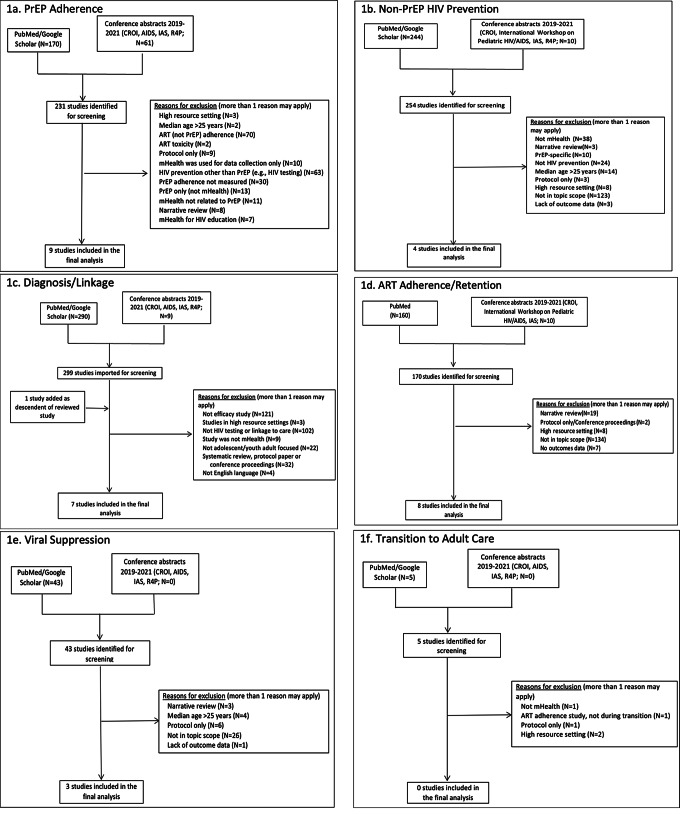
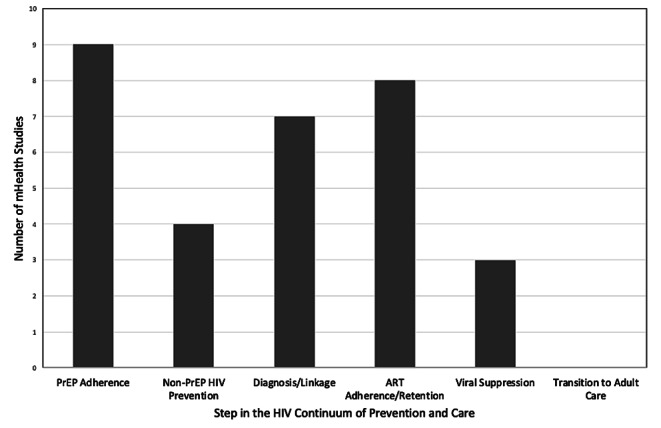
Adolescents and young adults (AYA) in low to middle income countries (LMIC) have poorer outcomes along each step in the HIV continuum of prevention and care compared to younger children or older adults. The use of mHealth technology provides a potentially promising implementation strategy for interventions to remedy these disparities. We therefore conducted a systematic review of the English literature and conference proceedings from January 1, 2000 to April 1, 2021 evaluating mHealth interventions targeting AYA along each step of the HIV continuum of care in LMIC. We identified 27 mHealth interventions across the HIV continuum, with no interventions addressing transition from pediatric to adult care. The majority of studies were single arm, uncontrolled or underpowered, with few randomized trials resulting in mixed and inconclusive outcomes. mHealth interventions have potential to remedy disparities along the HIV continuum of care for AYA in LMIC but larger, powered randomized trials are needed.
Los adolescentes y adultos jóvenes (AYA) en países de ingresos bajos a medianos (LMIC) tienen peores resultados en cada paso del continuo de prevención y atención del VIH en comparación con los niños más pequeños o los adultos mayores. El uso de la tecnología mHealth proporciona una estrategia de implementación potencialmente prometedora para las intervenciones para remediar estas disparidades. Por lo tanto, realizamos una revisión sistemática de los resúmenes y artículos publicados en inglés desde el 1 de enero de 2000 hasta el 1 de abril de 2021 para evaluar las intervenciones de mHealth dirigidas a AYA a lo largo de cada paso del continuo de atención del VIH en LMIC. Identificamos 27 intervenciones de mHealth en todo el continuo del VIH, sin intervenciones que abordaran la transición de la atención pediátrica a la de adultos. La mayoría de los estudios fueron de un solo brazo, no controlados o con bajo poder estadístico, con pocos ensayos aleatorios que dieron resultados mixtos y no concluyentes. Las intervenciones de mHealth tienen el potencial de remediar las disparidades a lo largo de la continuidad de la atención del VIH para AYA en LMIC, pero se necesitan ensayos aleatorios más grandes y potentes.
Keywords: Adolescent; HIV; implementation science; low- and middle-income countries; mHealth.
© 2022. The Author(s).
Figures
References
-
- Joint United Nations Programme on HIV/AIDS. Global AIDS Update 2021: Confronting Inequalities. Joint United Nations Programme on HIV/AIDS; 2021.
Publication types
MeSH terms
Grants and funding
LinkOut - more resources
Full Text Sources
Medical
Miscellaneous
