. 2022 Nov 18;87(22):15011-15021.
doi: 10.1021/acs.joc.2c01311. Epub 2022 Nov 2.

One-Step Regio- and Stereoselective Electrochemical Synthesis of Orexin Receptor Antagonist Oxidative Metabolites

Affiliations

One-Step Regio- and Stereoselective Electrochemical Synthesis of Orexin Receptor Antagonist Oxidative Metabolites

Huifang Yao et al. J Org Chem. .

Abstract

Synthesis of drug metabolites, which often have complex structures, is an integral step in the evaluation of drug candidate metabolism, pharmacokinetic (PK) properties, and safety profiles. Frequently, such synthetic endeavors entail arduous, multiple-step de novo synthetic routes. Herein, we present the one-step Shono-type electrochemical synthesis of milligrams of chiral α-hydroxyl amide metabolites of two orexin receptor antagonists, MK-8133 and MK-6096, as revealed by a small-scale (pico- to nano-mole level) reaction screening using a lab-built online electrochemistry (EC)/mass spectrometry (MS) (EC/MS) platform. The electrochemical oxidation of MK-8133 and MK-6096 was conducted in aqueous media and found to produce the corresponding α-piperidinols with exclusive regio- and stereoselectivity, as confirmed by high-resolution nuclear magnetic resonance (NMR) characterization of products. Based on density functional theory (DFT) calculations, the exceptional regio- and stereoselectivity for this electrochemical oxidation are governed by more favorable energetics of the transition state, leading to the preferred secondary carbon radical α to the amide group and subsequent steric hindrance associated with the U-shaped conformation of the cation derived from the secondary α-carbon radical, respectively.


Conflict of interest statement

Conflicts of interest

There are no conflicts to declare.

Figures
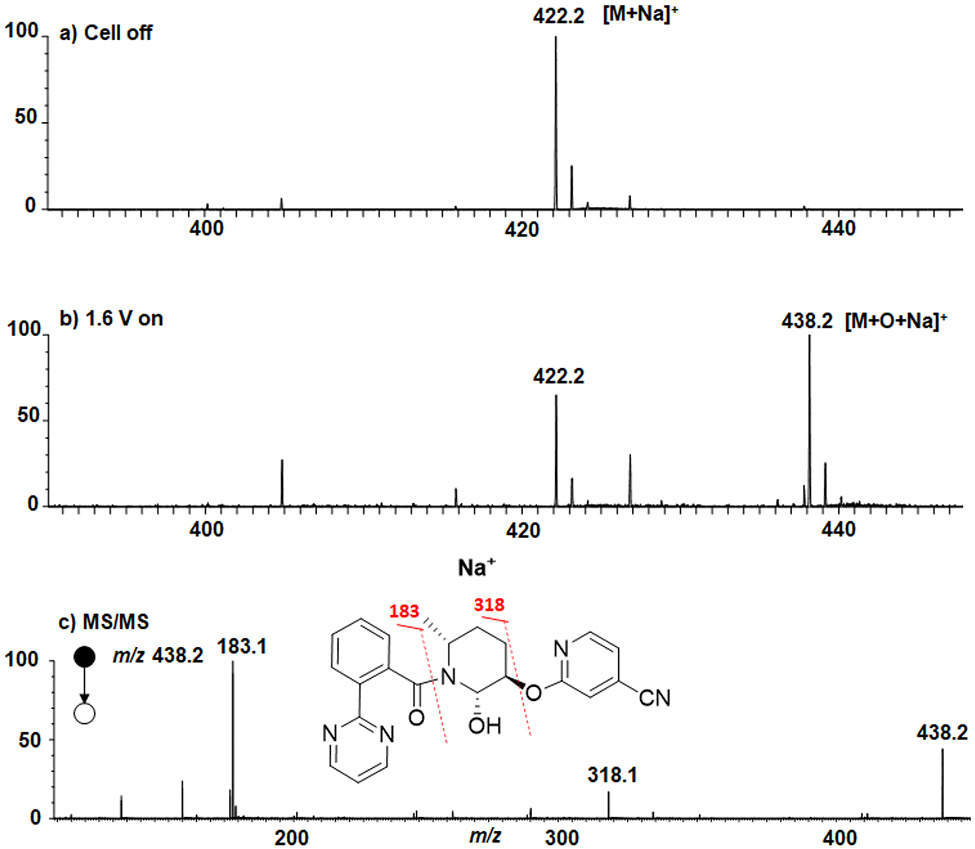
Figure 1.
Figure 1.
DESI-MS spectra acquired when a solution of 100 μM MK-8133 in water containing 20 mM Na2HPO4/NaH2PO4 (pH=7.0) was flowed through the thin-layer electrochemical cell a) without and b) with an applied 1.6 V; c) CID MS/MS spectrum of m/z 438.
Figure 2.
Figure 2.
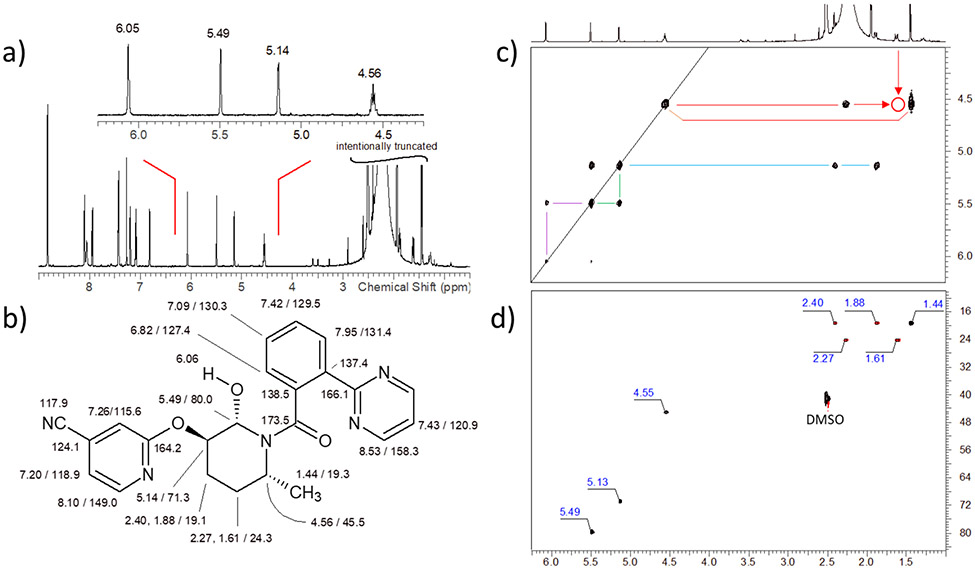
a) 600 MHz 1H NMR spectrum of the M-11 metabolite of MK-8133 in d6-DMSO. b) 1H and 13C NMR resonance assignments for the M-11 metabolite made from the ensemble of 2D NMR data acquired for the sample. c) Pertinent region of the COSY spectrum showing correlations for the aliphatic resonances of the piperidine moiety in the structure. The proton resonating at 4.56 ppm affords correlations to the vicinal proton resonating at 2.27 ppm and to the methyl group resonating at 1.44 ppm. The open circle corresponds to a very weak correlation to the vicinal proton resonating at 1.61 ppm (see also the multiplicity-edited HSQC data shown in panel d) that is below the threshold used to plot the COSY data. d) Correlations for the aliphatic resonances of the M-11 metabolite observed in the multiplicity-edited HSQC spectrum.
Figure 3.
Figure 3.
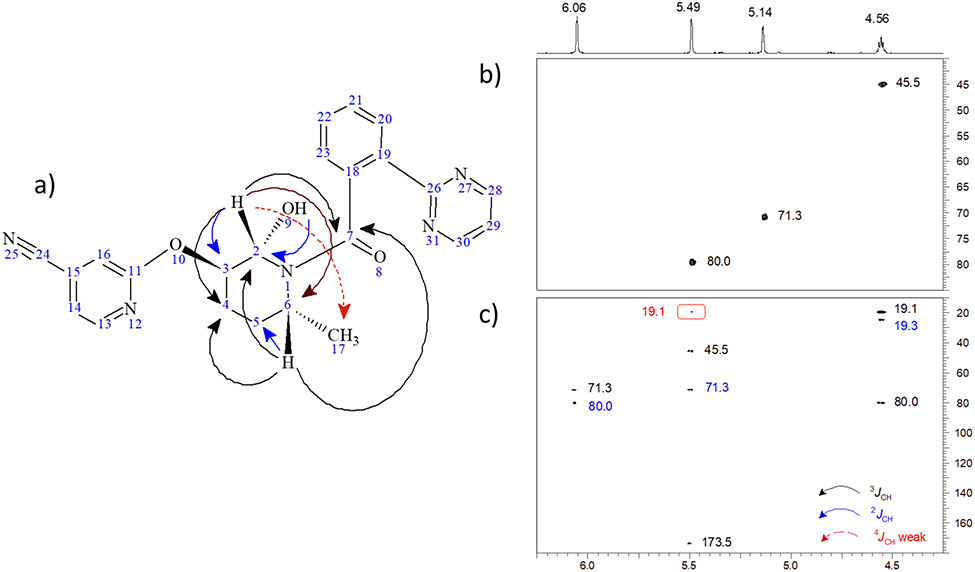
a) Structure of the M-11 metabolite showing long-range 1H-13C correlations observed in the 8 Hz optimized HMBC spectrum. Correlation pathways are color-coded on the structure, with the most prevalent 3JCH correlations denoted by black arrows; 2JCH correlations are denoted by blue arrows; the single, weak 4JCH correlation observed is denoted by the dashed red arrow. b) Aliphatic moiety correlations in the multiplicity-edited HSQC spectrum of the M11 metabolite. c) Correlations observed in the 8 Hz optimized HMBC spectrum. Chemical shift labels are color-coded as a function of the long-range heteronuclear correlation pathway involved. The very weak 4JCH correlation from the proton resonating at 5.49 ppm to the methyl doublet is enclosed in the red box. It is interesting to note that no HMBC correlations were observed from the H3 proton resonating at 5.14 ppm to any of the aliphatic carbon resonances in the HMBC spectrum.
Figure 4.
Figure 4.
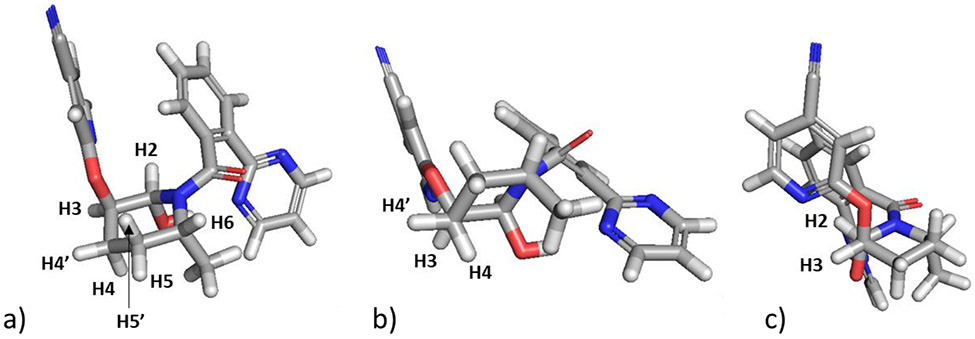
a) Energy-minimized structure of the M11 metabolite of MK-8133. The orientation of the H3 resonance relative to the H2 and H4′ and H4″ resonances lead to dihedral angles that are consistent, based on the Karplus relationship, with the observed three small coupling constants exhibited by the H3 resonance. b) View along the C-4-C3 bond axis showing the gauche relationship of the H3 resonance to both H4 protons. c) View along the C2-C3 bond axis of the piperidine ring showing the gauche relationship of the H2 and H3 protons (see computational details below).
Figure 5.
Figure 5.
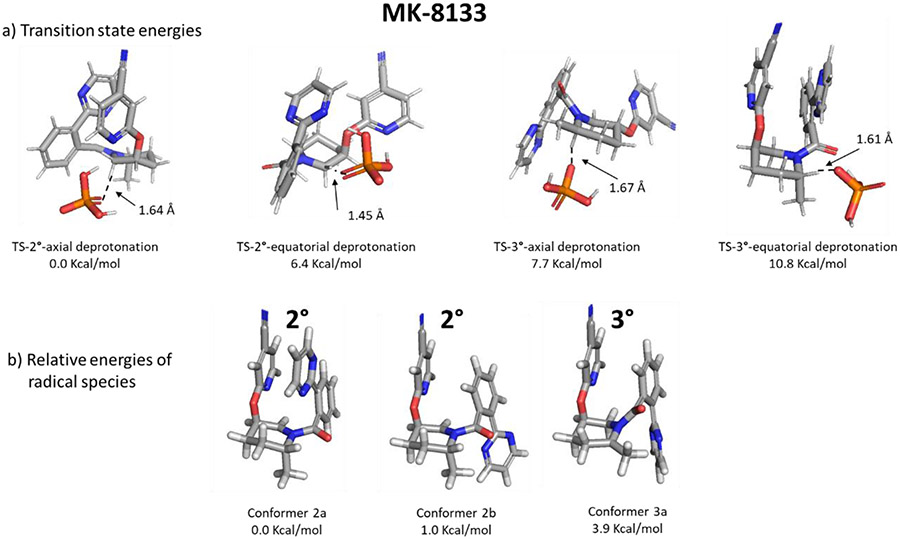
(a) Transition states for deprotonation, by a dihydrogen phosphate anion, of the radical cation leading to either the secondary or tertiary radicals. (b) Low energy conformations of the secondary and tertiary radicals for MK-8133. Carbon = grey, oxygen = red, nitrogen = blue, hydrogen = white, phosphorous = orange.
Figure 6.
Figure 6.
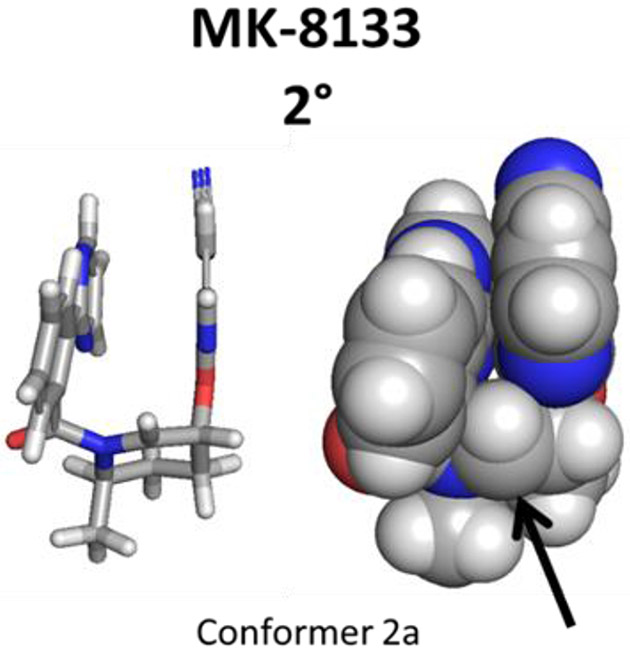
Global minima conformation of the MK-8133 iminium cation 4 (derived from the secondary (2°) radical) shown in both a stick and space-filling representation. The arrow indicates favorable ‘bottom’ side approach in the axial position for the nucleophile whereas nucleophilic approach from the ‘top’ side is sterically blocked. Carbon = grey, oxygen = red, nitrogen = blue, hydrogen = white.
Scheme 1.
Scheme 1.
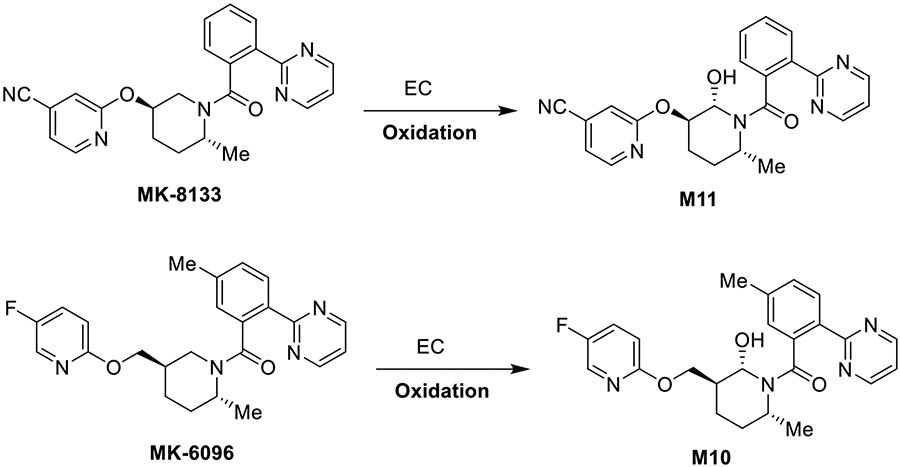
One-step electrochemical oxidation of MK-8133 and MK-6096 to produce hydroxylated metabolites, M11 and M10, respectively.
Scheme 2.
Scheme 2.
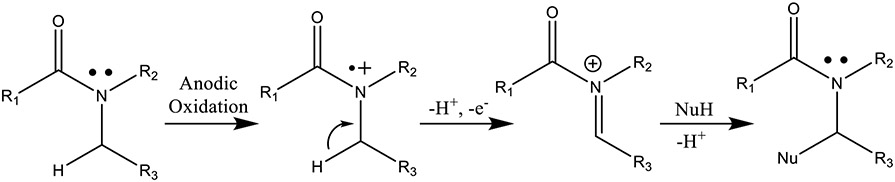
Schematic representation of the anodic electrochemical oxidation of an amide where NuH = nucleophile; e.g., water in this study.
Scheme 3.
Scheme 3.
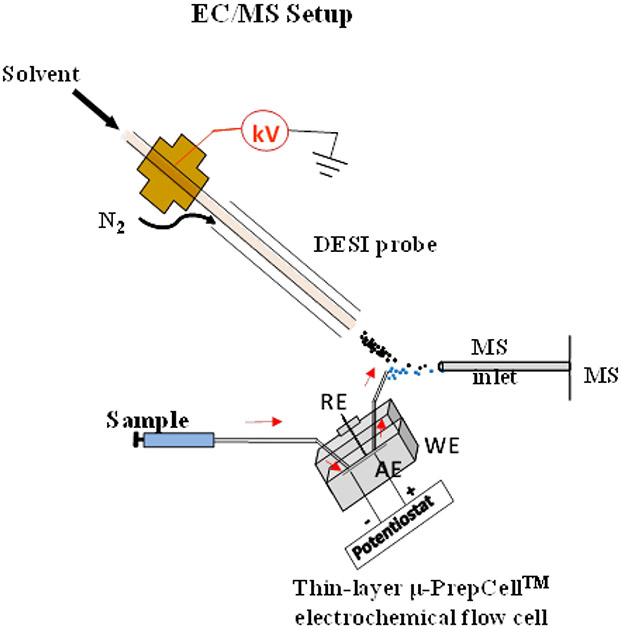
EC/MS apparatus for online electrosynthesis monitoring/screening, and the optimization of the electrosynthesis parameters such as the initial concentration, solvents, applied potential, electrolysis time, pH and electrode materials.
Scheme 4.
Scheme 4.
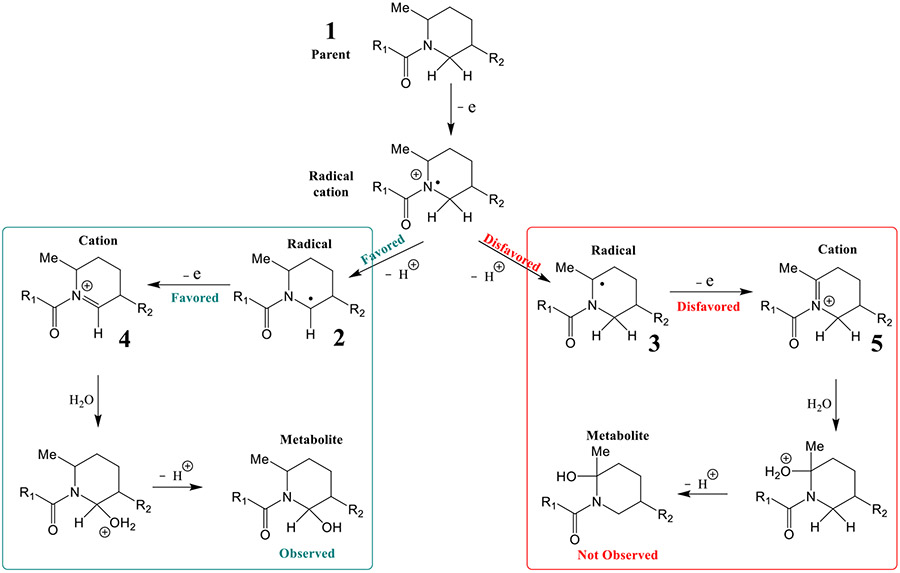
The proposed mechanism for the electrochemical hydroxylation of MK-8133 and MK-6096.

References

    1. Benca RM, Diagnosis and Treatment of Chronic Insomnia: A Review. Psych. Serv 2005, 56 (3), 332–343. - PubMed
    1. Compernolle F; Saleh MA; Van den Branden S; Toppet S; Hoornaert G, Regioselective oxidation of piperidine-3 derivatives: a synthetic route to 2,5-substituted piperidines. J. Org. Chem 1991, 56 (7), 2386–2390.
    1. Pelkonen O; Turpeinen M; Uusitalo J; Rautio A; Raunio H, Prediction of drug metabolism and interactions on the basis of in vitro investigations. Basic Clin. Pharmacol. Toxicol 2005, 96 (3), 167–175. - PubMed
    1. Plant N, Strategies for using in vitro screens in drug metabolism. Drug Discov. Today 2004, 9 (7), 328–336. - PubMed
    1. Brandon EFA; Raap CD; Meijerman I; Beijnen JH; Schellens JHM, An update on in vitro test methods in human hepatic drug biotransformation research: pros and cons. Toxicol. Appl. Pharmacol 2003, 189 (3), 233–246. - PubMed

Publication types