


Tranexamic acid in pertrochanteric fractures: a retrospective analysis of perioperative outcomes after fixation with a proximal femoral nail
- PMID: 36324129
- PMCID: PMC9632134
- DOI: 10.1186/s12891-022-05889-3
Tranexamic acid in pertrochanteric fractures: a retrospective analysis of perioperative outcomes after fixation with a proximal femoral nail
Abstract
Background: Treatment of pertrochanteric femoral fractures is often associated with significant blood loss. It has already been demonstrated that the administration of tranexamic acid (TXA) for endoprosthetic procedures reduces blood losses and leads to a decreased frequency of postoperative complications. The aim of this study is to demonstrate whether the administration of TXA as part of osteosynthesis treatment for pertrochanteric fractures using a proximal femoral nail reduces perioperative blood losses and haemorrhage-related complications.
Methods: In a two-centre retrospective cohort study, 1 g TXA i.v. was administered preoperatively to 294 patients who had suffered from pertrochanteric femoral fractures. The subjects were compared clinically to a historical control group who did not receive TXA (nonTXA). Outcomes were evaluated on the basis of perioperative blood loss, transfusion requirement, and occurrence of complications.
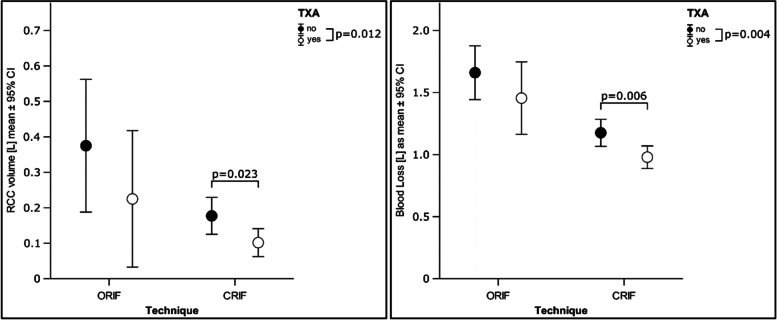
Results: The TXA group showed evidence of a reduction in blood loss (TXA = 0.97 ± 0.47 l; nonTXA = 1.06 ± 0.47 l; p = 0.004) and a lower frequency of transfusion (TXA = 20%; nonTXA = 31%; p = 0.032) as compared to the nonTXA group. However, evidence of this therapeutic effect could only be demonstrated at one of the centres on subgroup comparison between the two centres. At the second centre, the data did not show a significant difference. A trend could be seen towards a reduction in postoperative renal failure. No complications occurred resulting from the administration of tranexamic acid.
Conclusion: Preoperative administration of TXA does not lead to an increased rate of thromboembolic complications when applied for treatment of pertrochanteric femoral fractures. Evidence of a positive effect could be seen in principle in relation to the reduction in perioperative blood loss and the frequency of transfusion. The difference in effect between the two centres remains to be clarified: for this reason, it is possible to assume that further factors influencing the efficacy of TXA administration are at play which were not taken into account in this study.
Keywords: Geriatric; Haemoglobin monitoring; Proximal femoral fracture; Proximal femur nail; Tranexamic acid.
© 2022. The Author(s).
Conflict of interest statement
The authors do not have any conflict of interest or competing interest to report associated with this research.
Figures
References
-
- Bundesauswertung zum Erfassungsjahr 2019 Hüftgelenknahe Femurfraktur mit osteosynthetischer Versorgung Qualitätsindikatoren und Kennzahlen. IQTIG – Institut für Qualitätssicherung und Transparenz im Gesundheitswesen 2020.
-
- Sadegi M, Mehr-Aein A. Does a single bolus dose of tranexamic acid reduce blood loss and transfusion requirements during hip fracture surgery? A Prospective Randomized Double Blind Study in 67 patients. Acta Med Iran. 2007;45(6):6.
MeSH terms
Substances
LinkOut - more resources
Full Text Sources
Medical
