. 2022 Nov 2;10(1):185.
doi: 10.1186/s40168-022-01368-y.

Target-enriched long-read sequencing (TELSeq) contextualizes antimicrobial resistance genes in metagenomes

Affiliations

Target-enriched long-read sequencing (TELSeq) contextualizes antimicrobial resistance genes in metagenomes

Ilya B Slizovskiy et al. Microbiome. .

Abstract

Background: Metagenomic data can be used to profile high-importance genes within microbiomes. However, current metagenomic workflows produce data that suffer from low sensitivity and an inability to accurately reconstruct partial or full genomes, particularly those in low abundance. These limitations preclude colocalization analysis, i.e., characterizing the genomic context of genes and functions within a metagenomic sample. Genomic context is especially crucial for functions associated with horizontal gene transfer (HGT) via mobile genetic elements (MGEs), for example antimicrobial resistance (AMR). To overcome this current limitation of metagenomics, we present a method for comprehensive and accurate reconstruction of antimicrobial resistance genes (ARGs) and MGEs from metagenomic DNA, termed target-enriched long-read sequencing (TELSeq).

Results: Using technical replicates of diverse sample types, we compared TELSeq performance to that of non-enriched PacBio and short-read Illumina sequencing. TELSeq achieved much higher ARG recovery (>1,000-fold) and sensitivity than the other methods across diverse metagenomes, revealing an extensive resistome profile comprising many low-abundance ARGs, including some with public health importance. Using the long reads generated by TELSeq, we identified numerous MGEs and cargo genes flanking the low-abundance ARGs, indicating that these ARGs could be transferred across bacterial taxa via HGT.

Conclusions: TELSeq can provide a nuanced view of the genomic context of microbial resistomes and thus has wide-ranging applications in public, animal, and human health, as well as environmental surveillance and monitoring of AMR. Thus, this technique represents a fundamental advancement for microbiome research and application. Video abstract.

Keywords: Antimicrobial resistance; Long-read sequencing; Metagenomics; Microbiome; Mobile genetic elements; Public health; Resistome.


Conflict of interest statement

The authors declare that they have no competing interests.

Figures

Fig. 1
Fig. 1
TELSeq workflow overview. Utilizing replicates of diverse sample types, gDNA was extracted (1), and sheared, fragmented, size selected, A-tailed and adapter ligated (2). Then, custom-designed biotinylated 120-mer probes (3) were used to capture ARGs with streptavidin-coated magnetic beads (4). Captured fragments were amplified and purified (5) and submitted for PacBio CCS (6). Resulting TELSeq reads were deduplicated to correct for amplification bias (7). Finally, reads were aligned to numerous reference databases to identify and annotate ARGs, MGEs, and cargo genes (8)
Fig. 2
Fig. 2
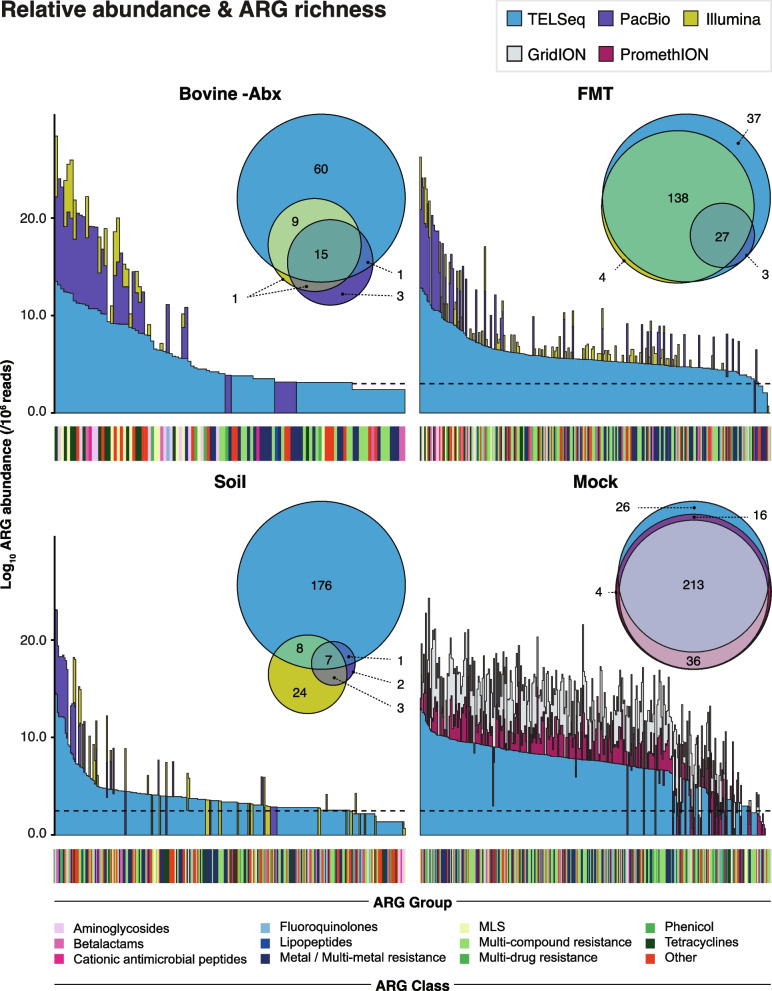
ARG abundance and richness. Stacked bar plots depict the relative abundance (y-axis) of unique ARG groups across technical replicates of each sample type (x-axis), with each ARG group count normalized for sequencing depth and expressed on a 106 read basis generated by each sequencing platform (TELSeq= light blue, PacBio= purple; Illumina= yellow; GridION= gray; PromethION= magenta). Final relative abundances are scaled using a log10 transformation. Rug colors on the x-axis of each plot indicate the MEGARes class to which each ARG belongs. The “Other” classification refers to drug classes present in <15 % of ARG hits by alignment, including aminocoumarins, bacitracin, biocides, elfamycin, fosfomycin, glycopeptides, nucleosides, oxazolidinone, pleuromutilin, quaternary ammonium compounds, trimethoprim / sulfas, and Mycobacterium tuberculosis drugs. Inset Venn diagrams indicate ARG group-level richness and composition, compared between sequencing platforms
Fig. 3
Fig. 3
Resistome distribution and composition. a Violin plots showing resistome distribution as the log10 relative abundance of ARG groups (y-axis), normalized for gene length and sequencing depth, by sample type and sequencing platform. b Binary heatmap of resistome composition at the ARG mechanism level, for metals and biocides (left) and antibiotic drugs (right), by sample type and sequencing platform
Fig. 4
Fig. 4
ARG-MGE colocalizations in TELSeq reads. Individual TELSeq reads (black horizontal dashed lines, length on x-axis) containing both ARGs (green and blue) and MGEs (yellow), as well as cargo genes (red), separated by sample type (y-axis). Color of ARG groups indicates the World Health Organization’s (WHO) classification status. Light green: highest priority, critically important. Medium green: high priority, critically important. Dark green: highly important. The −Abx sample did not contain any ARG-MGE colocalizations
Fig. 5
Fig. 5
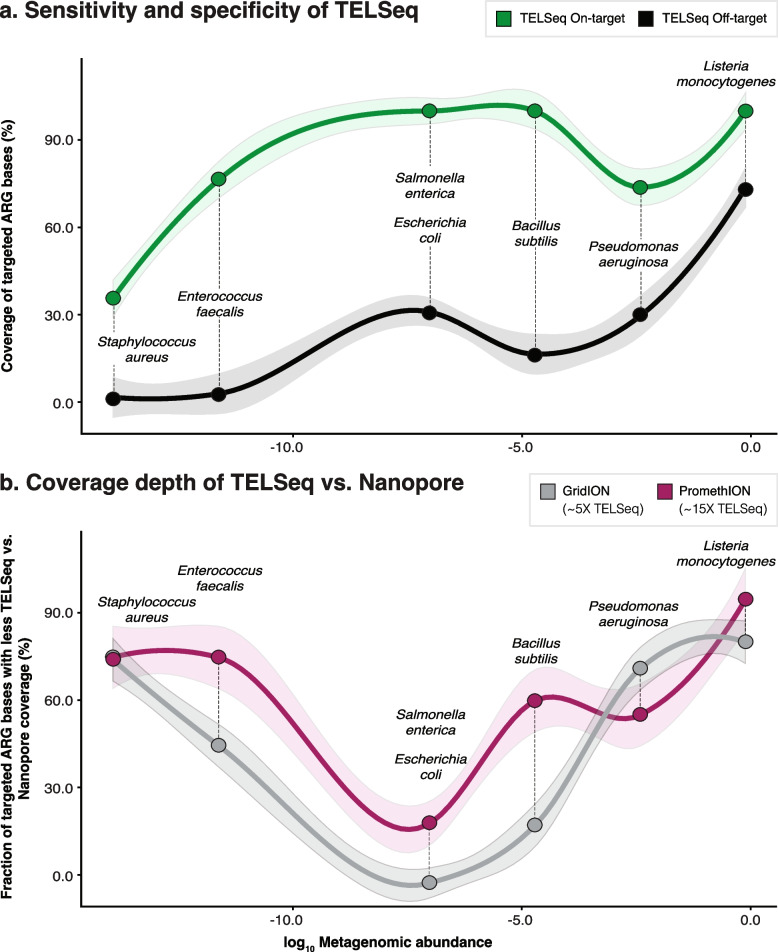
a Proportion of probe-covered bases that received TELSeq read coverage of at least 1× (on-target, green line), versus proportion of non-probe-covered bases that received TELSeq read coverage of at least 1× (off-target, black line). b Proportion of probe-covered bases for which high-depth GridION (gray line) and ultra high-depth PromethION (purple line) read coverage exceeded that of TELSeq coverage. Parentheses in figure legend indicate the relative sequencing throughput difference of GridION and PromethION platforms relative to TELSeq, i.e., 5× and 15×. Organisms in MOCK are listed in order of ascending relative abundance, from left to right on the x-axis. L. fermentum, C. neoformans, and S. cerevisiae did not have any known ARGs and did not receive any probe-specific coverage; therefore, the on-target rates by TELSeq (a) and Nanopore are not calculable. L. fermentum, C. neoformans, and S. cerevisiae received 17,922, 1242, and 571 alignments by TELSeq respectively, which can be considered off-target alignments. However, none of these off-target reads aligned to any MEGARes accessions (i.e., false positive ARGs) across any of the MOCK replicates
Fig. 6
Fig. 6
Sequencing coverage of genomes in MOCK. Genomes are arranged on the y-axis in descending order of relative abundance (ah), with the log10 relative abundance of each genome in MOCK displayed beneath the genome name. Coverage depth ranging from 100 to 104 is displayed on the y-axis and genome position (Mbp) on the x-axis for each genome. Areas of probe coverage are colored pink. Sequencing coverage achieved by deep GridION sequencing is indicated in gray, while TELSeq coverage is indicated in tan (2 kb library), blue (5 kb library), and green (8 kb library). Zoomed-in subsets from select loci of each genome are included for visualization purposes. Plots for the two eukaryotic genomes in MOCK can be found in Supp Table 3

References

    1. Nayfach S, Shi ZJ, Seshadri R, Pollard KS, Kyrpides NC. New insights from uncultivated genomes of the global human gut microbiome. Nature. 2019;568:505–510. doi: 10.1038/s41586-019-1058-x. - DOI - PMC - PubMed
    1. Xu L, Dong Z, Chiniquy D, Pierroz G, Deng S, Gao C, et al. Genome-resolved metagenomics reveals role of iron metabolism in drought-induced rhizosphere microbiome dynamics. Nat Commun. 2021;12:3209. doi: 10.1038/s41467-021-23553-7. - DOI - PMC - PubMed
    1. Coutinho FH, Silveira CB, Gregoracci GB, Thompson CC, Edwards RA, Brussaard CPD, et al. Marine viruses discovered via metagenomics shed light on viral strategies throughout the oceans. Nat Commun. 2017;8:15955. doi: 10.1038/ncomms15955. - DOI - PMC - PubMed
    1. Carr VR, Shkoporov A, Hill C, Mullany P, Moyes DL. Probing the mobilome: discoveries in the dynamic microbiome. Trends Microbiol. 2021;29:158–170. doi: 10.1016/j.tim.2020.05.003. - DOI - PubMed
    1. Zaheer R, Noyes N, Ortega Polo R, Cook SR, Marinier E, Van Domselaar G, et al. Impact of sequencing depth on the characterization of the microbiome and resistome. Sci Rep. 2018;8:5890. doi: 10.1038/s41598-018-24280-8. - DOI - PMC - PubMed

Publication types

Substances