


Quantative MRI predicts tendon mechanical behavior, collagen composition, and organization
- PMID: 36324161
- PMCID: PMC10151441
- DOI: 10.1002/jor.25471
Quantative MRI predicts tendon mechanical behavior, collagen composition, and organization
Abstract
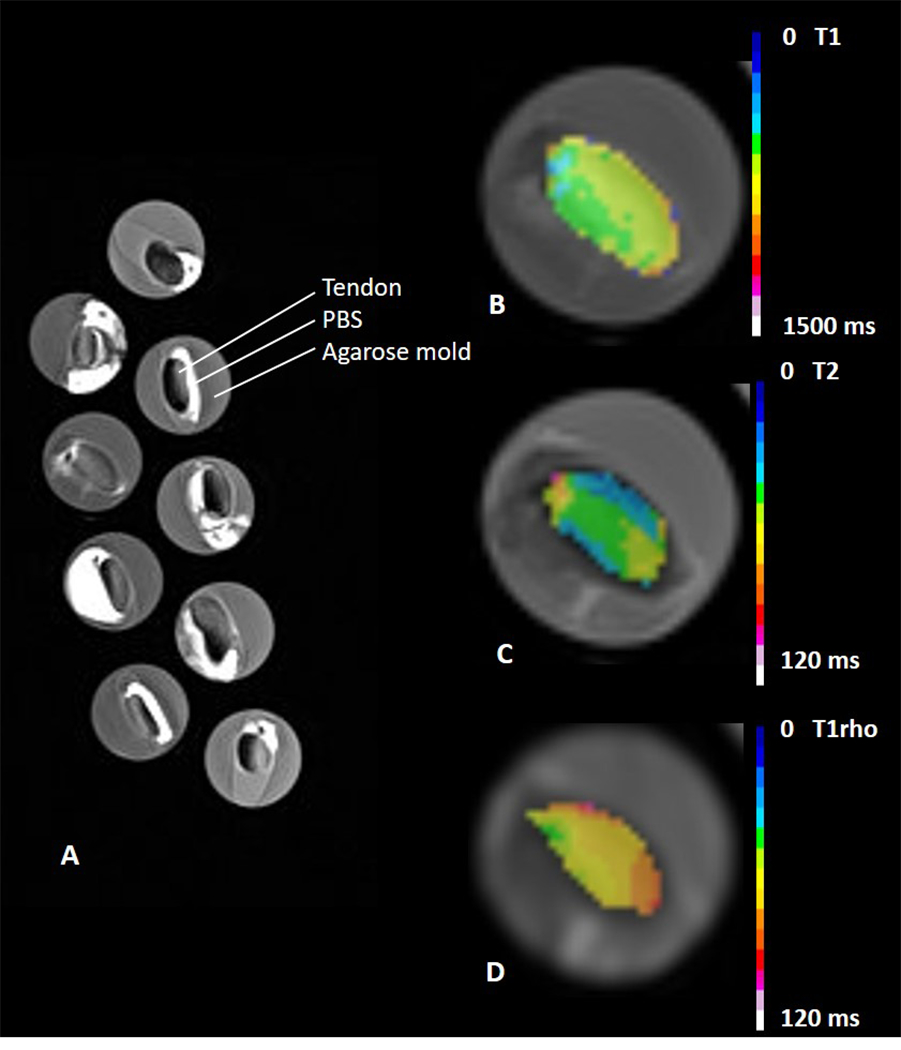
Quantitative magnetic resonance imaging (qMRI) measures have provided insights into the composition, quality, and structure-function of musculoskeletal tissues. Low signal-to-noise ratio has limited application to tendon. Advances in scanning sequences and sample positioning have improved signal from tendon allowing for evaluation of structure and function. The purpose of this study was to elucidate relationships between tendon qMRI metrics (T1, T2, T1ρ and diffusion tensor imaging [DTI] metrics) with tendon tissue mechanics, collagen concentration and organization. Sixteen human Achilles tendon specimens were collected, imaged with qMRI, and subjected to mechanical testing with quantitative polarized light imaging. T2 values were related to tendon mechanics [peak stress (rsp = 0.51, p = 0.044), equilibrium stress (rsp = 0.54, p = 0.033), percent relaxation (rsp = -0.55, p = 0.027), hysteresis (rsp = -0.64, p = 0.007), linear modulus (rsp = 0.67, p = 0.009)]. T1ρ had a statistically significant relationship with percent relaxation (r = 0.50, p = 0.048). Collagen content was significantly related to DTI measures (range of r = 0.56-0.62). T2 values from a single slice of the midportion of human Achilles tendons were strongest predictors of tendon tensile mechanical metrics. DTI diffusivity indices (mean diffusivity, axial diffusivity, radial diffusivity) were strongly correlated with collagen content. These findings build on a growing body of literature supporting the feasibility of qMRI to characterize tendon tissue and noninvasively measure tendon structure and function. Statement of Clinical Significance: Quantitative MRI can be applied to characterize tendon tissue and is a noninvasive measure that relates to tendon composition and mechanical behavior.
Keywords: Achilles; diagnostic imaging; diffusion tensor imaging; mechanical properties; musculoskeletal imaging.
© 2022 Orthopaedic Research Society. Published by Wiley Periodicals LLC.
Figures


References
-
- Leadbetter WB. 1992. Cell-matrix response in tendon injury. Clin Sports Med 11(3):533–578. - PubMed
-
- Silbernagel KG, Thomeé R, Eriksson BI, Karlsson J. 2007. Continued sports activity, using a pain-monitoring model, during rehabilitation in patients with Achilles tendinopathy: a randomized controlled study. Am J Sports Med 35(6):897–906. - PubMed
-
- Gajhede-Knudsen M, Ekstrand J, Magnusson H, Maffulli N. 2013. Recurrence of Achilles tendon injuries in elite male football players is more common after early return to play: An 11-year follow-up of the UEFA Champions League injury study. Br J Sports Med 47(12):763–768 Available from: http://www.ncbi.nlm.nih.gov/pubmed/23770660. - PubMed
-
- Vicenzino B, de Vos RJ, Alfredson H, et al. 2020. ICON 2019 - International Scientific Tendinopathy Symposium Consensus: There are nine core health-related domains for tendinopathy (CORE DOMAINS): Delphi study of healthcare professionals and patients. Br J Sports Med 54(8):444–451. - PubMed
Publication types
MeSH terms
Substances
Grants and funding
LinkOut - more resources
Full Text Sources
