


Ruptured aneurysm associated with a twig-like middle cerebral artery: An illustrative case report
- PMID: 36324980
- PMCID: PMC9610211
- DOI: 10.25259/SNI_678_2022
Ruptured aneurysm associated with a twig-like middle cerebral artery: An illustrative case report
Abstract
Background: Anomalies of the middle cerebral artery (MCA) are rare; among the different types of anomalies, the aplastic or twig-like (Ap/T) MCA is extremely rare and has been reported under various names, including aplastic, unfused, or rete type anomaly. The occurrence of a brain aneurysm associated with this anatomic variant is an even rare event, and probably their development and rupture are related to hemodynamic stress of the tinny wall of vessels forming the network.
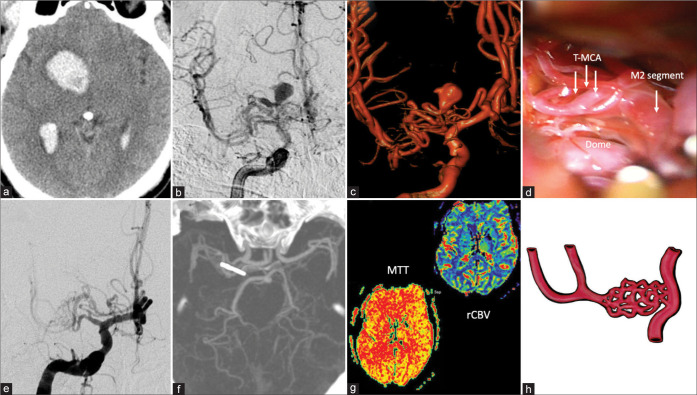
Case description: We present a 43-year-old male patient with an explosive and persistent right orbitofrontal headache. A computed tomography showed a right frontobasal hematoma with intraventricular disruption. Magnetic resonance angiography showed a right MCA aneurysm and what seems to be a MCA trunk stenosis. Cerebral digital subtraction angiography demonstrated a plexiform arterial network and one aneurysm arising from the network. The patient was successfully treated by surgical clipping to evacuate the hematoma and to prevent further intracranial hemorrhages.
Conclusion: The Ap/T-MCA may be associated with hemodynamic stress with a significant effect through the tinny wall of the vessels causing hemorrhage or leading to the formation and rupture of cerebral aneurysms. Based on a correct diagnosis of the anomaly, treatment can be completed successfully through different standard methods.
Keywords: Aneurysm; Clipping surgery; MCA anomaly; Middle cerebral artery; Twiglike MCA.
Copyright: © 2022 Surgical Neurology International.
Conflict of interest statement
There are no conflicts of interest.
Figures
References
-
- Akkan K, Ucar M, Kilic K, Celtikci E, Ilgit E, Onal B. Unfused or twig-like middle cerebral artery. Eur J Radiol. 2015;84:2013–8. - PubMed
-
- Amagasaki K, Yagishita T, Kawataki T, Kase M, Nukui H. Middle cerebral artery aplasia associated with an aneurysm of the proximal anterior cerebral artery. Acta Neurochir (Wien) 1998;140:1313–4. - PubMed
-
- Cekirge HS, Peynircioglu B, Saatci I. Endovascular treatment of an “anterior cerebral artery” aneurysm in a patient with “embryonic unfused middle cerebral artery” anomaly: A case report. Neuroradiology. 2005;47:690–4. - PubMed
-
- Cho KC, Kim JJ, Jang CK, Hong CK, Joo JY, Kim YB. Rete middle cerebral artery anomalies: A unifying name, case series, and literature review. J Neurosurg. 2018;131:453–61. - PubMed
-
- Cho WS, Kim JE, Kim CH, Ban SP, Kang HS, Son YJ, et al. Long-term outcomes after combined revascularization surgery in adult moyamoya disease. Stroke. 2014;45:3025–31. - PubMed
Publication types
LinkOut - more resources
Full Text Sources