. 2022 Jun 14;15(11):2046-2055.
doi: 10.1093/ckj/sfac155. eCollection 2022 Nov.

Effect of kidney replacement therapy modality after first kidney graft failure on second kidney transplantation outcomes

Affiliations

Effect of kidney replacement therapy modality after first kidney graft failure on second kidney transplantation outcomes

Carlos Couceiro et al. Clin Kidney J. .

Abstract

Background: There is a lack of information regarding which is the best dialysis technique after kidney transplant (KT) failure. The aim of this study is to compare the effect of kidney replacement therapy modality-peritoneal dialysis (TX-PD-TX), haemodialysis (TX-HD-TX) and preemptive deceased donor retransplantation (TX-TX) on patient survival and second KT outcomes.

Methods: A retrospective observational study from the Catalan Renal Registry was carried out. We included adult patients with failing of their first KT from 2000 to 2018.

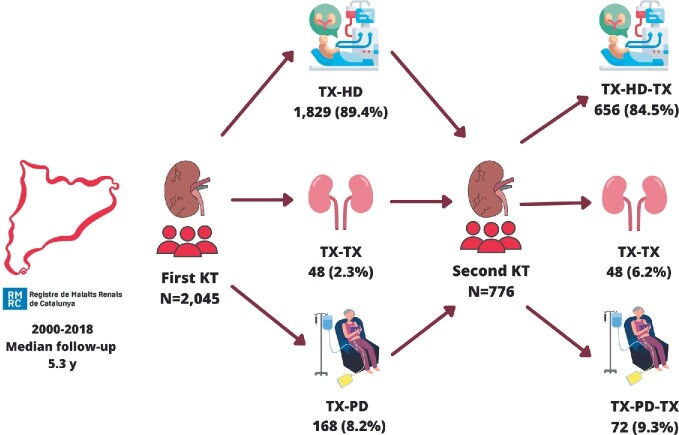
Results: Among 2045 patients, 1829 started on HD (89.4%), 168 on PD (8.2%) and 48 (2.4%) received a preemptive KT. Non-inclusion on the KT waiting list and HD were associated with worse patient survival. For patients included on the waiting list, the probability of human leucocyte antigens (HLA) sensitization and to receive a second KT was similar in HD and PD. A total of 776 patients received a second KT (38%), 656 in TX-HD-TX, 72 in TX-PD-TX and 48 in TX-TX groups. Adjusted mortality after second KT was higher in TX-HD-TX patients compared with TX-TX and TX-PD-TX groups, without differences between TX-TX and TX-PD-TX groups. Death-censored second graft survival was similar in all three groups.

Conclusions: Our results suggest that after first KT failure, PD is superior to HD in reducing mortality in candidates for a second KT without options for preemptive retransplantation.

Keywords: allograft failure; dialysis; kidney replacement therapy; kidney transplantation; transitional care.


Figures

FIGURE 1:
FIGURE 1:
Flowchart of the study.
FIGURE 2:
FIGURE 2:
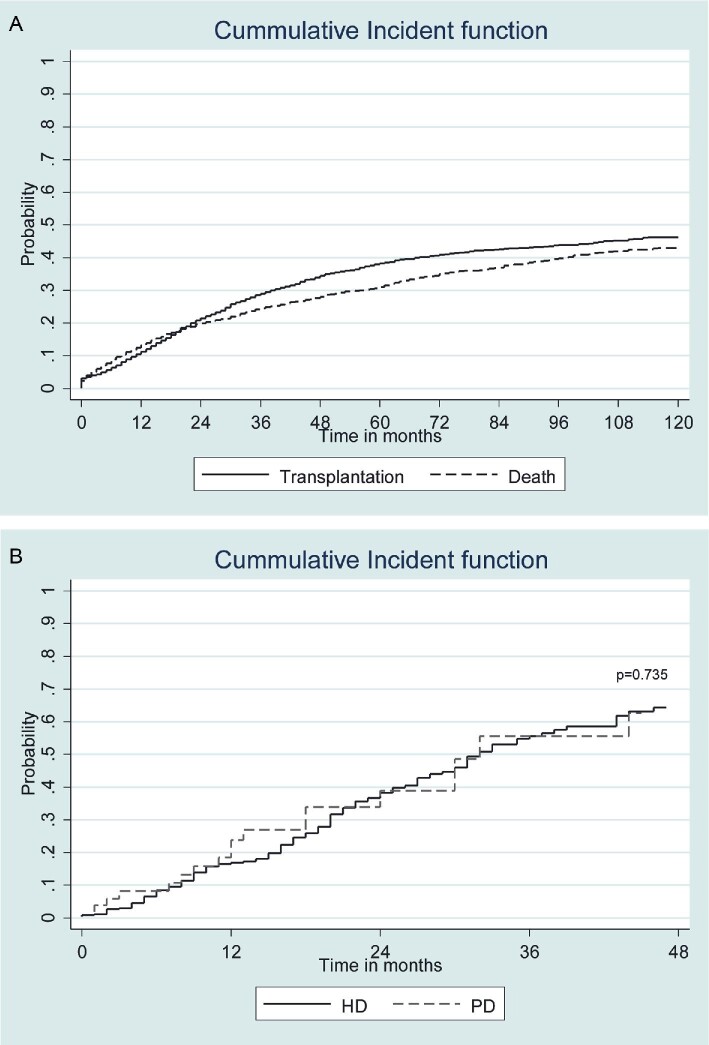
(A) Death and second kidney transplantation probability after first kidney graft failure. (B) Probability of receiving a second kidney transplant in waitlisted patients, comparing haemodialysis (HD) with peritoneal dialysis (PD). Once included on the waiting list, probability of receiving a second transplant is similar in both HD and PD groups (P = .735).
FIGURE 3:
FIGURE 3:
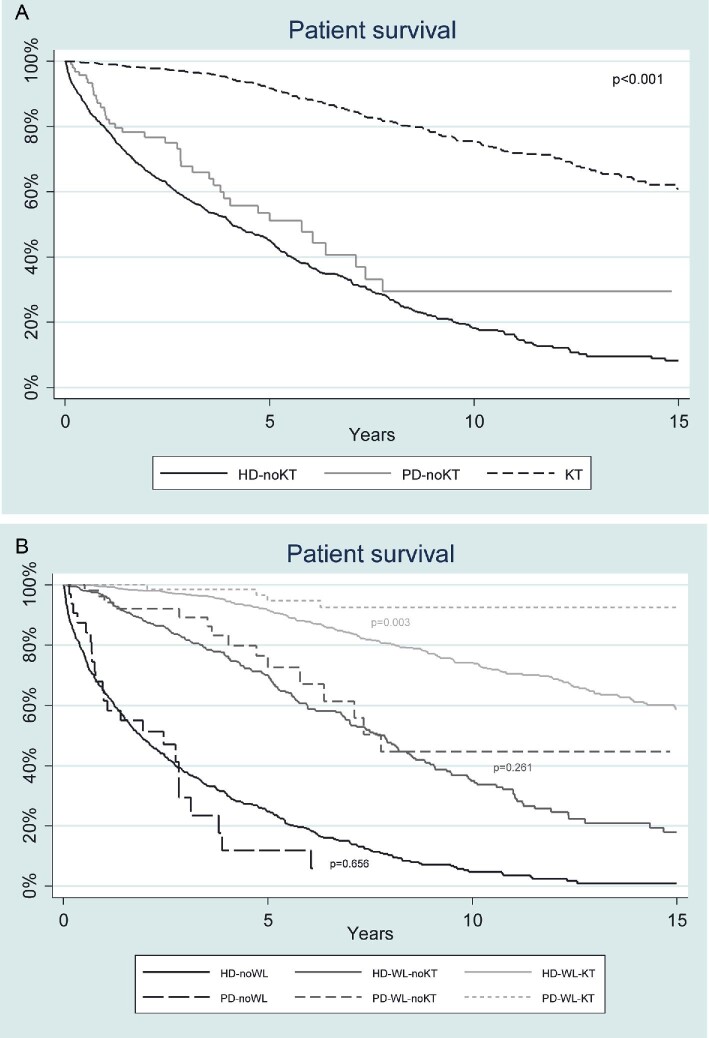
(A) Patient survival after first kidney graft failure in non-transplanted patients on haemodialysis (HD) and peritoneal dialysis (PD); and in patients receiving a second kidney transplant (KT). Non-transplanted patients exhibit worse survival compared with those retransplanted (P < .001). (B) Patient survival after first kidney graft failure according to: kidney replacement therapy, inclusion on the waiting list for second transplantation and retransplantation. Survival between haemodialysis (HD) and peritoneal dialysis (PD) patients and not included in waiting list (WL) was not statistically different (P = .656), nor between HD and PD groups when included in WL (P = .261). However, survival is superior in the PD group receiving a second transplantation, compared with the also retransplanted HD group (P = .0030).
FIGURE 4:
FIGURE 4:
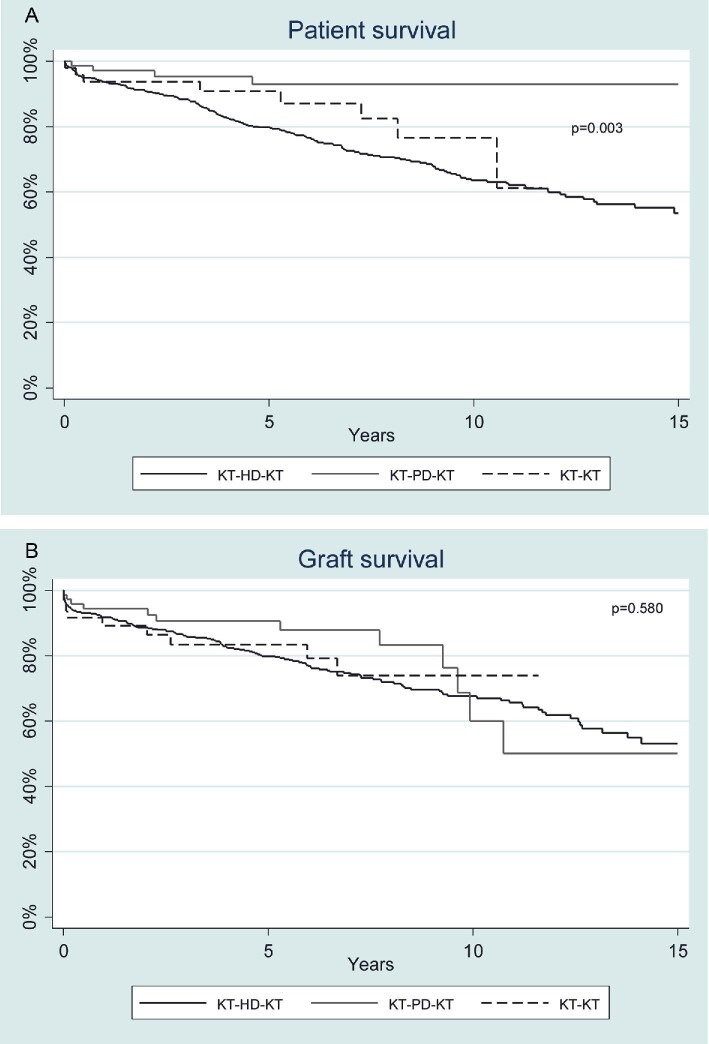
(A) Patient survival after second kidney transplant (KT) according to previous kidney replacement therapy. Survival in TX-PD-TX and TX-TX groups is greater compared with the TX-HD-TX group (P = .003). There was no statistically difference between TX-TX and TX-PD-TX groups. (B) Death-censored second kidney graft survival according to previous kidney replacement therapy. HD, haemodialysis; KT, kidney transplant; PD, peritoneal dialysis. No difference was found among the different groups: HD-KT, PD-KT or KT-KT (P = .580).

References

    1. Organització Catalana de Trasplantaments (OCATT) . Registre de Malalts Renals de Catalunya, Informe Estadístic2019; Barcelona
    1. Perl J, Zhang J, Gillespie Bet al. . Reduced survival and quality of life following return to dialysis after transplant failure: the Dialysis Outcomes and Practice Patterns Study. Nephrol Dial Transplant 2012; 27: 4464–4472 - PMC - PubMed
    1. Clark S, Kadatz M, Gill Jet al. . Access to kidney transplantation after a failed first kidney transplant and associations with patient and allograft survival: an analysis of national data to inform allocation policy. Clin J Am Soc Nephrol 2019; 14: 1228–1237 - PMC - PubMed
    1. Fiorentino M, Gallo P, Giliberti Met al. . Management of patients with a failed kidney transplant: what should we do? Clin Kidney J 2021; 14: 98–106 - PMC - PubMed
    1. Davies SJ. Peritoneal dialysis in the patient with a failing renal allograft. Perit Dial Int 2001; 21: 280–284 - PubMed