


Effects of exercise interventions on cancer-related fatigue in breast cancer patients: an overview of systematic reviews
- PMID: 36326908
- PMCID: PMC9715478
- DOI: 10.1007/s00520-022-07389-5
Effects of exercise interventions on cancer-related fatigue in breast cancer patients: an overview of systematic reviews
Abstract
Objective: This overview of systematic reviews aims to critically appraise and consolidate evidence from current systematic reviews (SRs)/meta-analyses on the effects of exercise interventions on cancer-related fatigue (CRF) in breast cancer patients.
Methods: SRs/meta-analyses that explored the effects of exercise interventions on CRF in breast cancer patients compared with the routine methods of treatment and care were retrieved from nine databases. The methodological quality of the included SRs was appraised using A MeaSurement Tool to Assess systematic Reviews II (AMSTAR II). The Grading of Recommendations Assessment, Development and Evaluation (GRADE) was used to calculate the grading of outcomes in the included SRs. The exercise type, frequency, duration, and inclusion/absence of supervision were further evaluated with subgroup analyses. The Stata 16.0 software was utilized for data analysis.
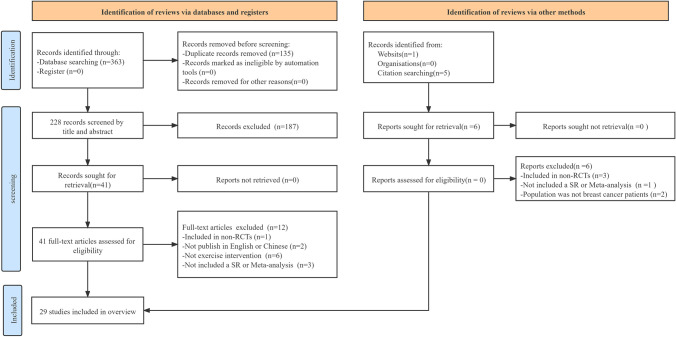
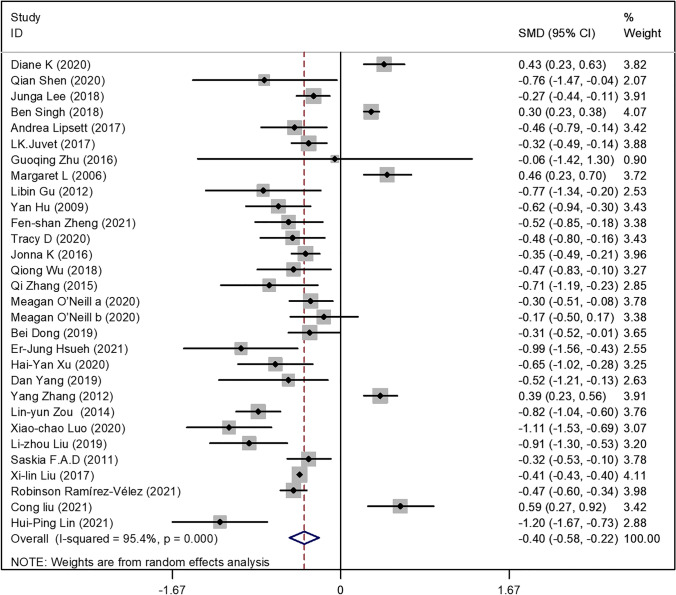
Results: Twenty-nine reviews were included. The overall methodological quality and level of evidence of the included reviews were unsatisfactory, with only three reviews rated as high methodological quality and no review identified as high-quality evidence. Moderate certainty evidence indicated that exercise could improve fatigue in breast cancer patients (SMD = - 0.40 [95%CI - 0.58, - 0.22]; P = 0.0001). Subgroup analysis based on the types of exercise showed that yoga (SMD = - 0.30 [95%CI - 0.56, - 0.05]; I2 = 28.7%) and aerobic exercise (SMD = - 0.29 [95%CI - 0.56, - 0.02]; I2 = 16%) had a significantly better effect on CRF in breast cancer patients; exercising for over 6 months (SMD = - 0.88 [95%CI - 1.59, - 0.17]; I2 = 42.7%; P = 0.0001), three times per week (SMD = - 0.77 [95%CI - 1.04, - 0.05]; I2 = 0%; P = 0.0001), and for 30 to 60 min per session (SMD = - 0.81 [95%CI - 1.15, - 0.47]; I2 = 42.3%; P = 0.0001) can contribute to a moderate improvement of CRF. Supervised exercise (SMD = - 0.48 [95%CI - 0.77, - 0.18]; I2 = 87%; P = 0.001) was shown to relieve CRF.
Conclusion: Exercise played a favorable role in alleviating CRF in breast cancer. Yoga was recommended as a promising exercise modality for CRF management in the majority of the included studies. Exercising for at least three times per week with 30 to 60 min per session could be recommended as a suitable dosage for achieving improvement in CRF. Supervised exercise was found to be more effective in alleviating CRF than unsupervised exercise. More rigorously designed clinical studies are needed to specify the exact exercise type, duration, frequency, and intensity to have an optimal effect on CRF in breast cancer patients.
Trial registration: ClinicalTrials.gov Identifier: CRD42020219866.
Keywords: Breast neoplasms; Exercise; Fatigue; Overview; Systematic reviews.
© 2022. The Author(s).
Conflict of interest statement
The authors declare no competing interests.
Figures
Similar articles
-
Effects of exercise interventions on cancer-related fatigue and quality of life among cancer patients: a meta-analysis.BMC Nurs. 2023 Jun 13;22(1):200. doi: 10.1186/s12912-023-01363-0. BMC Nurs. 2023. PMID: 37312185 Free PMC article.
-
The effects of aerobic exercise in patients with cancer-related fatigue: A systematic review and meta-analysis.PLoS One. 2025 Jun 9;20(6):e0325100. doi: 10.1371/journal.pone.0325100. eCollection 2025. PLoS One. 2025. PMID: 40489401 Free PMC article.
-
The Effect of Yoga Interventions on Cancer-Related Fatigue and Quality of Life for Women with Breast Cancer: A Systematic Review and Meta-Analysis of Randomized Controlled Trials.Integr Cancer Ther. 2020 Jan-Dec;19:1534735420959882. doi: 10.1177/1534735420959882. Integr Cancer Ther. 2020. PMID: 33073636 Free PMC article.
-
Comparative Efficacy of Various Exercise Types on Cancer-Related Fatigue for Cancer Survivors: A Systematic Review and Network Meta-Analysis of Randomized Controlled Trials.Cancer Med. 2025 Apr;14(7):e70816. doi: 10.1002/cam4.70816. Cancer Med. 2025. PMID: 40145635 Free PMC article.
-
Is physical activity effective against cancer-related fatigue in lung cancer patients? An umbrella review of systematic reviews and meta-analyses.Support Care Cancer. 2023 Feb 13;31(3):161. doi: 10.1007/s00520-023-07627-4. Support Care Cancer. 2023. PMID: 36781549
Cited by
-
Feasibility of implementing a supervised telehealth exercise intervention in frail survivors of hematopoietic cell transplantation: a pilot randomized trial.BMC Cancer. 2023 May 1;23(1):390. doi: 10.1186/s12885-023-10884-5. BMC Cancer. 2023. PMID: 37127595 Free PMC article. Clinical Trial.
-
Effects of combined exercises on shoulder mobility and strength of the upper extremities in breast cancer rehabilitation: a 3-week randomized controlled trial.Support Care Cancer. 2023 Sep 1;31(9):550. doi: 10.1007/s00520-023-07959-1. Support Care Cancer. 2023. PMID: 37656241 Free PMC article. Clinical Trial.
-
Effects of Exercise on Cancer-Related Fatigue in Breast Cancer Patients: A Systematic Review and Meta-Analysis of Randomized Controlled Trials.Life (Basel). 2024 Aug 14;14(8):1011. doi: 10.3390/life14081011. Life (Basel). 2024. PMID: 39202753 Free PMC article. Review.
-
Factors associated with physical activity among Thai women with breast cancer postmastectomy at a university hospital, Thailand: A cross-sectional study.Sci Rep. 2025 May 19;15(1):17266. doi: 10.1038/s41598-025-02137-1. Sci Rep. 2025. PMID: 40383805 Free PMC article.
-
Symptom clusters and network analysis of patients with intermediate and advanced liver cancer treated with targeted immunotherapy.Support Care Cancer. 2024 Aug 8;32(9):580. doi: 10.1007/s00520-024-08784-w. Support Care Cancer. 2024. PMID: 39115725
References
-
- Fu Z. Comparison of the effect of different chemotherapy regimens in postoperative breast cancer. China Pract Med. 2020;15(35):148–150. doi: 10.14163/j.cnki.11-5547/r.2020.35.063. - DOI
Publication types
MeSH terms
LinkOut - more resources
Full Text Sources
Medical
