Review
. 2022 Dec:70:102231.
doi: 10.1016/j.mib.2022.102231. Epub 2022 Oct 31.

The mystery of persistent, asymptomatic Plasmodium falciparum infections

Affiliations
Review

The mystery of persistent, asymptomatic Plasmodium falciparum infections

Xu Zhang et al. Curr Opin Microbiol. 2022 Dec.

Abstract

Plasmodium falciparum causes millions of malaria infections and hundreds of thousands of deaths annually. These parasites avoid the adaptive immune response by systematically cycling through a limited repertoire of variant surface antigens after which the number of circulating parasites drops to extremely low levels, coinciding with a loss of symptoms and eventual clearance of the infection. However, in regions with extended dry seasons or in individuals who no longer reside in endemic areas, asymptomatic infections have been observed to persist for many months or years, potentially serving as reservoirs for transmission. Recent work suggests the possibility that parasites can assume a state in which no variant surface antigens are expressed, thus rendering them virtually invisible to the immune system and enabling them to persist at low levels indefinitely.


Conflict of interest statement

Declarations of interest: none.

Figures
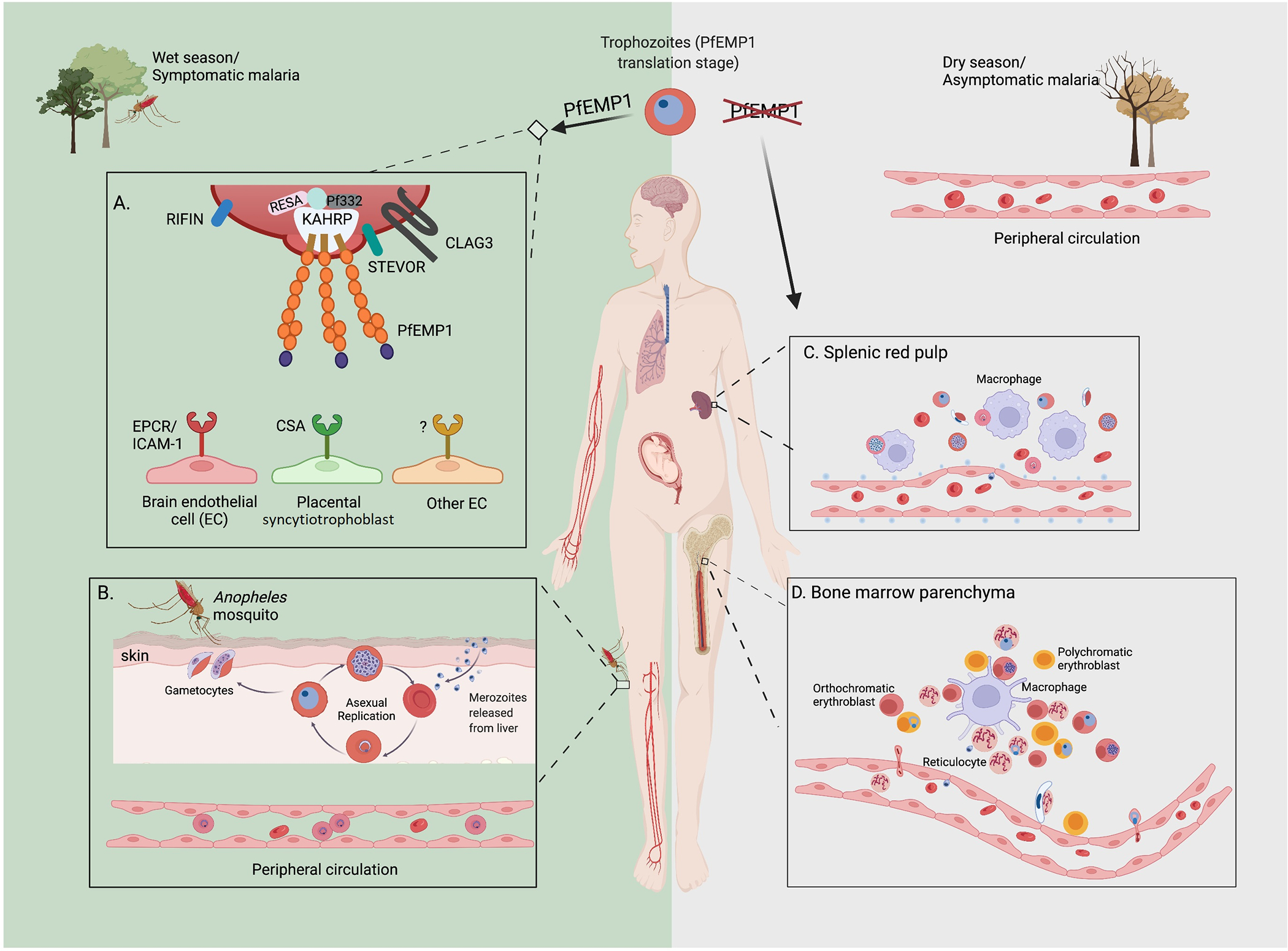
Figure 1.
Figure 1.
Schematic representation of the roles of PfEMP1, cytoadherence and sequestration of infected RBCs in symptomatic and asymptomatic malaria. Left green box: Symptomatic malaria cases during a rainy/transmission season or any symptomatic malaria cases characterized by high parasitemia: in the latter half of 48-hour replicative cycle, parasite-infected RBCs display the surface protein PfEMP1, the primary component mediating adhesion to variable receptors on the endothelial surface of the vasculature within different organs. This leads to sequestration of parasites in the deep tissue capillary beds, thereby avoiding filtration by the spleen. A. Display of PfEMP1 on the surface of infected RBC involves multiple other parasite-produced proteins, including knob associated histidine rich protein (KAHRP), Plasmodium falciparum 332 kd protein (Pf332), and ring expressed surface antigen (RESA). Other proteins displayed on the infected RBC surface include Rifins and Clag3. The specific PfEMP1 receptors on human endothelial cells associated with cerebral malaria include endothelial protein complex receptor (EPCR) and intracellular adhesion molecule 1 (ICAM-1), and pregnancy-associated malaria has been linked to the epithelial receptor chondroitin sulfate A (CSA) displayed on the surface of syncytiotrophoblasts, however receptors related to other malaria manifestations remain largely unknown. B. In the human host, P. falciparum asexual replication leads to exponential growth of infected erythrocytes, while less than 20% of parasites commit to sexual development generating female and male gametocytes. During blood meals, female Anopheles mosquitos ingest male and female gametocytes, where they mate, develop and produce sporozoites that will be inoculated into a new human host, thereby perpetuating the parasite’s life cycle. Due to sequestration and splenic filtration, only the early stages of the asexual cycle (ring stages) are observed in blood smears of symptomatic malaria cases. Right gray box: Asymptomatic malaria cases during a dry season or after a lengthy infection: cases manifest as extremely low parasitemias and routine detection methods (blood smears and PCR) often fail to detect the parasites. In this review, we present a model that parasites not expressing PfEMP1 are primarily responsible for chronic, asymptomatic infections. Non-PfEMP1 expressing parasites lose the ability to cytoadhere, hence parasites numbers are held in check and infected humans don’t suffer from severe symptoms. C. The vast majority of infected RBCs are filtered and pitted by the spleen. There is evidence that some parasites can complete both sexual and asexual development inside the red pulp, however only infected RBCs that remain deformable, including ring stages and stage V gametocytes, can travel back to the circulation (the function of spleen during malaria infections was comprehensively discussed by Henry et al [54]. D. The bone marrow is another possible reservoir for parasites escaping both immune elimination and spleen clearance. Merozoites are likely the only form that can travel from the sinusoids to the bone marrow parenchyma. In the parenchyma, both asexual and sexually committed merozoites could invade and develop in erythrocyte precursor cells within erythroblastic islands. While orthochromatic cells can support merozoite entry, only enucleating reticulocytes support intracellular parasites growth [43]. Due the loss of deformability, only ring-infected or stage V gametocyte-infected reticulocytes can return to the peripheral blood. Neveu et al. [40] have shown that infection of erythroblasts by gametocytes and parasite-derived extracellular vesicles delay erythroid differentiation, enabling the stage V gametocyte-infected reticulocytes to successfully leave the bone marrow parenchyma, however it is unknown if asexual parasites have a similar mechanism. It is possible that asexual parasites instead tend to stay in the parenchyma where the bone marrow environment promotes sexual commitment. Thus, the bone marrow could serve as a reservoir for gametocytes, with occasional release of ring-infected reticulocytes.
Figure 2.
Figure 2.
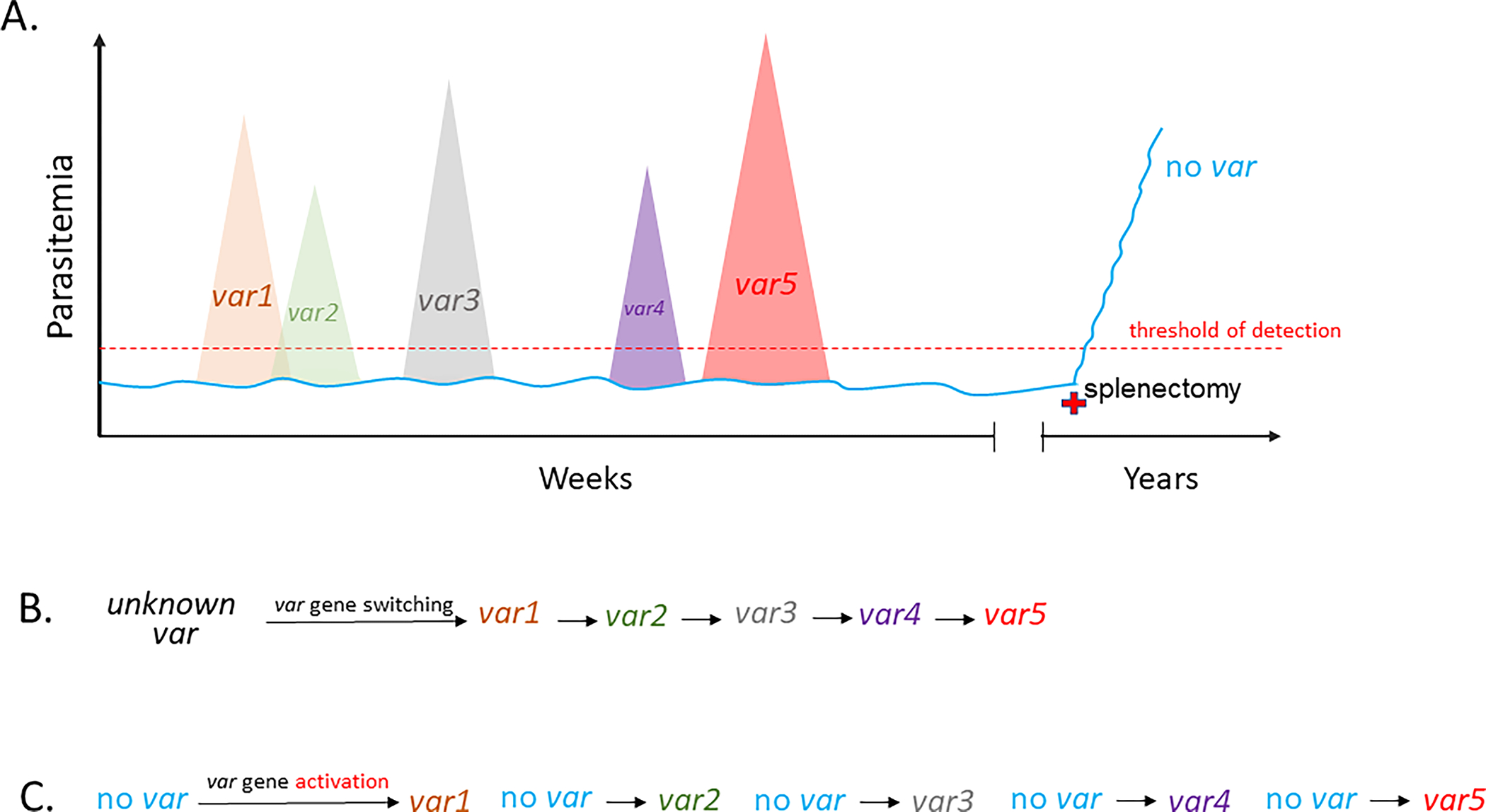
Changes in parasitemia over the course of a hypothetical Plasmodium falciparum infection. A. Levels of parasitemia are shown on the vertical axis while time is shown horizontally. Large waves of parasitemia are indicative of activation of specific var genes, leading to surface display of distinct forms of PfEMP1 and cytoadhesion of the infected RBCs, thereby avoiding clearance by the spleen. Expansion of these parasite populations is countered by the production of anti-PfEMP1 antibodies, resulting in rapid reductions in parasitemia. Activation of alternative var genes leads to new waves of parasitemia, shown with different colors, until the var repertoire is exhausted. Low levels of non-cytoadherent, non-PfEMP1 expressing parasites (blue line) that do not express var genes can persist below the threshold of detection (red dashed line). These parasites can serve as a reservoir for each new wave of parasitemia while avoiding the antibody response and extending the infection indefinitely. This population of parasites is prevented from expanding due to filtration by the spleen, however splenectomy (red cross) can lead to rapid expansion of this non-cytoadherent population. B and C. Switches in var gene expression underlying the waves of parasitemia shown in A. B displays switching directly from one var to the next while C displays independent activation of each var gene from a low level, persistent population that does not express var genes. The “no var” state could be identical to or derived from parasites that express a very low level of numerous var genes, referred to as the “many” state, that has been observed in cultured parasites.

References

    1. WHO: World Malaria Report 2021. 2021.
    1. Moxon CA, Grau GE, Craig AG: Malaria: modification of the red blood cell and consequences in the human host. Br. J. Haematol 2011, 154:670–679. - PMC - PubMed
    1. Deitsch KW, Dzikowski R: Variant Gene Expression and Antigenic Variation by Malaria Parasites. Annu. Rev. Microbiol 2017, 71:625–641. - PubMed
    1. Bernabeu M, Smith JD: EPCR and Malaria Severity: The Center of a Perfect Storm. Trends Parasitol 2017, 33:295–308. - PMC - PubMed
    1. Baruch DI, Pasloske BL, Singh HB, Bi X, Ma XC, Feldman M, Taraschi TF, Howard RJ: Cloning the P. falciparum gene encoding PfEMP1, a malarial variant antigen and adherence receptor on the surface of parasitized human erythrocytes. Cell 1995, 82:77–87. - PubMed

Publication types

Substances