. 2022 Nov 3;12(1):18547.
doi: 10.1038/s41598-022-21779-z.

Sampling from four geographically divergent young female populations demonstrates forensic geolocation potential in microbiomes

Affiliations

Sampling from four geographically divergent young female populations demonstrates forensic geolocation potential in microbiomes

Thomas Clarke et al. Sci Rep. .

Erratum in

Abstract

Studies of human microbiomes using new sequencing techniques have increasingly demonstrated that their ecologies are partly determined by the lifestyle and habits of individuals. As such, significant forensic information could be obtained from high throughput sequencing of the human microbiome. This approach, combined with multiple analytical techniques demonstrates that bacterial DNA can be used to uniquely identify an individual and to provide information about their life and behavioral patterns. However, the transformation of these findings into actionable forensic information, including the geolocation of the samples, remains limited by incomplete understanding of the effects of confounding factors and the paucity of diverse sequences. We obtained 16S rRNA sequences of stool and oral microbiomes collected from 206 young and healthy females from four globally diverse populations, in addition to supporting metadata, including dietary and medical information. Analysis of these microbiomes revealed detectable geolocation signals between the populations, even for populations living within the same city. Accounting for other lifestyle variables, such as diet and smoking, lessened but does not remove the geolocation signal.


Conflict of interest statement

The authors declare no competing interests.

Figures
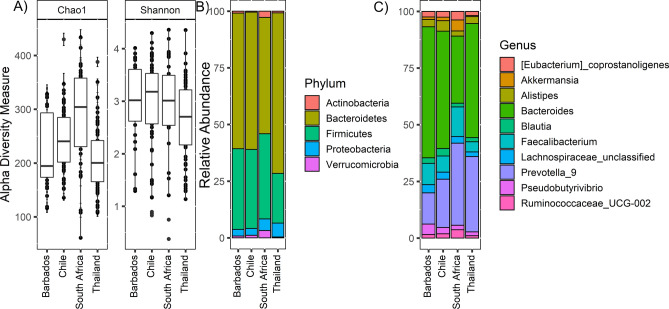
Figure 1
Figure 1
Stool alpha diversity: (A) microbial richness and evenness of cheek was calculated based on the Chao1 and Shannon index of four different sites. The y-axis represents the alpha diversity unit scale either Shannon or Chao1. (B) Phylum level abundance of stool samples, (C) top ten most abundance genera in stool samples.
Figure 2
Figure 2
The significant differential abundant stool genera between four countries displayed as Box and whisker plot.
Figure 3
Figure 3
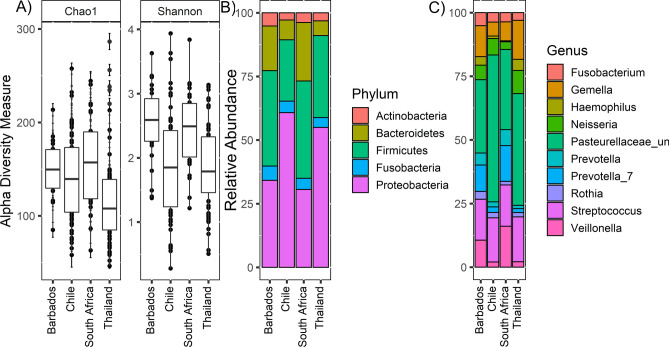
Cheek alpha diversity: (A) microbial richness and evenness of cheek was calculated based on the Chao1 and Shannon index of four different sites. The y-axis represents the alpha diversity unit scale either Shannon or Chao1. (B) Phylum level abundance of Cheek samples, (C) top ten most abundance genera in cheek samples.
Figure 4
Figure 4
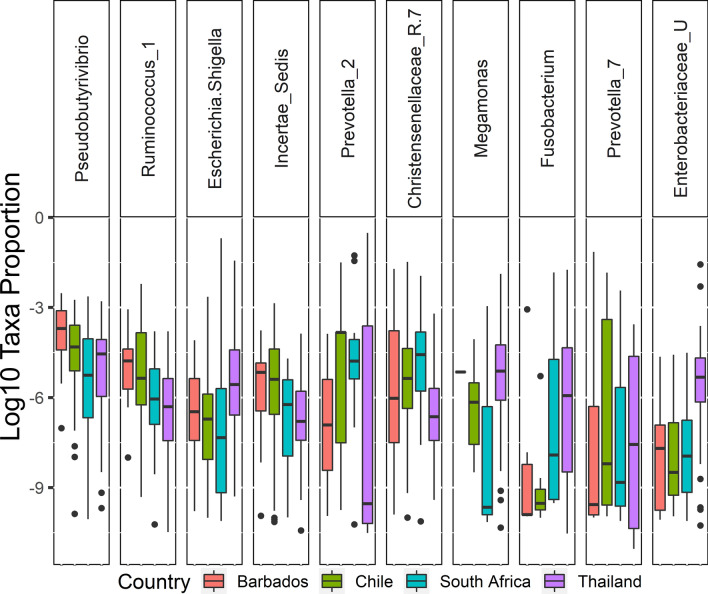
Box and whisker plot showing the significant differential abundant cheek genera between four countries.
Figure 5
Figure 5
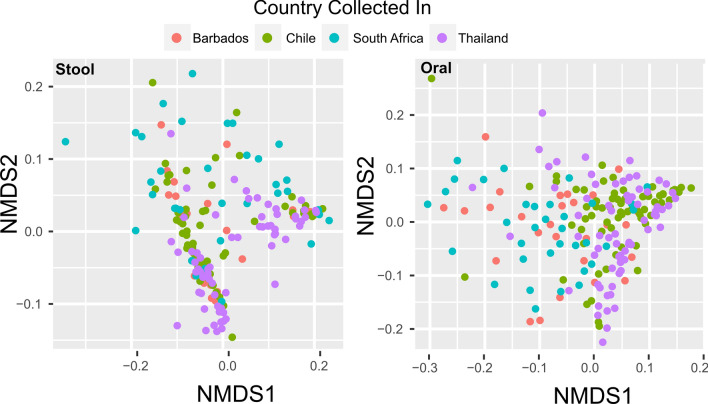
Oral (n = 195) and stool (n = 196) microbiota differences according to body site and geographical location (Barbados, Chile, Thailand and S. Africa). Measured by NMDS using weighted UniFrac distance in stool (PERMANOVA r2 = 0.084, p = 0.001), and oral (PERMANOVA r2 = 0.161, p = 0.001).
Figure 6
Figure 6
Oral (n = 66) and stool (n = 67) microbiota diversity between populations from different neighborhoods (sub-region 1 and sub-region 2) in Santiago, Chile as shown by NMDS using weighted UniFrac distance (stool: PERMANOVA r2 = 0.026, p = 0.159; oral: PERMANOVA r2 = 0.032 p = 0.089). The boundaries of the neighborhoods are shown in Supplementary Fig. S2B.

References

    1. Mobeen F, Sharma V, Tulika P. Enterotype variations of the healthy human gut microbiome in different geographical regions. Bioinformation. 2018;14:560–573. doi: 10.6026/97320630014560. - DOI - PMC - PubMed
    1. Lan D, et al. Correlations between gut microbiota community structures of Tibetans and geography. Sci. Rep. 2017;7:1–9. doi: 10.1038/s41598-017-17194-4. - DOI - PMC - PubMed
    1. Yatsunenko T, et al. Human gut microbiome viewed across age and geography. Nature. 2012;486:222–227. doi: 10.1038/nature11053. - DOI - PMC - PubMed
    1. Escobar JS, Klotz B, Valdes BE, Agudelo GM. The gut microbiota of Colombians differs from that of Americans, Europeans and Asians. BMC Microbiol. 2014;14:311. doi: 10.1186/s12866-014-0311-6. - DOI - PMC - PubMed
    1. Li J, et al. Comparative analysis of the human saliva microbiome from different climate zones: Alaska, Germany, and Africa. BMC Microbiol. 2014;14:316. doi: 10.1186/s12866-014-0316-1. - DOI - PMC - PubMed

Publication types