


Cough Characteristics and Healthcare Journeys of Chronic Cough Patients in Community-Based Populations in South Korea and Taiwan
- PMID: 36329168
- PMCID: PMC9675671
- DOI: 10.1007/s00408-022-00586-3
Cough Characteristics and Healthcare Journeys of Chronic Cough Patients in Community-Based Populations in South Korea and Taiwan
Abstract
Purpose: This study aimed to understand the cough characteristics and health journeys among community-based chronic cough (CC) patients, and their characteristics associated with healthcare visits.
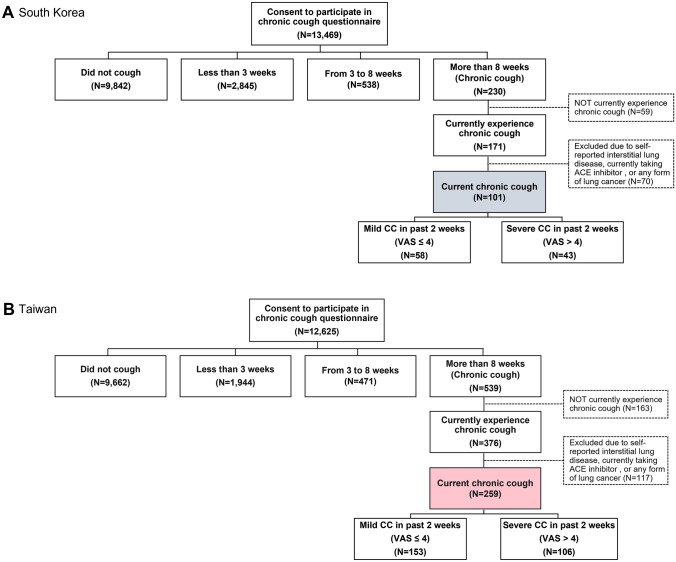
Methods: A population-based cross-sectional study was conducted in 2020, using the South Korea and Taiwan National Health and Wellness Survey (NHWS) and CC surveys. Patients with current CC were defined by daily coughing for > 8 weeks in the past 12 months and currently coughing at the time of survey. The survey items pertained to CC patients' treatment journey and cough characteristics.
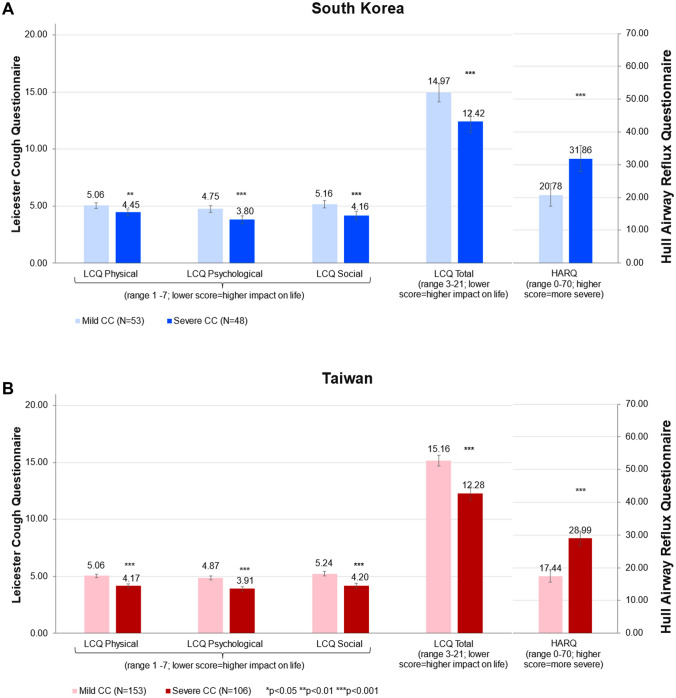
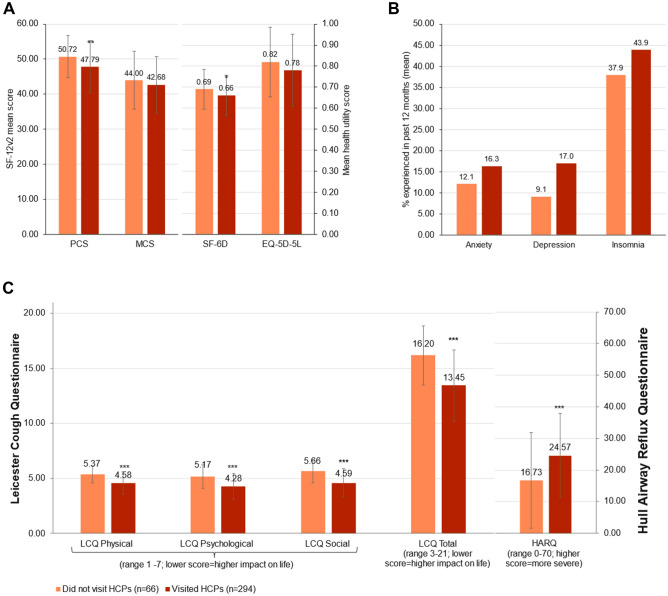
Results: Patients with current CC in South Korea and Taiwan, respectively, had cough duration for 3.45 ± 5.13 years and 5.75 ± 7.28 years and cough severity visual analogue scale (VAS) scores of 4.50 ± 2.15 and 4.46 ± 1.92 out of 0-10 scale, with 70.3% and 57.9% having spoken with a physician about cough. Compared to CC patients who had not visited healthcare professionals for cough, those who visited reported more severe cough (VAS: 3.89 ± 1.71 vs. 4.6 ± 2.02; p = 0.009), worse cough-specific quality of life (Leicester Cough Questionnaire: 16.20 ± 3.23 vs.13.45 ± 2.68, p < 0.001), greater symptom severity (Hull Airway Reflux Questionnaire: 16.73 ± 15.16 vs. 24.57 ± 13.38; p < 0.001), and more urinary incontinence (13.6 vs. 26.5%, p = 0.027). More than 50% of patients perceived cough medication(s) as not or a little useful and 25% felt their physicians did not well understand how CC impacts their life.
Conclusion: Cough is frequently severe and persistent among community-based CC patients. They experience several issues in their health journey, including treatment ineffectiveness and physician's understanding. Further efforts are warranted to reduce CC burden in the community.
Keywords: Chronic cough; Cough-specific health-related quality of life; Disease burden; Treatment journey.
© 2022. The Author(s).
Conflict of interest statement
SH Kang is an employee of MSD, Korea. WJ Song has received research grants from MSD and AstraZeneca, consulting fees from MSD and AstraZeneca, and lecture fees from MSD, AstraZeneca, GSK, and Novartis. CJ Yu declares no conflict of interest.
Figures
References
MeSH terms
LinkOut - more resources
Full Text Sources
Medical
Miscellaneous
