Rapamycin treatment early in life reprograms aging: hyperfunction theory and clinical practice
- PMID: 36332147
- PMCID: PMC9648808
- DOI: 10.18632/aging.204354
Rapamycin treatment early in life reprograms aging: hyperfunction theory and clinical practice
Abstract
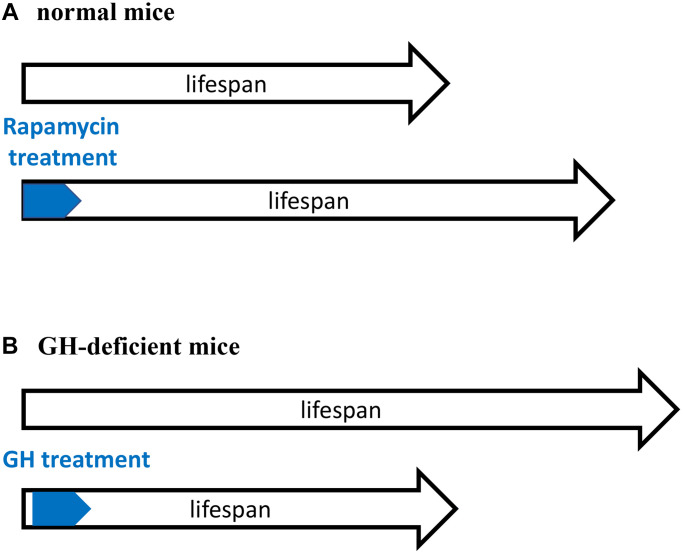
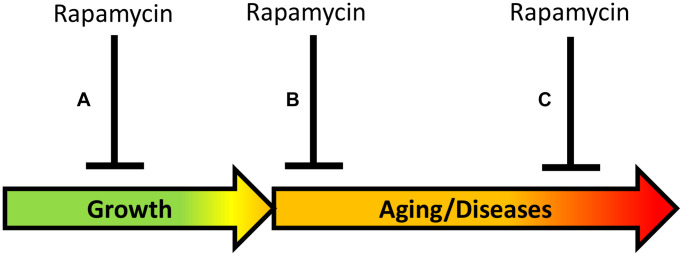
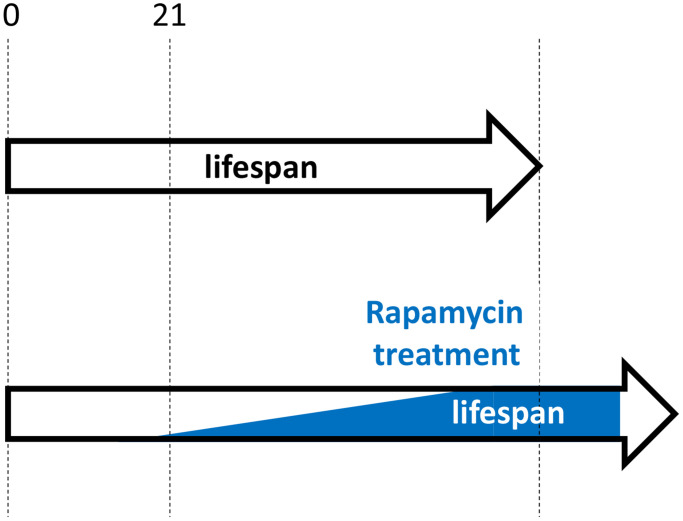
Making provocative headlines, three outstanding publications demonstrated that early-life treatment with rapamycin, including treatments during developmental growth, extends lifespan in animals, confirming predictions of hyperfunction theory, which views aging as a quasi-program (an unintended continuation of developmental growth) driven in part by mTOR. Despite their high theoretical importance, clinical applications of two of these studies in mice, Drosophila and Daphnia cannot be implemented in humans because that would require growth retardation started at birth. A third study demonstrated that a transient (around 20% of total lifespan in Drosophila) treatment with rapamycin early in Drosophila adult life is as effective as lifelong treatment, whereas a late-life treatment is not effective. However, previous studies in mice demonstrated that a transient late-life treatment is highly effective. Based on hyperfunction theory, this article attempts to reconcile conflicting results and suggests the optimal treatment strategy to extend human lifespan.
Keywords: geroscience; gerostatics; healthspan; senescence; sirolimus.
Conflict of interest statement
Figures
References
-
- Juricic P, Lu YX, Leech T, Drews LF, Paulitz J, Lu J, Nespital T, Azami S, Regan JC, Funk E, Fröhlich J, Grönke S, Partridge L. Long-lasting geroprotection from brief rapamycin treatment in early adulthood by persistently increased intestinal autophagy. Nat Aging. 2022; 2:824–36. 10.1038/s43587-022-00278-w - DOI - PMC - PubMed
-
- Aiello G, Sabino C, Pernici D, Audano M, Antonica F, Gianesello M, Ballabio C, Quattrone A, Mitro N, Romanel A, Soldano A, Tiberi L. Transient rapamycin treatment during developmental stage extends lifespan in Mus musculus and Drosophila melanogaster. EMBO Rep. 2022; 23:e55299. 10.15252/embr.202255299 - DOI - PMC - PubMed
-
- Shindyapina AV, Cho Y, Kaya A, Tyshkovskiy A, Castro JP, Deik A, Gordevicius J, Poganik JR, Clish CB, Horvath S, Peshkin L, Gladyshev VN. Rapamycin treatment during development extends life span and health span of male mice and Daphnia magna. Sci Adv. 2022; 8:eabo5482. 10.1126/sciadv.abo5482 - DOI - PMC - PubMed
MeSH terms
Substances
LinkOut - more resources
Full Text Sources
Medical
Molecular Biology Databases
Miscellaneous