. 2023 Jan:27:101579.
doi: 10.1016/j.tranon.2022.101579. Epub 2022 Nov 1.

MicroRNAs and long non-coding RNAs in pancreatic cancer: From epigenetics to potential clinical applications

Affiliations

MicroRNAs and long non-coding RNAs in pancreatic cancer: From epigenetics to potential clinical applications

Luis Alberto Bravo-Vázquez et al. Transl Oncol. 2023 Jan.

Abstract

MicroRNAs (miRNAs) and long non-coding RNAs (lncRNAs) are two relevant classes of non-coding RNAs (ncRNAs) that play a pivotal role in a number of molecular processes through different epigenetic regulatory mechanisms of gene expression. As a matter of fact, the altered expression of these types of RNAs leads to the development and progression of a varied range of multifactorial human diseases. Several recent reports elucidated that miRNA and lncRNAs have been implicated in pancreatic cancer (PC). For instance, dysregulation of such ncRNAs has been found to be associated with chemoresistance, apoptosis, autophagy, cell differentiation, tumor suppression, tumor growth, cancer cell proliferation, migration, and invasion in PC. Moreover, several aberrantly expressed miRNAs and lncRNAs have the potential to be used as biomarkers for accurate PC diagnosis. Additionally, miRNAs and lncRNAs are considered as promising clinical targets for PC. Therefore, in this review, we discuss recent experimental evidence regarding the clinical implications of miRNAs and lncRNAs in the pathophysiology of PC, their future potential, as well as the challenges that have arisen in this field of study in order to drive forward the design of ncRNA-based diagnostics and therapeutics for PC.

Keywords: Biomarker; MicroRNAs; Pancreatic cancer; Therapeutics; lncRNAs.


Conflict of interest statement

Declaration of Competing Interest The authors declare that they have no known competing financial interests or personal relationships that could have appeared to influence the work reported in this paper.

Figures
Image, graphical abstract
Graphical abstract
Fig 1
Fig. 1
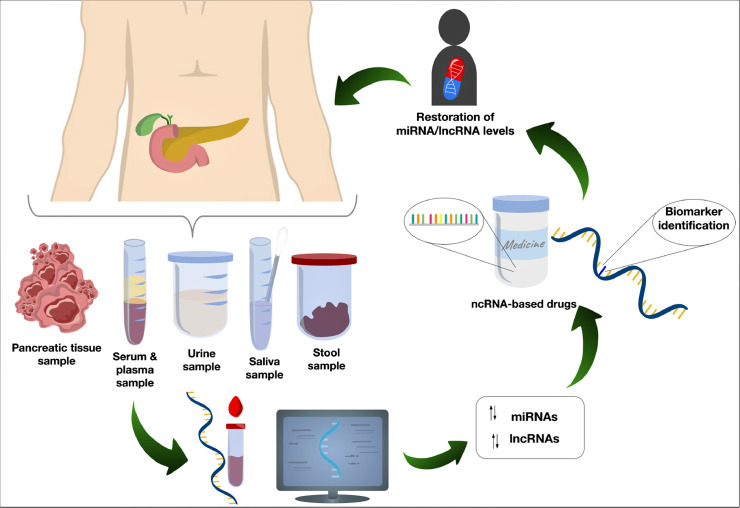
Potential clinical applications of miRNAs and lncRNAs. The analysis of diverse types of samples (e.g., PC tissues, serum, plasma, urine, saliva, and stool) can lead to the identification of dysregulated circulating miRNAs and lncRNAs involved in PC progression, which might set the foundations for creating ncRNA-based drugs and diagnostic protocols for PC.
Fig 2
Fig. 2
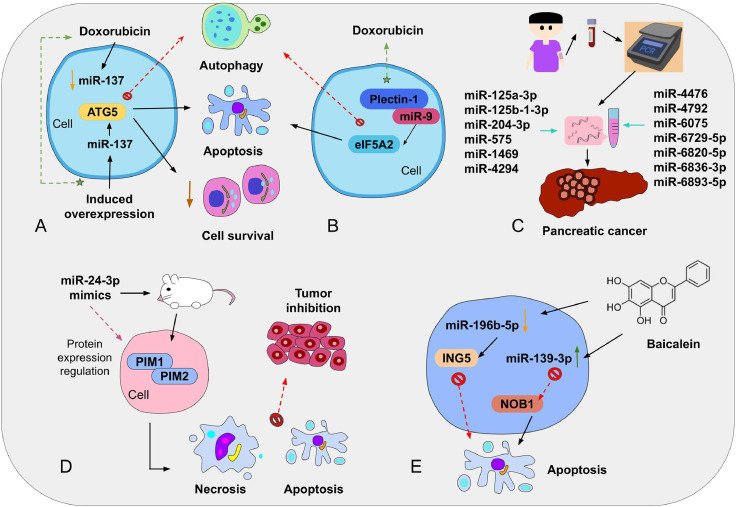
Schematic representation of important clinical applications of miRNAs in PC. (A) MiRNAs have been discovered to play an important role in cancer progression if combined with chemotherapy medicines, such as doxorubicin which, if used alone, can downregulate miR-137, triggering autophagy; while induced overexpression of miR-137 can promote doxorubicin effects, diminish cell survival, and block autophagy by regulating ATG5 expression. (B) Similarly, downregulating eIF5A2 expression via plectin-1/miR-9 complexes lead to autophagy suppression, increased apoptosis, and improvement of doxorubicin anti-cancer effects. (C) Serum samples of PC patients indicated that a specific miRNA signature conformed by 13 miRNAs might be helpful for PC diagnosis. (D) Preclinical studies in mice with miR-24–3p mimics showed that the targets of such miRNA are PIM1 and PIM2; its use resulted in cell apoptosis and necrosis. (E) Treatment with baicalein also affects miRNA expression, and miR-196b-5p and miR-139–3p were significantly affected by this flavonoid. Further assays evidenced that miR-139–3p, by inhibiting NOB1, stimulated apoptosis in PANC cells, while miR-196–5p suppressed this mechanism targeting ING5.
Fig 3
Fig. 3
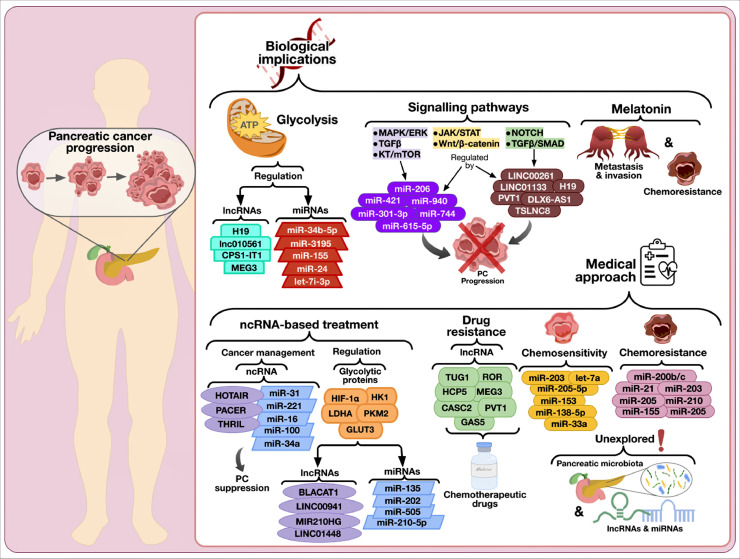
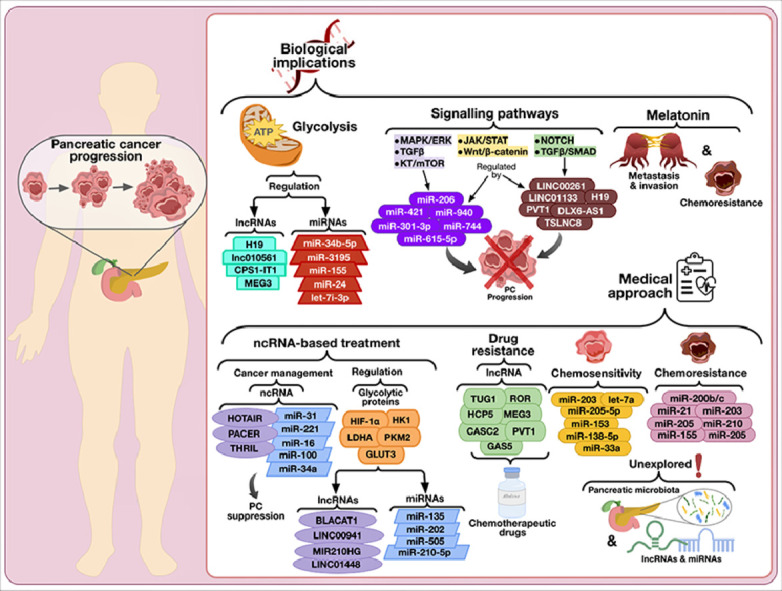
Future perspectives regarding the biological implications and medical approaches of miRNAs and lncRNAs in PC. As depicted, future research should focus on unveiling the regulatory roles of miRNAs and lncRNAs on glycolysis, PC-related pathways, melatonin, chemosensitivity, and chemoresistance. Likewise, it is necessary to explore the molecular crosstalk between pancreatic microbiota, miRNAs, and lncRNAs. As a whole, addressing these concerns could benefit the design of ncRNA-based treatments for PC.

References

    1. Cai J., Chen H., Lu M., Zhang Y., Lu B., You L., Zhang T., Dai M., Zhao Y. Advances in the epidemiology of pancreatic cancer: trends, risk factors, screening, and prognosis. Cancer Lett. 2021;520:1–11. doi: 10.1016/j.canlet.2021.06.027. - DOI - PubMed
    1. McGuigan A., Kelly P., Turkington R.C., Jones C., Coleman H.G., McCain R.S. Pancreatic cancer: a review of clinical diagnosis, epidemiology, treatment and outcomes. World J. Gastroenterol. 2018;24:4846–4861. doi: 10.3748/wjg.v24.i43.4846. - DOI - PMC - PubMed
    1. Khalaf N., El-Serag H.B., Abrams H.R., Thrift A.P. Burden of pancreatic cancer: from epidemiology to practice. Clin. Gastroenterol. Hepatol. 2021;19:876–884. doi: 10.1016/j.cgh.2020.02.054. - DOI - PMC - PubMed
    1. Traub B., Link K.H., Kornmann M. Curing pancreatic cancer. Semin. Cancer Biol. 2021;76:232–246. doi: 10.1016/j.semcancer.2021.05.030. - DOI - PubMed
    1. Mills K., Birt L., Emery J.D., Hall N., Banks J., Johnson M., Lancaster J., Hamilton W., Rubin G.P., Walter F.M. Understanding symptom appraisal and help-seeking in people with symptoms suggestive of pancreatic cancer: a qualitative study. BMJ Open. 2017;7 doi: 10.1136/bmjopen-2016-015682. - DOI - PMC - PubMed