


Perinatal outcomes associated with ICP in twin pregnancies were worse than singletons: an almost 5-year retrospective cohort study
- PMID: 36335293
- PMCID: PMC9636774
- DOI: 10.1186/s12884-022-05160-6
Perinatal outcomes associated with ICP in twin pregnancies were worse than singletons: an almost 5-year retrospective cohort study
Abstract
Background: Intrahepatic cholestasis of pregnancy (ICP) is associated with an increased risk of adverse perinatal outcomes leading to high perinatal morbidity and mortality. However, few studies have examined twin pregnancies complicated by ICP. To assess the perinatal outcomes of twin pregnancies with ICP, a retrospective cohort study was conducted.
Methods: A total of 633 twin pregnancies and 1267 singleton pregnancies with ICP were included. In addition, a correlation study was performed on the matched total bile acid (TBA) levels from maternal serum, fetal umbilical venous blood, and amniotic fluid of 33 twin pregnancies from twin groups.
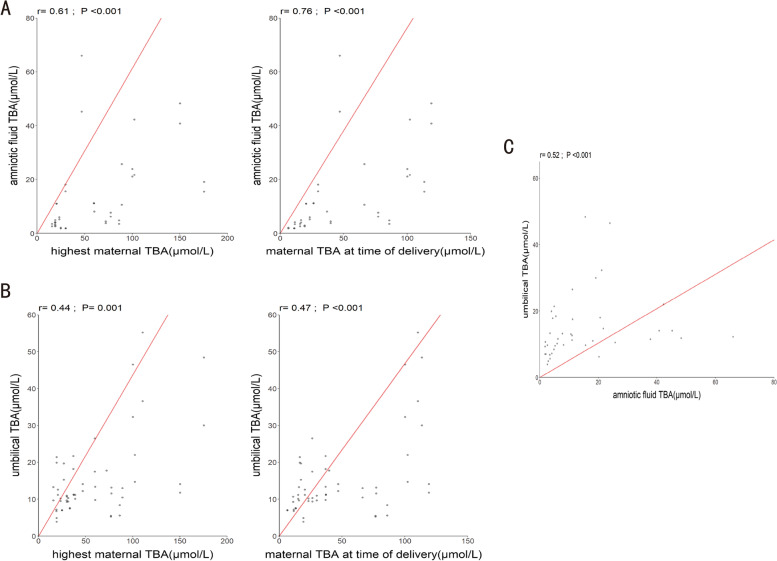
Results: When compared to singletons, twin pregnancies with ICP had a higher risk of cesarean section (CS) (96.4% vs. 76.1%), preterm birth (PTB) (82.6% vs. 19.7%), fetal distress (2.0% vs. 1.3%), and neonatal intensive care unit (NICU) admission (23.6% vs. 5.1%), which was significantly related to increasing TBA levels (P < 0.05). In twin pregnancies with TBA ≥100 μmol/L, the incidences of CS, PTB, fetal distress, neonatal asphyxia, and meconium-stained amniotic fluid were 94.4, 100, 11.1, 5.6, and 36.1%, respectively. Furthermore, the maximum maternal TBA levels were positively correlated with TBA levels in the amniotic fluid (r = 0.61, P < 0.05) and umbilical cord blood (r = 0.44, P < 0.05), and a similar correlation was found for maternal TBA levels at delivery. TBA levels in umbilical cord blood and amniotic fluid also had a significant and positive correlation (r = 0.52, P < 0.05).
Conclusions: Twin pregnancies with ICP had a higher risk for adverse perinatal outcomes than singletons, which was associated with higher TBA levels. TBA can be transported through the placenta and is involved in uterus-placenta-fetal circulation.
Keywords: Intrahepatic cholestasis of pregnancy; Perinatal outcomes; Retrospective cohort study; Twin pregnancies.
© 2022. The Author(s).
Conflict of interest statement
The authors have no actual or potential conflicts of interest to declare. All the funding bodies took part in the design of the study and collection, analysis, and interpretation of data, and the writing of the manuscript.
Figures
References
-
- Sharma AV, John S. StatPearls. StatPearls Publishing; 2019. Liver disease in pregnancy. - PubMed
-
- Bacq Y. Liver diseases unique to pregnancy: a 2010 update. Clin Res Hepatol Gastroenterol. 2011;35(3):182–193. - PubMed
-
- Williamson C, Geenes V. Intrahepatic cholestasis of pregnancy. Obstet Gynecol. 2014;124(1):120–133. - PubMed
-
- Berg B, Helm G, Petersohn L, Tryding N. Cholestasis of pregnancy. Clinical and laboratory studies. Acta Obstet Gynecol Scand. 1986;65(2):107–113. - PubMed
MeSH terms
Substances
Supplementary concepts
Grants and funding
LinkOut - more resources
Full Text Sources
Medical
