


Comparison of the effects of lidocaine and amiodarone for out-of-hospital cardiac arrest patients with shockable rhythms: a retrospective observational study from a multicenter registry
- PMID: 36335307
- PMCID: PMC9636706
- DOI: 10.1186/s12872-022-02920-2
Comparison of the effects of lidocaine and amiodarone for out-of-hospital cardiac arrest patients with shockable rhythms: a retrospective observational study from a multicenter registry
Abstract
Background: Out-of-hospital cardiac arrest (OHCA) with shockable rhythms, including ventricular fibrillation and pulseless ventricular tachycardia, is associated with better prognosis and neurological outcome than OHCA due to other rhythms. Antiarrhythmic drugs, including lidocaine and amiodarone, are often used for defibrillation. This study aimed to compare the effects of lidocaine and amiodarone on the prognosis and neurological outcome of patients with OHCA due to shockable rhythms in a real-world setting.
Methods: We conducted a retrospective observational study using a multicenter OHCA registry of 91 participating hospitals in Japan. We included adult patients with shockable rhythms, such as ventricular fibrillation and pulseless ventricular tachycardia, who were administered either lidocaine or amiodarone. The primary outcome was 30-day survival, and the secondary outcome was a good neurological outcome at 30 days. We compared the effects of lidocaine and amiodarone for patients with OHCA due to shockable rhythms for these outcomes using logistic regression analysis after propensity score matching (PSM).
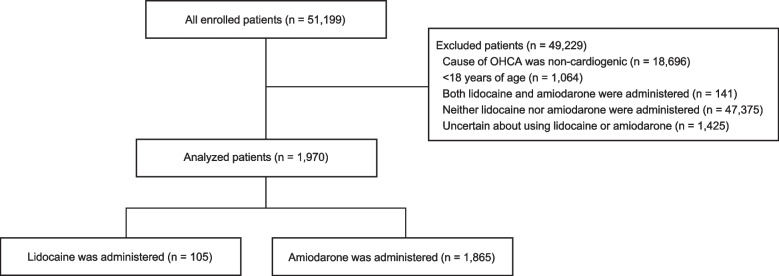
Results: Of the 51,199 patients registered in the OHCA registry, 1970 patients were analyzed. In total, 105 patients (5.3%) were administered lidocaine, and 1865 (94.7%) were administered amiodarone. After performing PSM with amiodarone used as the reference, the odds ratios and 95% confidence intervals of lidocaine use for 30-day survival and 30-day good neurological outcome were 1.44 (0.58-3.61) and 1.77 (0.59-5.29), respectively.
Conclusion: The use of lidocaine and amiodarone for patients with OHCA due to shockable rhythms within a real-world setting showed no significant differences in short-term mortality or neurological outcome. There is no evidence that either amiodarone or lidocaine is superior in treatment; thus, either or both drugs could be administered.
Keywords: Amiodarone; Lidocaine; Out-of-hospital cardiac arrest; Shockable rhythm.
© 2022. The Author(s).
Conflict of interest statement
All the authors declare that they have no conflict of interest.
Figures
References
-
- Gräsner JT, Lefering R, Koster RW, Masterson S, Böttiger BW, Herlitz J, et al. EuReCa ONE-27 nations, ONE Europe, ONE registry: a prospective one month analysis of out-of-hospital cardiac arrest outcomes in 27 countries in Europe. Resuscitation. 2016;105:188–195. doi: 10.1016/j.resuscitation.2016.06.004. - DOI - PubMed
-
- Rajan S, Folke F, Hansen SM, Hansen CM, Kragholm K, Gerds TA, et al. Incidence and survival outcome according to heart rhythm during resuscitation attempt in out-of-hospital cardiac arrest patients with presumed cardiac etiology. Resuscitation. 2017;114:157–163. doi: 10.1016/j.resuscitation.2016.12.021. - DOI - PubMed
Publication types
MeSH terms
Substances
LinkOut - more resources
Full Text Sources
Medical
Miscellaneous
