


Patient-reported functional outcome measures and treatment choice for prostate cancer
- PMID: 36335325
- PMCID: PMC9637295
- DOI: 10.1186/s12894-022-01117-1
Patient-reported functional outcome measures and treatment choice for prostate cancer
Abstract
Background: The aim of this study was to describe changes in patient-reported functional outcome measures (PROMs) comparing pre-treatment and 12 months after radical prostatectomy (RP), external beam radiation therapy (EBRT), brachytherapy and active surveillance (AS).
Methods: Men enrolled from 2010 to 2019 in the South Australian Prostate Cancer Clinical Outcomes Collaborative registry a prospective clinical registry were studied. Urinary, bowel, and sexual functions were measured using Expanded Prostate Cancer Index Composite (EPIC-26) at baseline and 12 months post-treatment. Higher scores on the EPIC-26 indicate better function. Multivariable regression models were applied to compare differences in function and extent of bother by treatment.
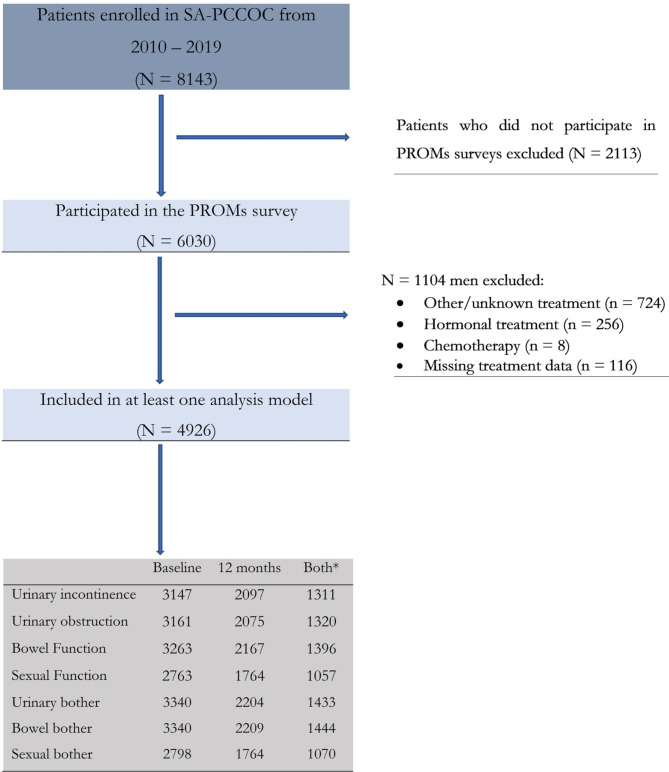
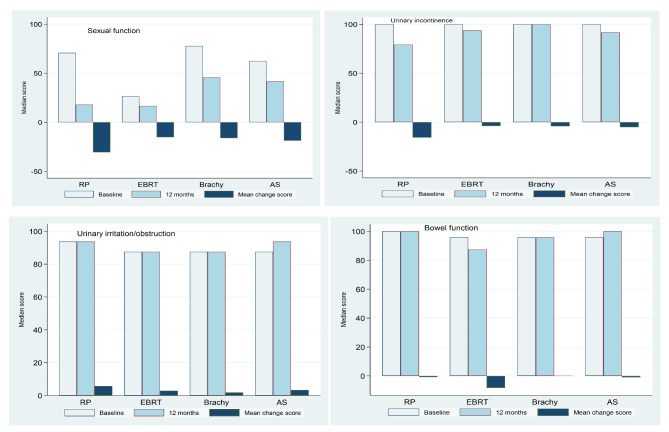
Results: Of the 4926 eligible men, 57.0% underwent RP, 20.5% EBRT, 7.0% brachytherapy and 15.5% AS. While baseline urinary and bowel function varied little across treatment groups, sexual function differed greatly (adjusted mean scores: RP = 56.3, EBRT = 45.8, brachytherapy = 61.4, AS = 52.8; p < 0.001). Post-treatment urinary continence and sexual function declined in all treatment groups, with the greatest decline for sexual function after RP (adjusted mean score change - 28.9). After adjustment for baseline differences, post-treatment sexual function scores after EBRT (6.4; 95%CI, 0.9-12.0) and brachytherapy (17.4; 95%CI, 9.4-25.5) were higher than after RP. Likewise, urinary continence after EBRT (13.6; 95%CI, 9.0-18.2), brachytherapy (10.6; 95%CI, 3.9-17.3) and AS (10.6; 95%CI, 5.9-15.3) were higher than after RP. Conversely, EBRT was associated with lower bowel function (- 7.9; 95%CI, - 12.4 to - 3.5) than RP. EBRT and AS were associated with lower odds of sexual bother (OR 0.51; 95%CI, 0.29-0.89 and OR 0.60; 95%CI, 0.38-0.96, respectively), and EBRT with higher odds of bowel bother (OR 2.01; 95%CI, 1.23-3.29) compared with RP.
Conclusion: The four common treatment approaches for prostate cancer were associated with different patterns of patient-reported functional outcomes, both pre- and 12 months post-treatment. However, after adjustment, RP was associated with a greater decline in urinary continence and sexual function than other treatments. This study underscores the importance of collecting baseline PROMs to interpret post-treatment functional outcomes.
Keywords: Australia; Patient reported outcome measure; Prostate cancer; Quality of life.
© 2022. The Author(s).
Conflict of interest statement
The authors declare that they have no competing interests.
Figures
References
-
- Cancer Australia. National Cancer Control Indicators (NCCI) Internet. August 19. 2021. Accessed August 19, 2021. https://ncci.canceraustralia.gov.au/outcomes/relative-survival-rate.
-
- Chen RC, Basak R, Meyer A-M, et al. Association Between Choice of Radical Prostatectomy, External Beam Radiotherapy, Brachytherapy, or Active Surveillance and Patient-Reported Quality of Life Among Men With Localized Prostate Cancer. JAMA. 2017;317(11):1141–50. doi: 10.1001/jama.2017.1652. - DOI - PMC - PubMed
MeSH terms
Grants and funding
LinkOut - more resources
Full Text Sources
Medical
Research Materials
