


Association Between Shared Decision-Making During Family Meetings and Surrogates' Trust in Their ICU Physician
- PMID: 36336000
- PMCID: PMC10258434
- DOI: 10.1016/j.chest.2022.10.028
Association Between Shared Decision-Making During Family Meetings and Surrogates' Trust in Their ICU Physician
Abstract
Background: Although trust is central to successful physician-family relationships in ICUs, little is known about how to promote surrogates' trust of ICU physicians in this setting.
Research question: Does the conduct of family conferences and physicians' use of shared decision-making (SDM) within family conferences impact surrogates' trust in the physician?
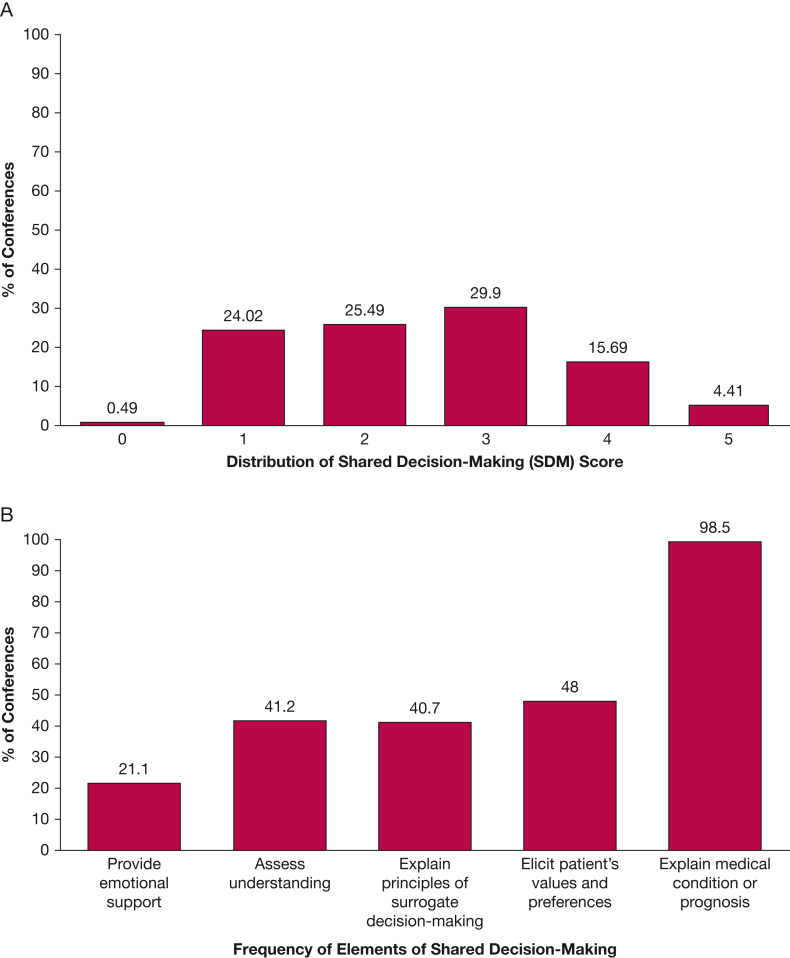
Study design and methods: A mixed-methods secondary analysis was done of a multicenter prospective cohort study of 369 surrogate decision-makers of 204 decisionally incapacitated patients at high risk of death or severe functional impairment within 13 ICUs at six US medical centers between 2008 and 2012. Surrogates completed the Abbreviated Wake Forest Physician Trust Scale (range, 5-25) before and after an audio-recorded family conference conducted within 5 days of ICU admission. We qualitatively coded transcribed conferences to determine physicians' use of five SDM behaviors: discussing surrogate's role, explaining medical condition and prognosis, providing emotional support, assessing understanding, and eliciting patient's values and preferences. Using multivariable linear regression with adjustment for clustering, we assessed whether surrogates' trust in the physician increased after the family meeting; we also examined whether the number of SDM behaviors used by physicians during the family meeting impacted trust scores.
Results: In adjusted models, conduct of a family meeting was associated with increased trust (average change, pre- to post family meeting: 0.91 point [95% CI, 0.4-1.4; P < .01]). Every additional element of SDM used during the family meeting, including discussing surrogate's role, providing emotional support, assessing understanding, and eliciting patient's values and preferences, was associated with a 0.37-point increase in trust (95% CI, 0.08-0.67; P = .01). If all four elements were used, trust increased by 1.48 points. Explaining medical condition or prognosis was observed in nearly every conference (98.5%) and was excluded from the final model.
Interpretation: The conduct of family meetings and physicians' use of SDM behaviors during meetings were both associated with increases in surrogates' trust in the treating physician.
Keywords: communication; goals of care; intensive care; qualitative methods; shared decision-making; trust.
Copyright © 2022 American College of Chest Physicians. Published by Elsevier Inc. All rights reserved.
Figures

References
-
- Mechanic D. The functions and limitations of trust in the provision of medical care. J Health Polit Policy Law. 1998;23(4):661–686. - PubMed
-
- Thom D.H., Campbell B. Patient-physician trust: an exploratory study. J Fam Pract. 1997;44(2):169–176. - PubMed
-
- Hall M.A., Zheng B., Dugan E., et al. Measuring patients’ trust in their primary care providers. Med Care Res Rev. 2002;59(3):293–318. - PubMed
