


Performance of point-of care molecular and antigen-based tests for SARS-CoV-2: a living systematic review and meta-analysis
- PMID: 36336237
- PMCID: PMC9660861
- DOI: 10.1016/j.cmi.2022.10.028
Performance of point-of care molecular and antigen-based tests for SARS-CoV-2: a living systematic review and meta-analysis
Abstract
Background: Molecular and antigen point-of-care tests (POCTs) have augmented our ability to rapidly identify and manage SARS-CoV-2 infection. However, their clinical performance varies among individual studies.
Objectives: The evaluation of the performance of molecular and antigen-based POCTs in confirmed, suspected, or probable COVID-19 cases compared with that of laboratory-based RT-PCR in real-life settings.
Data sources: MEDLINE/PubMed, Scopus, Embase, Web of Science, Cochrane Library, Cochrane COVID-19 study register, and COVID-19 Living Evidence Database from the University of Bern.
Study eligibility criteria: Peer-reviewed or preprint observational studies or randomized controlled trials that evaluated any type of commercially available antigen and/or molecular POCTs for SARS-CoV-2, including multiplex PCR panels, approved by the United States Food and Drug Administration, with Emergency Use Authorization, and/or marked with Conformitè Europëenne from European Commission/European Union.
Participants: Close contacts and/or patients with symptomatic and/or asymptomatic confirmed, suspected, or probable COVID-19 infection of any age.
Test/s: Molecular and/or antigen-based SARS-CoV-2 POCTs.
Reference standard: Laboratory-based SARS-CoV-2 RT-PCR.
Assessment of risk of bias: Eligible studies were subjected to quality-control and risk-of-bias assessment using the Quality Assessment of Diagnostic Accuracy Studies 2 tool.
Methods of data synthesis: Summary sensitivities and specificities with their 95% CIs were estimated using a bivariate model. Subgroup analysis was performed when at least three studies informed the outcome.
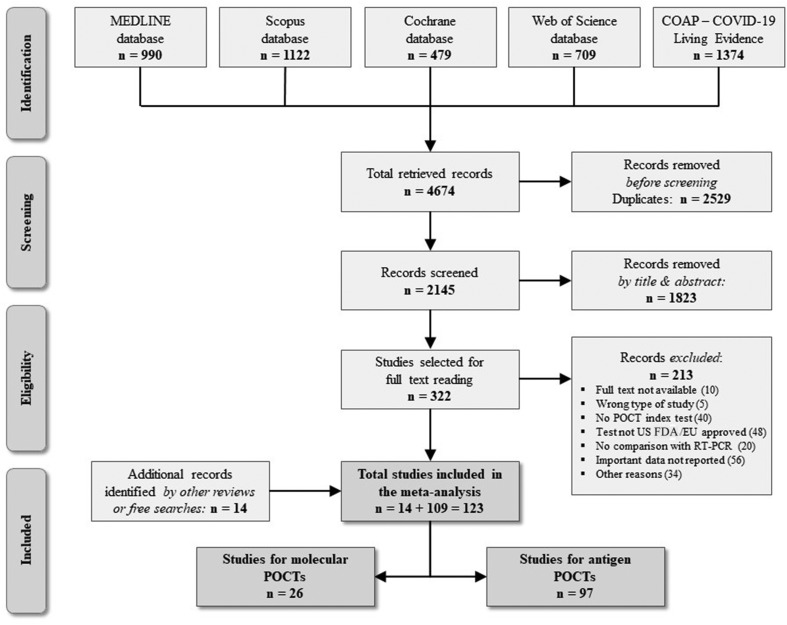
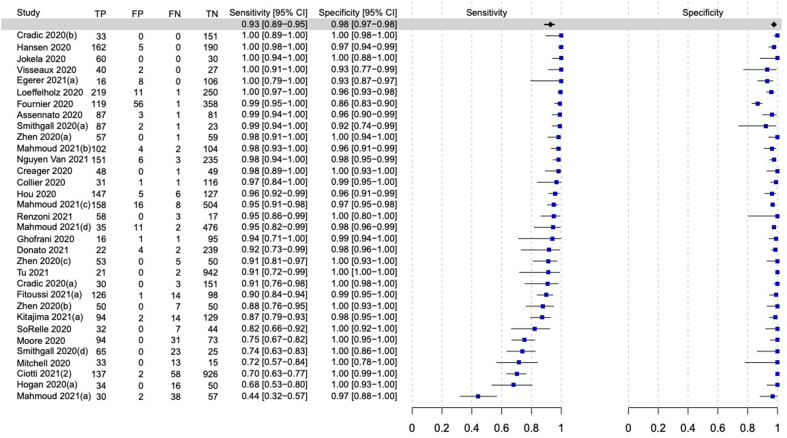
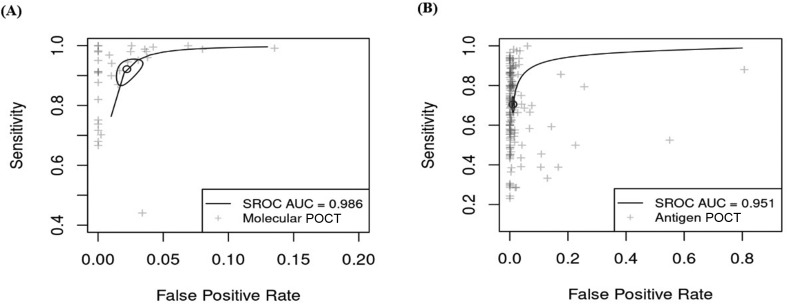
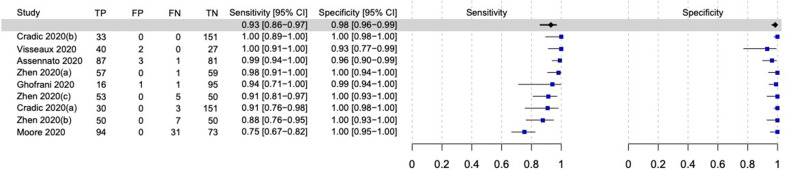
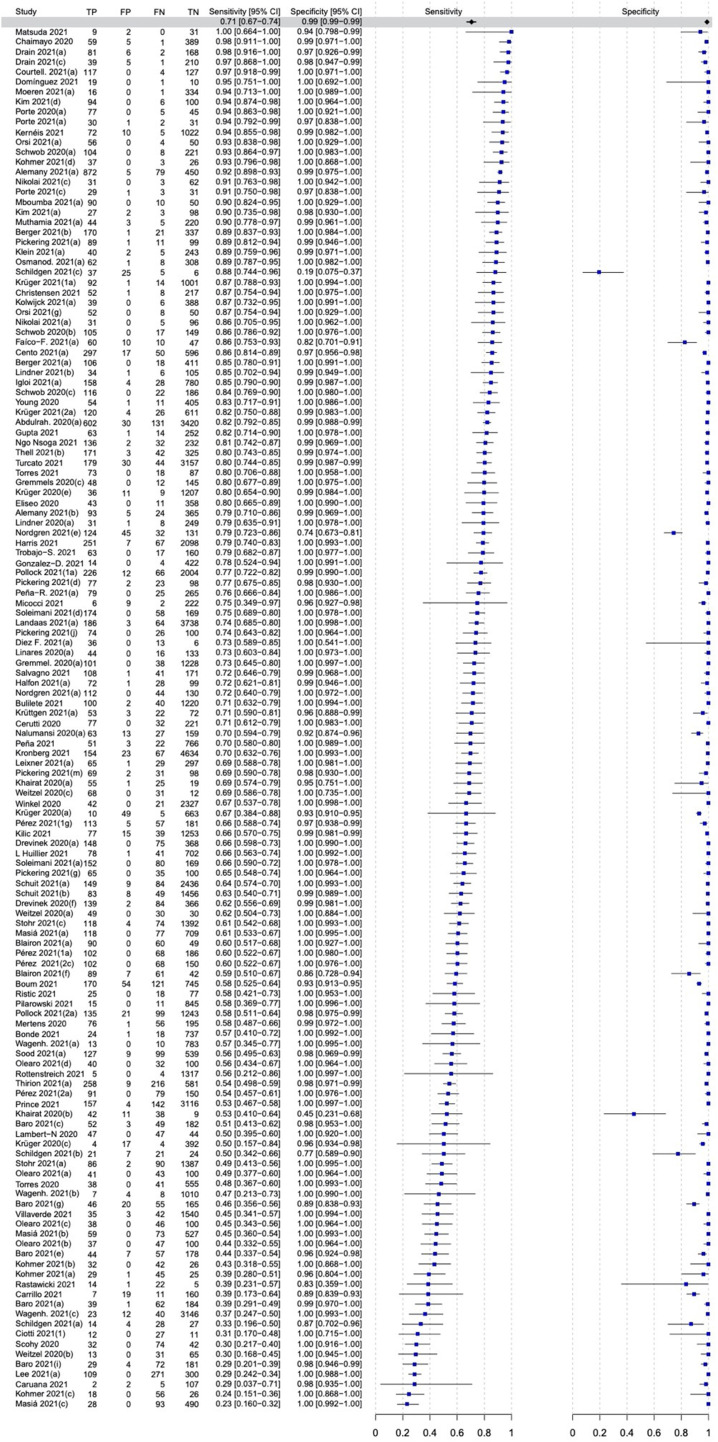
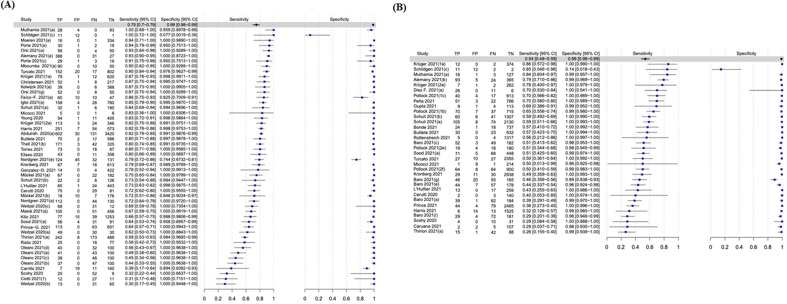
Results: A total of 123 eligible publications (97 and 26 studies assessing antigen-based and molecular POCTs, respectively) were retrieved from 4674 initial records. The pooled sensitivity and specificity for 13 molecular-based POCTs were 92.8% (95% CI, 88.9-95.4%) and 97.6% (95% CI, 96.6-98.3%), respectively. The sensitivity of antigen-based POCTs pooled from 138 individual evaluations was considerably lower than that of molecular POCTs; the pooled sensitivity and specificity rates were 70.6% (95% CI, 67.2-73.8%) and 98.9% (95% CI, 98.5-99.2%), respectively.
Discussion: Further studies are needed to evaluate the performance of molecular and antigen-based POCTs in underrepresented patient subgroups and different respiratory samples.
Keywords: Antigen-based test; COVID-19; Molecular test; Nucleic acid amplification test; Point-of-care test; Rapid test; SARS-CoV-2.
Copyright © 2022 European Society of Clinical Microbiology and Infectious Diseases. Published by Elsevier Ltd. All rights reserved.
Figures
References
-
- World Health Organization . 6 October 2021. Antigen-detection in the diagnosis of SARS-CoV-2 infection: interim guidance.https://apps.who.int/iris/handle/10665/345948
-
- World Health Organization Use of SARS-CoV-2 antigen-detection rapid diagnostic tests for COVID-19 self-testing. https://www.who.int/publications/i/item/WHO-2019-nCoV-Ag-RDTs-Self_testi... Published 9 March 2022.
Publication types
MeSH terms
LinkOut - more resources
Full Text Sources
Medical
Research Materials
Miscellaneous
