Review
. 2023 Jan;29(1):4-19.
doi: 10.1016/j.molmed.2022.10.001. Epub 2022 Nov 4.

Adenoviruses in medicine: innocuous pathogen, predator, or partner

Affiliations
Review

Adenoviruses in medicine: innocuous pathogen, predator, or partner

Katelyn M MacNeil et al. Trends Mol Med. 2023 Jan.

Abstract

The consequences of human adenovirus (HAdV) infections are generally mild. However, despite the perception that HAdVs are harmless, infections can cause severe disease in certain individuals, including newborns, the immunocompromised, and those with pre-existing conditions, including respiratory or cardiac disease. In addition, HAdV outbreaks remain relatively common events and the recent emergence of more pathogenic genomic variants of various genotypes has been well documented. Coupled with evidence of zoonotic transmission, interspecies recombination, and the lack of approved AdV antivirals or widely available vaccines, HAdVs remain a threat to public health. At the same time, the detailed understanding of AdV biology garnered over nearly 7 decades of study has made this group of viruses a molecular workhorse for vaccine and gene therapy applications.

Keywords: adenovirus; adenovirus vectors; outbreaks; pathogenesis; persistence; therapeutics.


Conflict of interest statement

Declaration of interests The authors declare no conflict of interest.

Figures
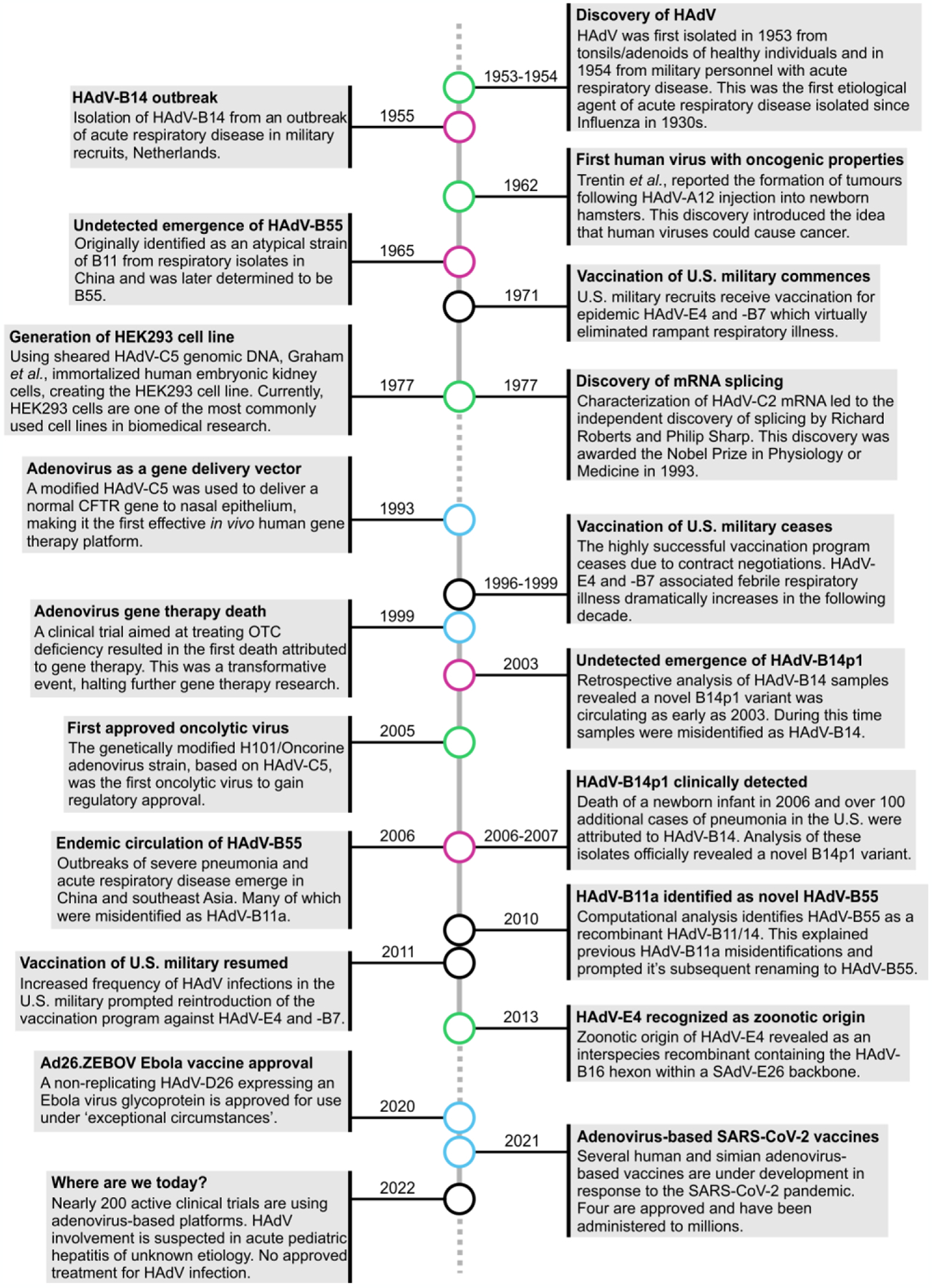
Figure 1.
Figure 1.
Timeline of key human adenovirus historic events, emergences, and technologies over 69 years. Human adenoviruses (HAdV) have been associated with advancements in bio-medical research technologies (blue circles), and many milestone discoveries (green circles) since its identification in 1953–1954 [138,139]. Additionally, this timeline follows the emergence and re-emergence of HAdV-B55 and HAdV-B14/HAdV-B14p1 (pink circles) [7,28,29,32]. In 1962, HAdV gained its distinction as the first human virus to cause cancer, albeit in a rodent model [140]. HAdV has also severed as a tool to study molecular biology. HAdV was instrumental in the discovery of splicing and generation of the popular human embryonic kidney (HEK) 293 cell line [–143]. The U.S. military experienced severe HAdV outbreaks in their recruits, and contracted Wyeth Laboratories Inc. to produce and supply them with the only approved HAdV vaccine (against HAdV-B7 and HAdV-E4, which was latter discovered to have a zoonotic origin) [6,34]. The vaccination program lasted from 1971 to 1996 when contract renegotiations failed, and the program ceased [6]. Without vaccine protection, HAdV outbreaks in the military drastically increased over the next decade until the program was reinstated in 2011 [6,7]. HAdVs are used as vectors in gene therapy, initially to deliver the cystic fibrosis transmembrane conductance regulator (CFTR) gene to humans in vivo, and later being associated with a patient death in a clinical trial on ornithine transcarbamylase (OTC) deficiency [108,144]. HAdV was also the first approved oncolytic virus [145]. HAdV has been successfully used as a vaccine platform for Ebola virus (Ad26.ZEBOV) and the SARS-CoV-2 pandemic, with many ongoing HAdV vector clinical trials [109].
Figure 2.
Figure 2.
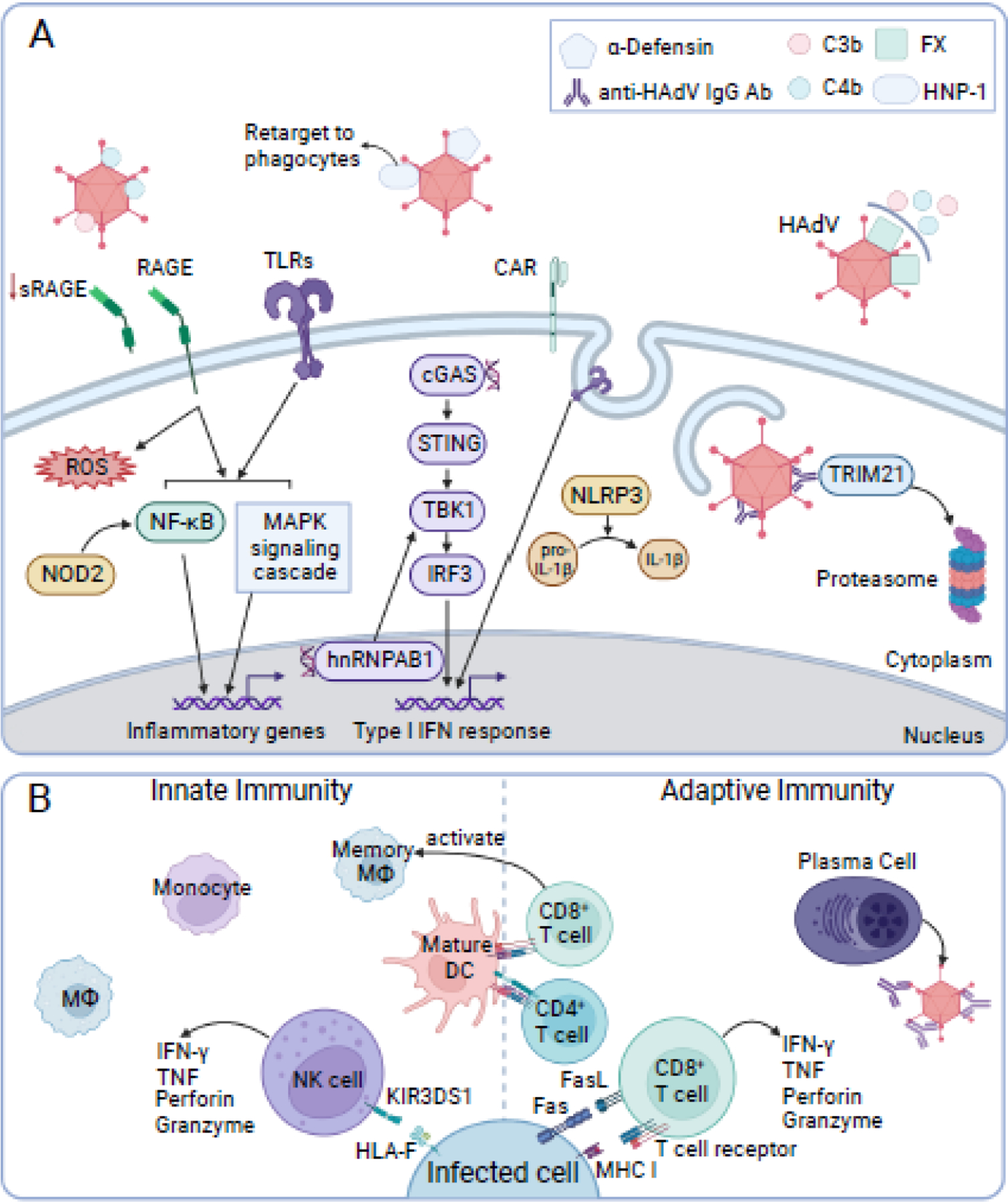
The cellular immune response, extracellular proteins, and molecular mechanisms involved during human adenovirus infection. This non-comprehensive overview of anti-HAdV immune responses emphasizes recent findings. (A) Extracellular proteins α-defensin and complement protein C4b can bind human adenovirus (HAdV) and impede entry. Binding of HNP-1 re-targets the virion to phagocytes, while binding of complement protein C3b leads to virion opsonization. FX binding protects HAdV from complement. RAGE activation produces reactive oxygen species (ROS). RAGE and TLR activation during infection ultimately results in NF-κB and MAPK signaling and transcription of inflammatory genes. A NOD receptor, NOD2, can also activate NF-κB. Signaling from endosomal TLRs, sensing of cytosolic double-stranded DNA (dsDNA) via cGAS/STING pathway or nuclear viral dsDNA via hnRNPAB1 stimulates transcription of type I IFN genes. Activation of NLRP3, a NOD-like receptor, helps regulate secretion of IL-1β. TRIM21 binds to cytosolic antibody-HAdV complexes, targeting the virion for proteasomal degradation. (B) Macrophages (MΦ), monocytes, dendritic cells (DCs), and natural killer (NK) cells are recruited and activated following HAdV infection. NK cell receptor KIR3DS1 recognizes HLA-F on infected cell surfaces. NK cell activation leads to degranulation (perforin and granzyme) and production of IFN-γ and TNF. Mature DCs present viral peptides to activate CD8+ and CD4+ T cells. CD8+ T cells produce IFN-γ and TNF, release perforin and granzyme, induce apoptosis via Fas-Fas ligand (FasL) interactions, and lyse cells presenting viral peptides via MHC I. In alveolar mucosal tissues, CD8+ T cells can induce alveolar memory MΦ, which provide protection against re-infection. Plasma cells produce high-affinity, HAdV-specific antibodies against HAdV structural proteins to inhibit receptor binding, neutralize/aggregate virions, and activate complement. Created with BioRender.com

References

    1. Dai X et al. (2017) Atomic Structures of Minor Proteins VI and VII in Human Adenovirus. J. Virol 91, e00850–17 - PMC - PubMed
    1. Yu X et al. (2017) Cryo-EM structure of human adenovirus D26 reveals the conservation of structural organization among human adenoviruses. Sci. Adv 3, e1602670. - PMC - PubMed
    1. Rafie K et al. (2021) The structure of enteric human adenovirus 41-A leading cause of diarrhea in children. Sci. Adv 7, eabe0974. - PMC - PubMed
    1. Pérez-Illana M et al. (2021) Cryo-EM structure of enteric adenovirus HAdV-F41 highlights structural variations among human adenoviruses. Sci. Adv 7, eabd9421. - PMC - PubMed
    1. Hearing P (2021) Adenoviridae: The Viruses and Their Replication. In Fields Virology,Volume 2: DNA viruses (7th edn) (Howley PM et al. , eds), pp. 98–128, Wolters Kluwer:Philadelphia, PA, USA