


Associations between executive functioning, challenging behavior, and quality of life in children and adolescents with and without neurodevelopmental conditions
- PMID: 36337537
- PMCID: PMC9632446
- DOI: 10.3389/fpsyg.2022.1022700
Associations between executive functioning, challenging behavior, and quality of life in children and adolescents with and without neurodevelopmental conditions
Abstract
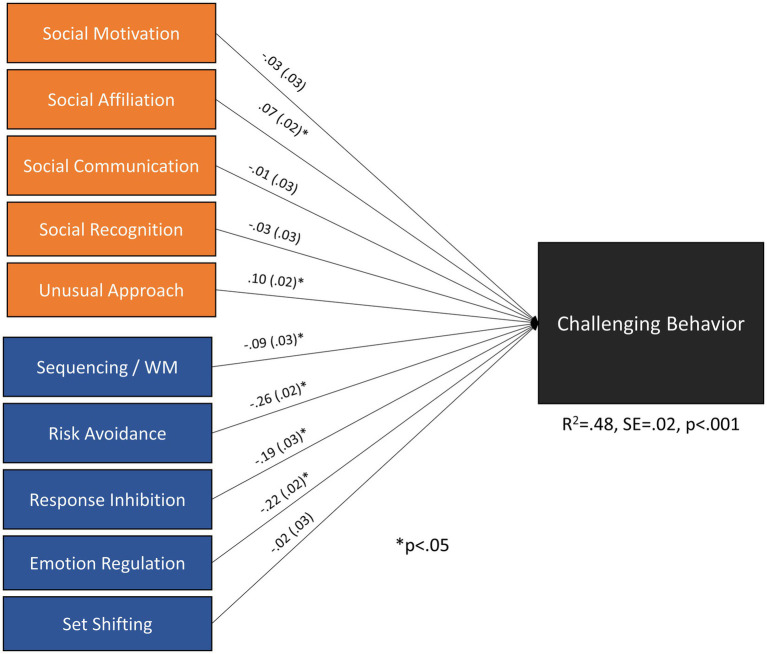
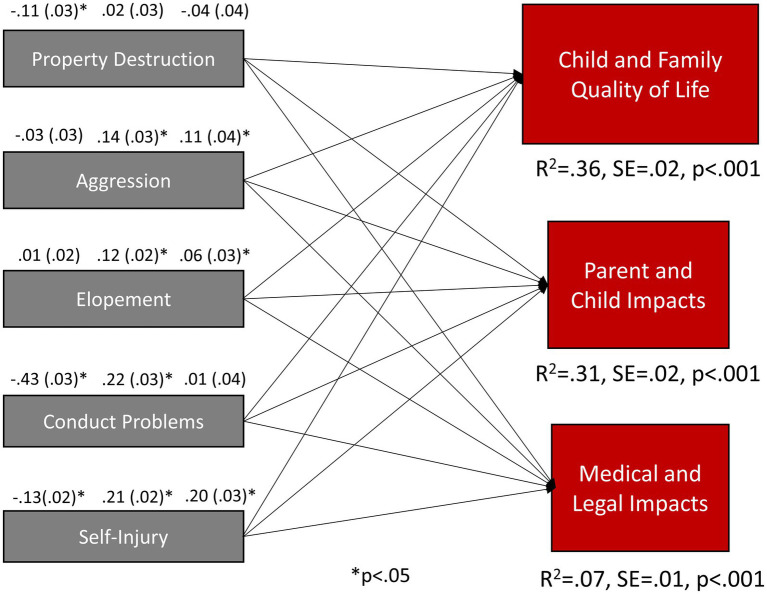
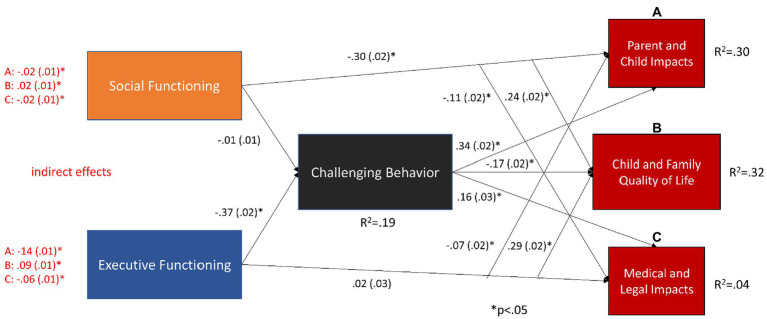
The present study sought to clarify the impact of executive and social functioning on challenging behavior and the downstream influence of challenging behavior on quality of life and functioning in a large transdiagnostic sample. Understanding these relationships is crucial for developing and designing tailored intervention strategies. In a cross-sectional study, parent informants of 2,004 children completed measures of executive and social functioning, challenging behavior, child and family quality of life, and reported on functional impacts of challenging behavior. Using structural (path) modeling, analyses evaluated the associations between executive and social functioning, including emotion regulation and risk avoidance, with overall and specific types of challenging behavior. Structural models also examined the influence of challenging behavior on child and family quality of life, including measures of the immediate and extended environment, and functional impacts on the parent/child as well as interactions with the medical/legal systems. Finally, mediational models explored the direct and indirect effects of executive and social functioning on quality of life and impact measures via challenging behavior. Results indicated that executive functioning accounts for substantial variance (R 2 = 0.47) in challenging behavior. In turn, challenging behavior accounts for substantial variance in child and family quality of life (R 2 = 0.36) and parent/child impacts (R 2 = 0.31). Exploratory mediational models identified direct effects from executive and social functioning measures on quality of life and functional impacts and indirect effects for executive functioning via challenging behavior. These findings support the development of new intervention strategies and suggest the need to measure executive functioning when assessing and tailoring the treatment of challenging behavior in clinical practice.
Keywords: challenging behavior; developmental disability; executive function; functional impact; quality of life; social skills.
Copyright © 2022 Frazier, Crowley, Shih, Vasudevan, Karpur, Uljarevic and Cai.
Conflict of interest statement
Beyond the scope of this research, TF has received funding or research support from, acted as a consultant to, received travel support from, and/or received a speaker’s honorarium from the PTEN Research Foundation, SYNGAP Research Fund, Malan Syndrome Foundation, ADNP Kids Research Foundation, Quadrant Biosciences, Autism Speaks, Impel NeuroPharma, F. Hoffmann-La Roche AG Pharmaceuticals, the Cole Family Research Fund, Simons Foundation, Ingalls Foundation, Forest Laboratories, Ecoeos, IntegraGen, Kugona LLC, Shire Development, Bristol-Myers Squibb, Roche Pharma, MaraBio, National Institutes of Health, and the Brain and Behavior Research Foundation and has an investor stake in Autism EYES LLC and iSCAN-R. EC received research support funding from Autism Speaks. The remaining authors declare that the research was conducted in the absence of any commercial or financial relationships that could be construed as a potential conflict of interest.
Figures
References
-
- Baiden P., Stewart S. L., Fallon B. (2017). The role of adverse childhood experiences as determinants of non-suicidal self-injury among children and adolescents referred to community and inpatient mental health settings. Child Abuse Negl. 69, 163–176. doi: 10.1016/j.chiabu.2017.04.011, PMID: - DOI - PubMed
-
- Beck K. B., Conner C. M., Breitenfeldt K. E., Northrup J. B., White S. W., Mazefsky C. A. (2020). Assessment and treatment of emotion regulation impairment in autism Spectrum disorder across the life span: current state of the science and future directions. Child Adolesc. Psychiatr. Clin. N. Am. 29, 527–542. doi: 10.1016/j.chc.2020.02.003, PMID: - DOI - PMC - PubMed
LinkOut - more resources
Full Text Sources
