Review
. 2022 Oct 20:13:991678.
doi: 10.3389/fmicb.2022.991678. eCollection 2022.

Drosophila melanogaster as a model to study innate immune memory

Affiliations
Review

Drosophila melanogaster as a model to study innate immune memory

Marta Arch et al. Front Microbiol. .

Abstract

Over the last decades, research regarding innate immune responses has gained increasing importance. A growing body of evidence supports the notion that the innate arm of the immune system could show memory traits. Such traits are thought to be conserved throughout evolution and provide a survival advantage. Several models are available to study these mechanisms. Among them, we find the fruit fly, Drosophila melanogaster. This non-mammalian model has been widely used for innate immune research since it naturally lacks an adaptive response. Here, we aim to review the latest advances in the study of the memory mechanisms of the innate immune response using this animal model.

Keywords: Drosophila melanogaster; infection; innate immune memory; resistance; tolerance; trained immunity.


Conflict of interest statement

The authors declare that the research was conducted in the absence of any commercial or financial relationships that could be construed as a potential conflict of interest.

Figures
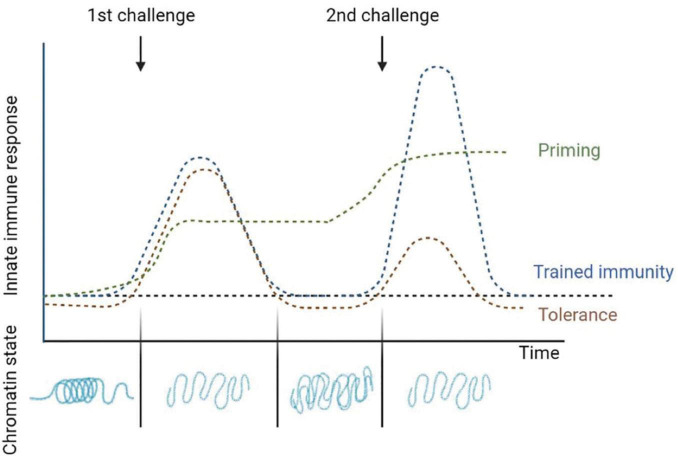
FIGURE 1
FIGURE 1
Changes after the induction of innate immune memory. Priming is characterized by an activation of gene expression in innate immune cells that is sustained over time and does not return to basal levels before the second challenge. Often the response to the second stimulus is synergistic with the first one. In trained immunity the gene expressions levels return to basal levels when the first stimulus is removed, but epigenetic changes persist favoring a faster and higher immune response in subsequent infections. Finally, tolerance is the opposite to trained immunity, where after activation by a first stimulus and returning to basal levels the immune response is reduced in subsequent challenges. The flat dotted line represents the basal activation levels of the innate immune response in absence of infection. Adapted from Divangahi et al. (2020) and Netea et al. (2020).
FIGURE 2
FIGURE 2
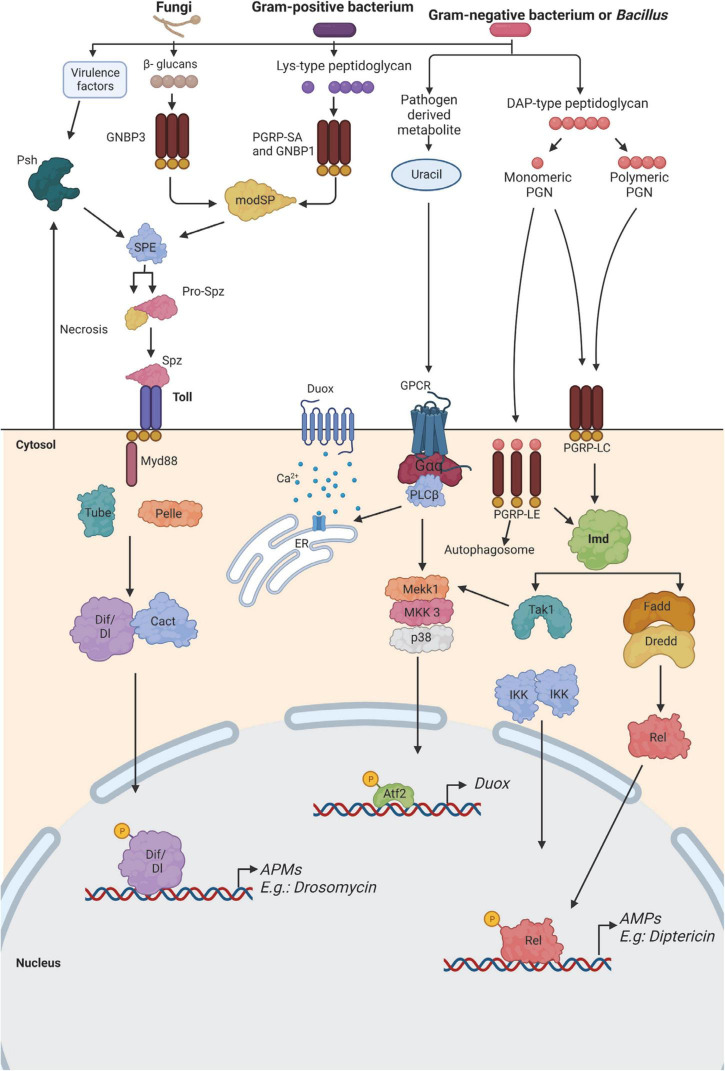
Immune recognition of microorganisms in Drosophila. The two major pathways that sense bacteria and fungi in fruit flies are the Toll pathway (left) and the immune deficiency (Imd) pathway (right). Both pathways function in the fat body for the production of antimicrobial peptides (AMP) by activating the expression of NF-κB-like factors, which are highly conserved among species. In addition, the Imd pathway also functions in the epithelial surfaces. The Imd pathway is activated when DAP-type peptidoglycan from gram-negative bacteria, and some gram-positive, binds to Peptidoglycan Recognition Proteins (PGRPs), and this activation leads to the generation of AMP and synthesis of Duox enzyme for the production of reactive oxygen species (ROS). Gram-positive bacteria contain lys-type peptidoglycan, which is recognized by PGRP-SA and Gram Negative Bacteria Protein (GNBP) 1, and GNBP3 binds to β-glucans of yeasts and fungi, leading to the activation of the Toll pathway. This pathway can also be triggered by danger signals like proteases or abnormal cell death that activates the protease Persephone (Psh). In all cases, the activation of the Toll pathway triggers a proteolytic cascade that activates the protease Spätzle- processing enzyme (SPE). This protein will cleave Spätzle (Spz). As a result of the activation of the Toll pathway, the transcription factors Dorsal-related immunity factor (Dif) or Dorsal (Dl) will translocate to the nucleus, thus inducing the expression of AMP genes like drosomycin. Similarly, the activation of the Imd pathway induces the nuclear translocation of the transcription factor Relish (Rel) and induction of the expression of AMP genes, such as diptericin. The generation of ROS is induced by the activation of Duox in the presence of uracil. This is caused by the activation of a G protein-coupled receptor (GPCR), which promotes the release of calcium from the endoplasmic reticulum. This signaling pathway, together with the activation of the Imd pathway, contributes to the expression of the Duox enzyme during infection. Atf2, activating transcription factor 2; Dredd, death-related ced-3/Nedd2-like caspase; Fadd, FAS-associated death domain ortholog; Gαq, G protein αq-subunit; IKK, inhibitor of NF-κB kinase; MKK3, MAPK kinase 3; modSP, modular serine protease; Tak1, TGFβ-activated kinase 1. Adapted from Buchon et al. (2014) and Younes et al. (2020).
FIGURE 3
FIGURE 3
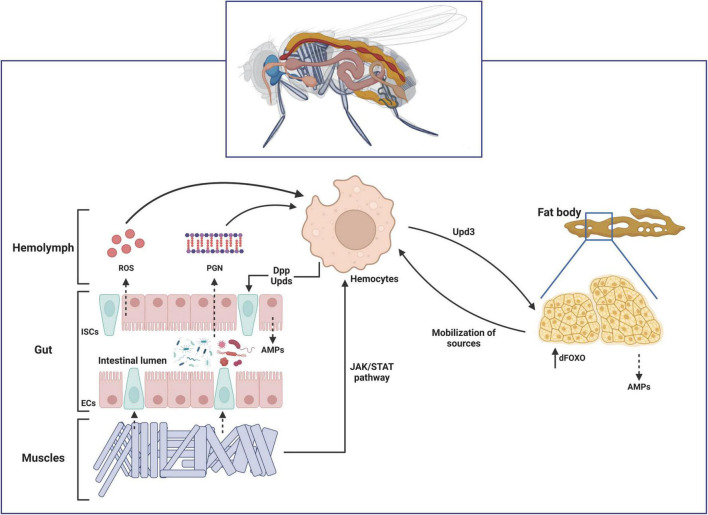
Schematic representation of the interorgan communication during infection in Drosophila melanogaster. In response to ingested pathogens, these microorganisms might either break the gut epithelium themselves or release peptidoglycan (PGN) from their cell walls into the hemolymph. The enterocytes (ECs) are also able to release reactive oxygen species (ROS) in response to tissue damage. These circulating signals are sensed by the hemocytes located close to the gut epithelium. Hemocyte-expressed Decapentaplegic (Dpp) and Unpaireds (Upds) during early stages of the infection activate the intestinal stem cells (ISCs) proliferation to cope with tissue damage. Hemocytes-derived Upds also induce accumulation of the transcription factor dFOXO in the fat body via JAK/STAT pathway. Activation of dFOXO induces expression of AMPs and a systemic metabolic dysregulation that mobilizes energy resourced toward phagocytic cells. Finally, infection-induced Upd3 in enterocytes activate the JAK/STAT signaling pathway in visceral muscles (VM), which in turns promote ISCs proliferation, as well as activation of the close-located hemocytes.

References

    1. Aaby P., Roth A., Ravn H., Napirna B. M., Rodrigues A., Lisse I. M., et al. (2011). Randomized trial of BCG vaccination at birth to low-birth-weight children: Beneficial nonspecific effects in the neonatal period?. J. Infect. Dis. 204 245–252. - PubMed
    1. Acuña Hidalgo B., Armitage S. A. O. (2022). Host Resistance to Bacterial Infection Varies Over Time, but Is Not Affected by a Previous Exposure to the Same Pathogen. Front. Physiol. 13:860875. 10.3389/fphys.2022.860875 - DOI - PMC - PubMed
    1. Agaisse H., Petersen U., Boutros M., Mathey-Prevot B., Perrimon N. (2003). Signaling role of hemocytes in Drosophila JAK/STAT-dependent response to septic injury. Dev. Cell. 5 441–450. 10.1016/s1534-5807(03)00244-2 - DOI - PubMed
    1. Amcheslavsky A., Ip Y. T. (2012). Be a Good Neighbor: Organ-to-Organ Communication during the Innate Immune Response. Cell Host Microbe 11 323–324. 10.1016/j.chom.2012.04.003 - DOI - PubMed
    1. Apidianakis Y., Rahme L. G. (2009). Drosophila melanogaster as a model host for studying Pseudomonas aeruginosa infection. Nat. Protoc. 4 1285–1294. - PubMed

LinkOut - more resources