Phytochemical study of the plant species Bidens pilosa L. (Asteraceae) and Croton floccosus (Euphorbiaceae)
- PMID: 36339983
- PMCID: PMC9623199
- DOI: 10.12688/f1000research.112653.2
Phytochemical study of the plant species Bidens pilosa L. (Asteraceae) and Croton floccosus (Euphorbiaceae)
Abstract
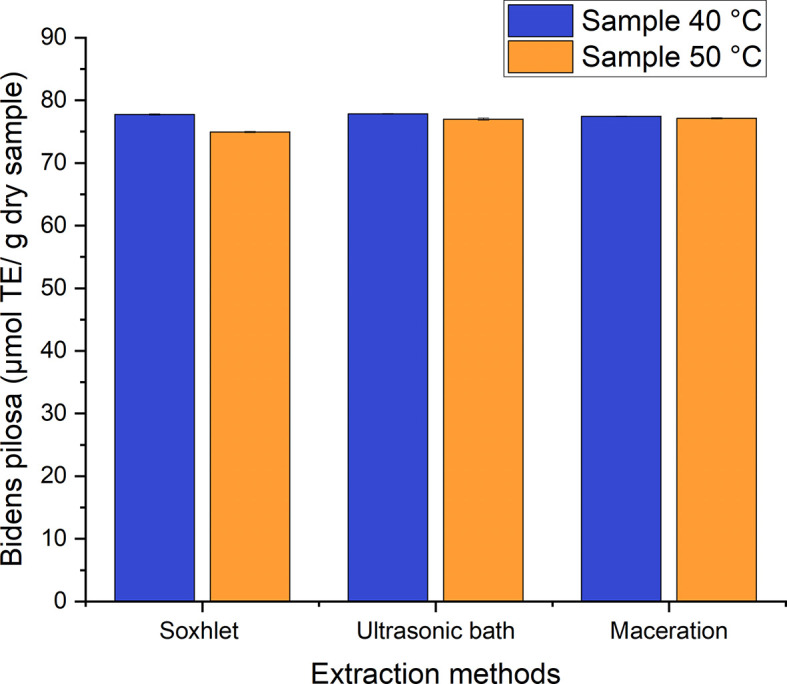
Background: Given the chemical richness of medicinal plants ( Bidens pilosa L. and Croton floccosus) in Ecuador, they are considered the natural source of numerous medicines. Methods: The leaves were dried at 40°C and 50°C and the extracts were characterized by means of phytochemical screening, verifying the presence of secondary metabolites such as alkaloids, reducing sugars, phenols, flavonoids, tannins and saponins. Three extraction processes were carried out, with two solvents of different polarities: hexane and ethanol. The extraction methods that were applied to the leaves of the plants were Soxhlet, ultrasonic bath and maceration, the latter two at room temperature and Soxhlet at the boiling temperature of the solvent. Determination of the total content of phenols and flavonoids is carried out using the Follin-Ciocalteau colorimetric reaction, Quercetin standard, Aluminum Chloride solution measured with a UV-Vis spectrophotometer. The antioxidant activity was performed with the DPPH radical and measured with the same equipment. Results: The highest content of total phenols obtained by employing the Soxhlet method for extraction when the material was dried at 50°C was 48.609 ± 0.370 mg GAE/g of dry sample for Bidens pilosa L. while in the case of Croton floccosus it was 128.212 ± 0.601 mg GAE/g of dry sample obtained from the extraction by means of maceration. Finally, the antioxidant activity against the 1.1-diphenyl-2-picryl-hydrazyl radical was determined, and it was found that the Bidens pilosa L. species performed better and responded better to the test, with an IC 50 value of 239.33 µg/mL, than Croton floccosus (IC 50 of 644.125 µg/mL). Conclusions: The following preliminary phytochemical study of the Bidens pilosa L. and Croton floccosus plants provided important information on the content of secondary metabolites and response to the DPPH radical reported for the first time in Ecuador, which may be future use for medicinal application.
Keywords: Asteraceae; Bidens pilosa L; Croton floccosus; Euphorbiaceae; extraction; flavonoids; phenols; phytochemical study.
Copyright: © 2022 Ruiz-Reyes E et al.
Conflict of interest statement
No competing interests were disclosed.
Figures







References
-
- Mittermeier RA: Primate diversity and the tropical forest. Washington, DC Washington, DC: National Academy Press;1988.
-
- Jørgensen PMlLo-YnSMBG: Catalogue of the vascular plants of Ecuador = Catologo de las plantas vasculares del Ecuador. St. Louis, Mo: Missouri Botanical Garden Press;1999.
-
- Riina R, Vigo MA, Ceron CE: Croton condorensis: an enigmatic new species of Euphorbiaceae from southern Ecuador. Phytotaxa. 2014;164(2):154–158. 10.11646/phytotaxa.164.2.10 - DOI
-
- Riina R, Cumbicus N, Feio AC, et al. : A new species of dragon’s blood Croton (Euphorbiaceae) from South America with singular inflorescences. Webbia. 2015;70(1):187–192. 10.1080/00837792.2015.1020129 - DOI
-
- Riina R, Berry PE: Two new South American species of Croton (Euphorbiaceae) and their phylogenetic affinities. Anales del Jardín Botánico de Madrid. Consejo Superior de Investigaciones Científicas;2010;67(1):23–27.
Publication types
MeSH terms
Substances
LinkOut - more resources
Full Text Sources