


Physical, functional, nutritional and antioxidant properties of foxtail millet in Bangladesh
- PMID: 36339997
- PMCID: PMC9626931
- DOI: 10.1016/j.heliyon.2022.e11186
Physical, functional, nutritional and antioxidant properties of foxtail millet in Bangladesh
Abstract
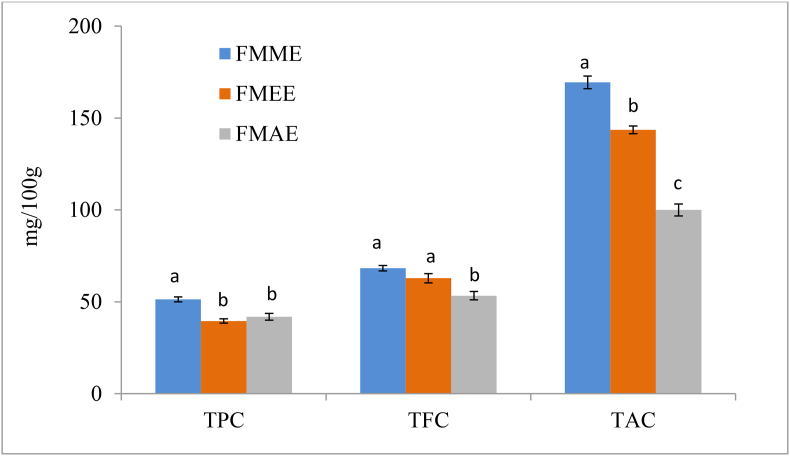
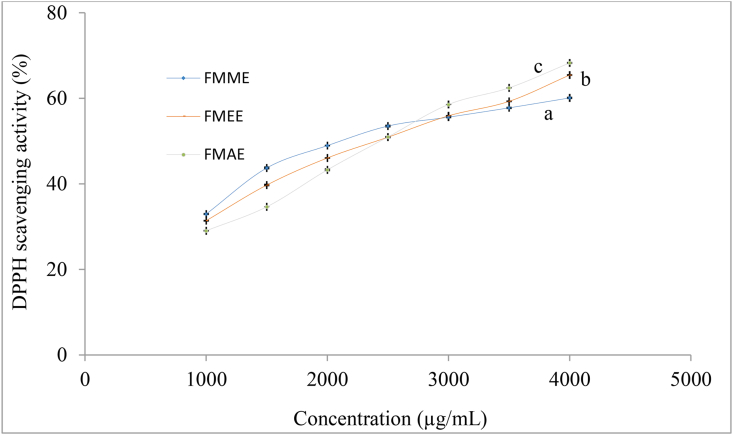
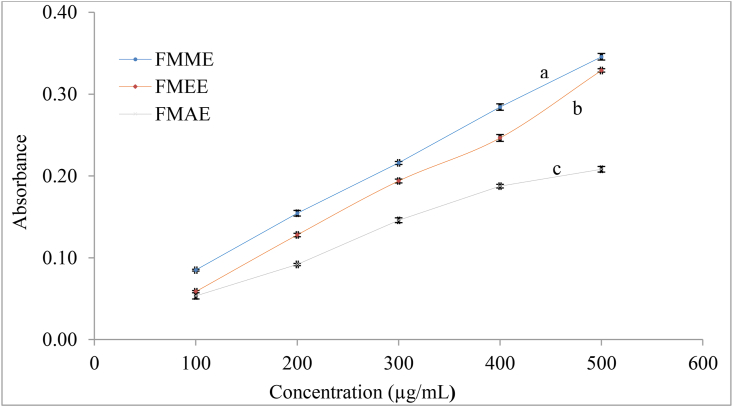
The nutritional and phytochemical content of foxtail millet (Cetaria italica) makes it a viable food grain. In this study, we looked at foxtail millet in Bangladesh and analyzed its nutritional value, functional and physical characteristics. In addition, methanol, ethanol, and acetone: water: acetic acid (70: 29.50: 0.50) extracts of foxtail millet flour (FMF) were analyzed for their antioxidant properties (total phenolic and flavonoid content, total antioxidant capacity, ferric reducing antioxidant power (FRAP) assay, and 2,2-diphenyl-1-picrylhydrazyl (DPPH) free radical scavenging activity). According to this study, foxtail millet has favorable physiological and functional properties. FMF had protein at 11.65 ± 0.45 g/100 g, fat at 3.48 ± 0.04 g/100 g, carbohydrates at 75.33 ± 0.53 g/100 g, and crude fiber at 2.21 ± 0.03 g/100 g. Calcium was found at 47 ± 0.48 mg/100 g, iron at 4.59 ± 0.14 mg/100 g, potassium at 393 ± 15.87, sodium at 27.4 ± 1.21, magnesium at 45.40 ± 2.22, manganese at 0.71 ± 0.02, copper at 0.58 ± 0.04 and zinc at 2.30 ± 0.18 mg/100 g. The total flavonoid content (TFC) of the methanolic extract (68.26 ± 1.51 mg quercetin equivalents (QE)/100 g) was significantly (p < 0.05) higher than the extract of acetone: water: acetic acid. Total antioxidant capacity (TAC) (169.40 ± 3.45 mg ascorbic acid equivalents (AAE)/100 g) and total phenolic content (TPC) (51.35 ± 1.35 mg gallic acid equivalents (GAE)/100 g) of the methanolic extracts were significantly (p < 0.05) higher than others. The ascending order of DPPH free radical scavenging activity of FMF extract is as follows: acetone: acetic acid: water < ethanol < methanol. In the ferric reducing antioxidant power (FRAP) test, the reducing power of FMF extracts increased with the rise in sample concentration. Foxtail millet has potential as a functional food that could influence rural residents' diets and health.
Keywords: Antioxidant activity; Foxtail millet; Functional properties; Nutritional properties.
© 2022 The Authors.
Conflict of interest statement
The authors declare no conflict of interest.
Figures
References
-
- Adekunle A.A., Ellis-Jones J., Ajibefun I., Nyikal R.A., Bangali S., Fatunbi O., Ange A. Forum for Agricultural Research in Africa (FARA) 2012. Agricultural innovation in sub-Saharan Africa: experiences from multiple-stakeholder approaches. Accra, Ghana.
-
- Akanbi T.O., Timilsena Y., Dhital S. In: Bioactive Factors and Processing Technology for Cereal Foods. Wang J., Sun B., Tsao R., editors. Springer; Singapore: 2019. Bioactives from millet: properties and effects of processing on bioavailability; pp. 171–183.
-
- Amadou I., Amza T., Shi Y.-H., Le G.-W. Chemical analysis and antioxidant properties of foxtail millet bran extracts. Songklanakarin J. Sci. Technol. 2011;33(5):509–515.
-
- Amarowicz R., Pegg R., Rahimi-Moghaddam P., Barl B., Weil J. Free-radical scavenging capacity and antioxidant activity of selected plant species from the Canadian prairies. Food Chem. 2004;84(4):551–562.
-
- AOAC . eighteenth ed. Association of Official Analytical Chemists; Gaithersburg, MD.,USA: 2005. Official Methods of Analysis.
LinkOut - more resources
Full Text Sources
Miscellaneous
