


The prevalence and risk factors of mental problems in medical students during COVID-19 pandemic: A systematic review and meta-analysis
- PMID: 36341802
- PMCID: PMC9613786
- DOI: 10.1016/j.jad.2022.10.040
The prevalence and risk factors of mental problems in medical students during COVID-19 pandemic: A systematic review and meta-analysis
Abstract
Background: This meta-analysis and systematic review aimed to evaluate the global prevalence and risk factors of mental problems (i.e., depression, anxiety, stress, sleep disorder, posttraumatic stress disorder (PTSD), burnout, psychological distress, and suicidal ideation) among medical students during the COVID-19 pandemic.
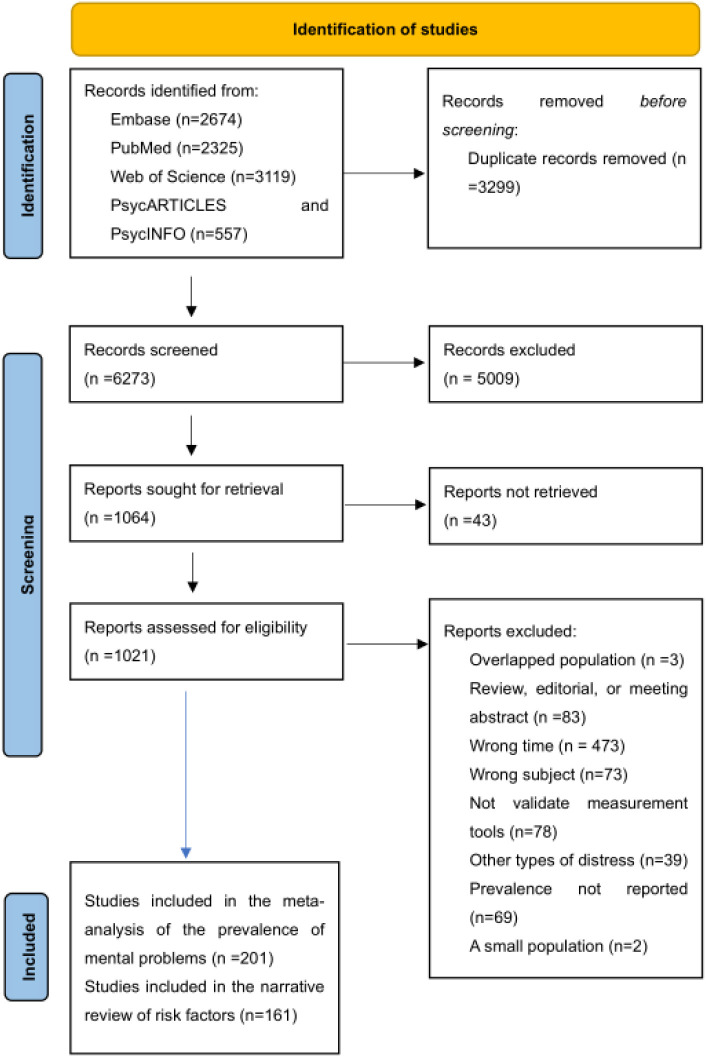
Method: We searched PubMed, Embase, Web of Science, psycARTICLES, PsycINFO, CNKI, and Wan Fang for studies on the prevalence of mental problems among medical students from January 1, 2020, to April 1, 2022. The pooled prevalence was calculated by random-effect models. We performed a narrative review to identify the risk factors.
Results: The meta-analysis included 201 studies (N = 198,000). The prevalence of depression (41 %, 95 % CI, 37-45 %,), anxiety (38 %,95 % CI, 34 %-42 %), stress (34 %, 95 % CI, 27 %-42 %), sleep disorder (52 %, 95 % CI, 44 %-60 %), psychological distress (58 %, 95 % CI, 51 %-65 %), PTSD (34 %, 95 % CI, 22 %-46 %), suicidal ideation (15 %, 95 % CI, 11 %-18 %) and burnout (38 %, 95 % CI, 25 %-50 %) was high. The major risk factors were being female, being junior or preclinical students, exposure to COVID-19, academic stress, psychiatric or physical disorders history, economic trouble, fear of education impairment, online learning trouble, fear of infection, loneliness, low physical activity, low social support, problematic internet or smartphone use, and young age.
Limitations: Most studies were cross-sectional. Few studies provided a reasonable response rate, suggesting potential selection bias.
Conclusions: The study demonstrated a high prevalence and risk factors for mental problems during COVID-19, calling for mental health services. Our findings are valuable for college and health authorities to identify high-risk students and provide targeted intervention.
Keywords: COVID-19; Medical students; Mental health; Meta-analysis.
Copyright © 2022 The Authors. Published by Elsevier B.V. All rights reserved.
Conflict of interest statement
Conflict of Interest The authors declare that they have no conflict of interest. Financial disclosure This study was supported by the Provincial Natural Science Foundation of Hunan (Grant No. 2020JJ4795 to TQ Liu). The funders had no influence on study design, analysis or decision to publish.
Figures
References
-
- Al-Hasani I.D., Salih H.S., Abdul Wahid A.T., Jabarah M. The impact of social support on students’ behavior in the context of iraqi medical education. Open Access Macedonian J. Med. Sci. 2021;9:1553–1559. doi: 10.3889/oamjms.2021.7688. - DOI
Publication types
MeSH terms
LinkOut - more resources
Full Text Sources
Medical
Miscellaneous
