


Sleep problems in autism: Sex differences in the school-age population
- PMID: 36341856
- PMCID: PMC9839593
- DOI: 10.1002/aur.2848
Sleep problems in autism: Sex differences in the school-age population
Erratum in
-
Correction to "Sleep problems in autism: Sex differences in the school-age population".Autism Res. 2024 Feb;17(2):443. doi: 10.1002/aur.3093. Epub 2024 Jan 14. Autism Res. 2024. PMID: 38220438 No abstract available.
Abstract
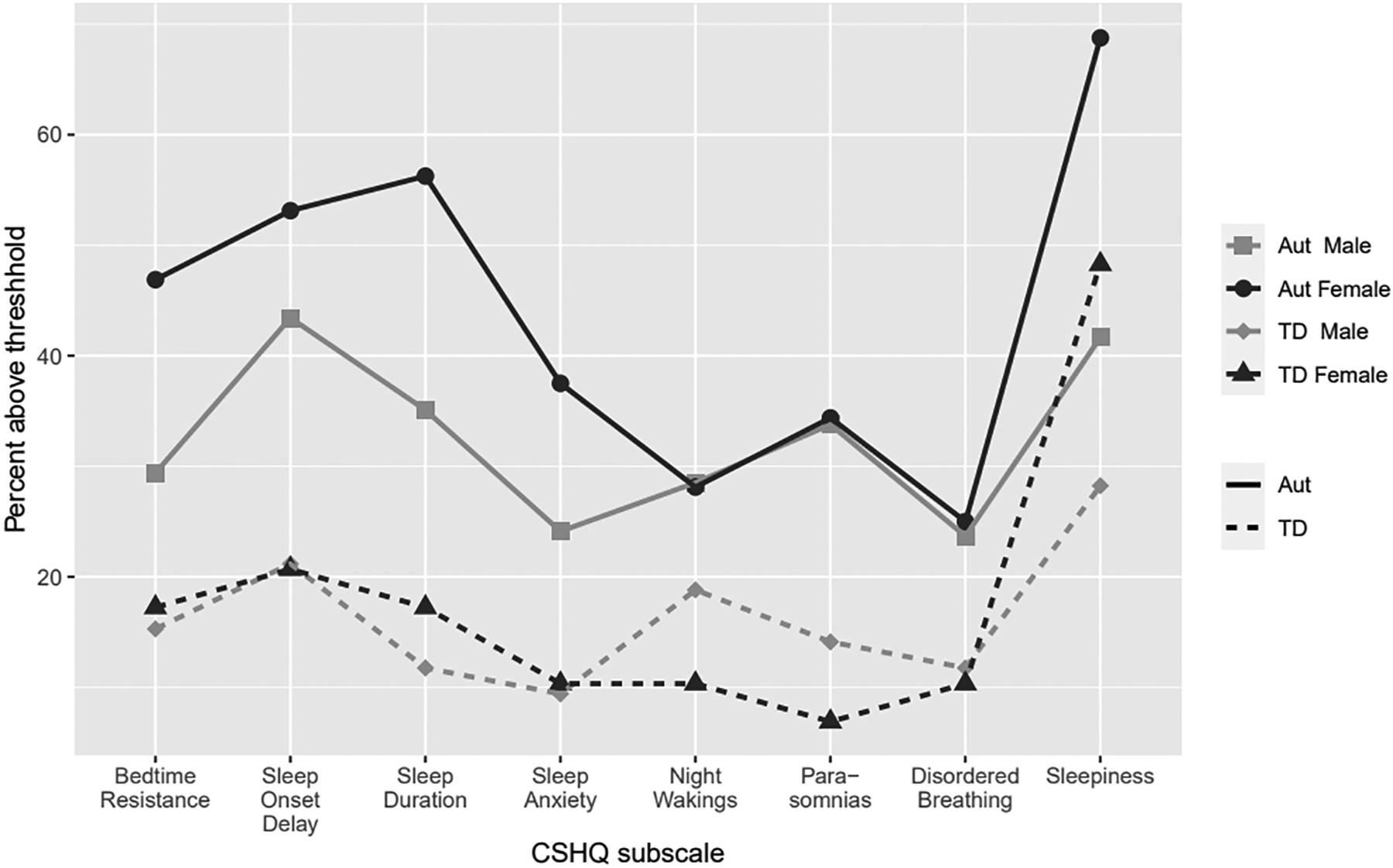
Clinically significant sleep problems affect up to 86% of the autistic population in school-age. Sleep problems can have negative impacts on child cognition, behavior, and health. However, sex differences in the prevalence and types of sleep problems are not well understood in autism. To evaluate sex differences in sleep problems in the school-age autistic population, we obtained parent-report of sleep problems on the Children's Sleep Habits Questionnaire and conducted direct assessments to establish diagnosis and intellectual ability in 6-12-year-old children (autism n = 250; typical development [TD] n = 114). Almost 85% of autistic females demonstrated sleep problems compared to 65.8% of autistic males, 44.8% of TD females, and 42.4% of TD males; a statistically significant increase for autistic females. Autistic females demonstrated increased bedtime resistance, sleep anxiety, and sleepiness, and decreased sleep duration, but did not differ in sleep onset delay, night wakings, parasomnias, or disordered breathing compared with autistic males. Intellectual ability was not related to increased sleep problems. Higher anxiety scores were associated with more sleep problems for males but not females. In one of the first studies to evaluate sex differences in sleep in the school-age, autistic population, autistic females demonstrated increased sleep problems compared to autistic males, TD females, and TD males. Current autism assessment and intervention practices may benefit from increased attention to sleep problems in autistic school-age females and to anxiety in autistic males to enhance well-being and behavioral and health outcomes.
Keywords: autism; school-age; sex; sleep.
© 2022 International Society for Autism Research and Wiley Periodicals LLC.
Figures
References
-
- Bach V, Telliez F, Leke A, Libert JP. Gender‐related sleep differences in neonates in thermoneutral and cool environments. Journal of Sleep Research, 2000; 9(3), 249–254. - PubMed
-
- Benjamini Y, Hochberg Y. Controlling the false discovery rate: a practical and powerful approach to multiple testing. Journal of the Royal statistical society: series B (Methodological), 1995; 57(1), 289–300.
-
- Bernier R, Golzio C, Xiong B, Stessman HA, Coe BP, Penn O, Witherspoon K, Gerdts J, Baker C, Vulto-van Silfhout AT, Schuurs-Hoeijmakers JH, Fichera M, Bosco P, Buono S, Alberti A, Failla P, Peeters H, Steyaert J, Vissers LELM, Francescatto L, Mefford HC, Rosenfeld JA, Bakken T, O’Roak BJ, Pawlus M, Moon R, Shendure J, Amaral DG, Lein E, Rankin J, Romano C, de Vries BBA, Katsanis N, Eichler EE. Disruptive CHD8 mutations define a subtype of autism early in development. Cell. 2014; 17;158(2):263–276. doi: 10.1016/j.cell.2014.06.017. - DOI - PMC - PubMed
