


The Role of Pain Catastrophizing, Emotional Intelligence, and Pain Intensity in the Quality of Life of Cancer Patients with Chronic Pain
- PMID: 36342590
- PMCID: PMC10390631
- DOI: 10.1007/s10880-022-09921-5
The Role of Pain Catastrophizing, Emotional Intelligence, and Pain Intensity in the Quality of Life of Cancer Patients with Chronic Pain
Abstract
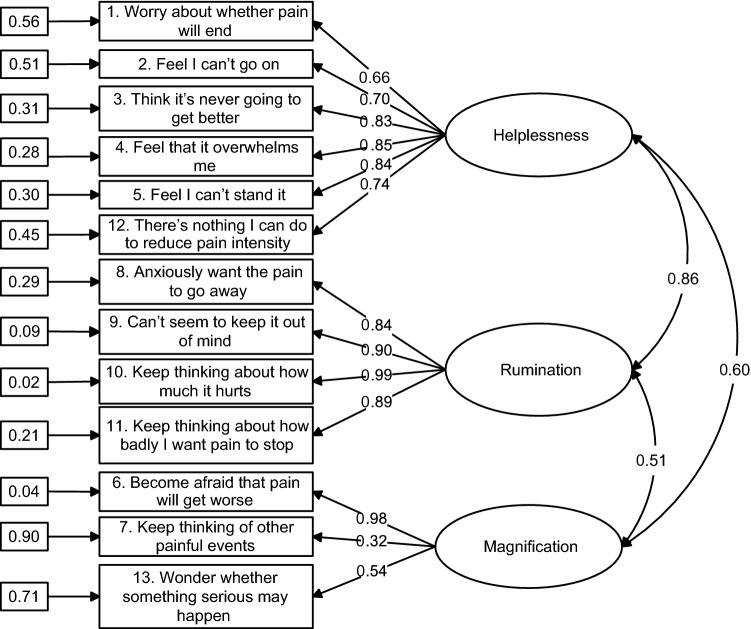
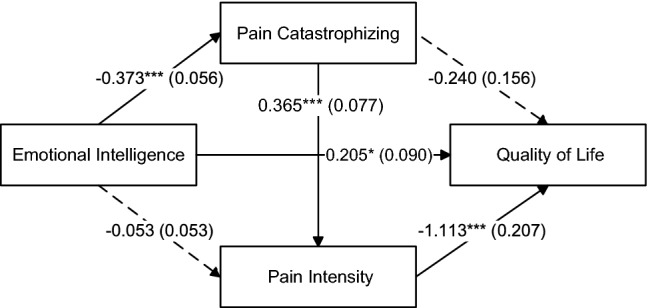
Pain catastrophizing (PC) is a negative cognitive distortion to actual or anticipated pain. This study aims to investigate the relationship between pain catastrophizing, emotional intelligence, pain intensity, and quality of life (QoL) in cancer patients with chronic pain. Eighty-nine outpatients with chronic pain attending pain clinics and palliative care units were recruited. Participants were men (42.7%) and women (57.3%) with an average age of 56.44 years (SD = 14.82). Self-report psychological measures were completed, including a measure of emotional intelligence, a standard measure of PC, a scale assessing pain intensity, and a scale measuring QoL. The PC scale was found to assess three correlated yet different dimensions of pain catastrophizing (helplessness, magnification, and rumination). Moreover, as expected, patients with PC scale scores ≥ 30 had lower scores in functional QoL dimensions and higher scores in the fatigue, pain, and insomnia symptom dimensions. Regression analyses demonstrated that PC (B = - 0.391, p = 0.004), pain intensity (B = - 1.133, p < 0.001), and education (B = 2.915, p = 0.017) remained the only significant variables related to QoL, when controlling for demographic and clinical confounders. Regarding mediating effects, PC and pain intensity were jointly found to be significant mediators in the relationship between emotional intelligence and QoL. Results are discussed in the context of the clinical implications regarding interventions designed to improve cancer patients' quality of life and offer new insight, understanding, and evaluation targets in the field of pain management.
Keywords: Cancer patients; Chronic pain; Emotional intelligence; Pain catastrophizing; Quality of life.
© 2022. The Author(s).
Conflict of interest statement
Fotios Anagnostopoulos, Aristi Paraponiari, and Konstantinos Kafetsios have no financial or proprietary interests in any material discussed in this article.
Figures
References
-
- Aaronson NK, Ahmedzai S, Bergman B, Bullinger M, Cull A, Duez NJ, Filiberti A, Flechtner H, Fleishman SB, de Haes JC, Kaasa S, Klee M, Osoba D, Razavi D, Rofe PB, Schraub S, Sneeuw K, Sullivan M, Takeda F. The European Organization for research and treatment of cancer QLQ-C30: A quality-of-life instrument for use in international clinical trials in oncology. Journal of the National Cancer Institute. 1993;85:365–376. doi: 10.1093/jnci/85.5.365. - DOI - PubMed
-
- Bandalos DL. Relative performance of categorical diagonally weighted least squares and robust maximum likelihood estimation. Structural Equation Modeling. 2014;21:102–116. doi: 10.1080/10705511.2014.859510. - DOI
MeSH terms
LinkOut - more resources
Full Text Sources
Medical