


Effect of early progressive mobilization on intensive care unit-acquired weakness in mechanically ventilated patients: An observational study
- PMID: 36343079
- PMCID: PMC9646566
- DOI: 10.1097/MD.0000000000031528
Effect of early progressive mobilization on intensive care unit-acquired weakness in mechanically ventilated patients: An observational study
Abstract
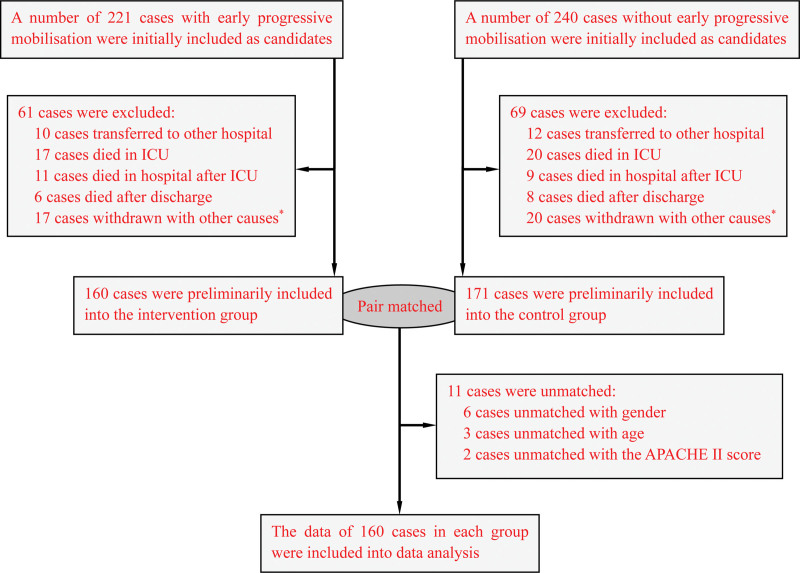
Early progressive mobilization is usually considered as an effective method for intensive care unit-acquired weakness (ICU-AW), but the controversies on this topic remain debatable, especially in initiation time, safety profile, and other implementation details. So, more studies should be performed to solve these disputes. A set of critically ill patients underwent mechanical ventilation in intensive care unit (ICU) of our hospital from March 2018 to September 2020 were included as study object. Patients received early progressive mobilization were included into the intervention group (n = 160), and another patients matched with the intervention group by gender, age, and APACHE II score, and these patients received routine intervention were included into the control group (n = 160). Then, indexes involving muscle strength, Barthel index, functional independence, incidence rates of ICU-AW and other complications were comparatively analyzed between the 2 groups. The Medical Research Council score and Barthel index score in the intervention group were significantly higher than those in the control group (all P < .05). The percentages of patients who were able to complete taking a shower, wearing clothes, eating, grooming, moving from bed to chair and using the toilet by alone in the intervention group were significantly higher than those in the control group (69.38% vs 49.38%, 73.13% vs 51.88%, 81.25% vs 55.63%, 74.38% vs 48.75%, 82.50% vs 65.63%, 78.13% vs 63.13%, respectively, all P < .05). The incidence rate of ICU-AW and overall incidence rate of complications in the intervention group were significantly lower than those in the control group (6.88% vs 28.13% and 23.13% vs 48.13%, both P < .05). Early progressive mobilization can effectively increase muscle strength and daily basic motion ability, improve functional status, and decrease risk of ICU-AW in critically ill patients underwent mechanical ventilation, and it has an attractive application value in clinic.
Copyright © 2022 the Author(s). Published by Wolters Kluwer Health, Inc.
Conflict of interest statement
The authors have no funding and conflicts of interest to disclose.
Figures
References
-
- Kramer CL. Intensive care unit-acquired weakness. Neurol Clin. 2017;35:723–36. - PubMed
-
- Sidiras G, Patsaki I, Karatzanos E, et al. . Long term follow-up of quality of life and functional ability in patients with ICU acquired Weakness - a post hoc analysis. J Crit Care. 2019;53:223–30. - PubMed
-
- Sun Y, Zhang J. A review of preventing ICU-acquired weakness in mechanically ventilated critical patients. Chin Nurs Manag. 2016;16:247–50.
-
- Veldema J, Bösl K, Kugler P, et al. . Cycle ergometer training vs resistance training in ICU-acquired weakness. Acta Neurol Scand. 2019;140:62–71. - PubMed
Publication types
MeSH terms
LinkOut - more resources
Full Text Sources
