


Prognosis of resected invasive mucinous adenocarcinoma compared with the IASLC histologic grading system for invasive nonmucinous adenocarcinoma: Surgical database study in the TKIs era in Korea
- PMID: 36345148
- PMCID: PMC9715870
- DOI: 10.1111/1759-7714.14687
Prognosis of resected invasive mucinous adenocarcinoma compared with the IASLC histologic grading system for invasive nonmucinous adenocarcinoma: Surgical database study in the TKIs era in Korea
Abstract
Background: The prognosis of invasive mucinous adenocarcinoma (IMA) remains controversial and should be clarified by comparison with the International Association for the Study of Lung Cancer (IASLC) histologic grading system for invasive nonmucinous adenocarcinoma (INMA).
Methods: This study included patients with IMA who underwent curative resection. Their clinicopathological outcomes were compared with those of patients with INMA. Propensity score matching was performed to compare the prognosis of IMA with IASLC grade 2 or 3. Kaplan-Meier survival curves and log-rank tests were used to analyze recurrence-free survival (RFS) and overall survival (OS).
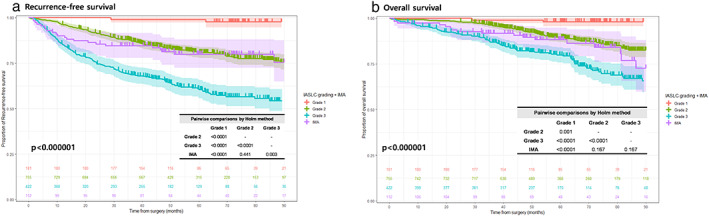
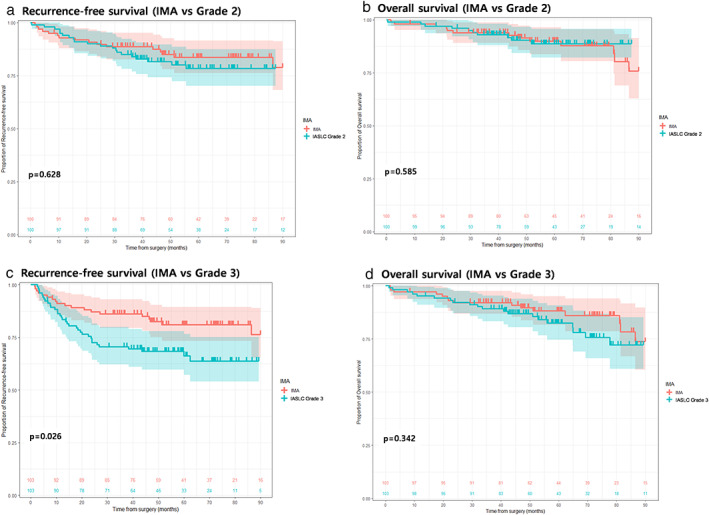
Results: The prognoses of IMA and IASLC grade 2 were similar in terms of RFS and OS. Although patients with IMA had better RFS than patients with IASLC grade 3, the OS was not significantly different. After propensity score matching, IMA demonstrated similar RFS to IASLC grade 2 but superior to IASLC grade 3; there was no difference in the OS compared with grades 2/3. Multivariate analysis revealed that tumor size (hazard ratio [HR] = 1.20, p = 0.028), lymphovascular invasion (HR = 127.5, p = 0.003), and maximum standardized uptake value (HR = 1.24, p = 0.005) were poor prognostic predictors for RFS. Patients with IMA demonstrated RFS similar to and significantly better than that of patients with IASLC grades 2 and 3, respectively. For OS, IMA prognosis was between that of IASLC grades 2 and 3.
Conclusions: Since the prognosis of IMA among lung adenocarcinomas appears to be relatively worse, further clinical studies investigating IMA-specific treatment and follow-up plans are necessary to draw more inferences.
Keywords: classification; lung adenocarcinoma; mucinous adenocarcinoma; pathologic subtype; prognosis.
© 2022 The Authors. Thoracic Cancer published by China Lung Oncology Group and John Wiley & Sons Australia, Ltd.
Conflict of interest statement
The authors disclose no financial or nonfinancial conflicts of interest, including funding, provision of study materials, medical writing, or article processing charges. This research did not receive grants from funding agencies in the public, commercial, or not‐for‐profit sectors.
Figures
References
-
- Travis WD, Brambilla E, Burke AP, Marx A, Nicholson AG. Introduction to the 2015 World Health Organization classification of tumors of the lung, pleura, thymus, and heart. J Thorac Oncol. 2015;10(9):1240–2. - PubMed
-
- Saito T, Tsuta K, Honda O, Ishida M, Yamaka R, Tanaka N, et al. Prognostic impact of mucin spread, tumor cell spread, and invasive size in invasive mucinous adenocarcinoma of the lung. Lung Cancer. 2020;146:50–7. - PubMed
-
- Travis WD, Brambilla E, Noguchi M, Nicholson AG, Geisinger KR, Yatabe Y, et al. International association for the study of lung cancer/american thoracic society/european respiratory society international multidisciplinary classification of lung adenocarcinoma. J Thorac Oncol. 2011;6(2):244–85. - PMC - PubMed
-
- Travis WD, Brambilla E, Nicholson AG, Yatabe Y, Austin JHM, Beasley MB, et al. The 2015 World Health Organization classification of lung tumors: impact of genetic, clinical and radiologic advances since the 2004 classification. J Thorac Oncol. 2015;10(9):1243–60. - PubMed
MeSH terms
LinkOut - more resources
Full Text Sources
Medical
