


The positive energy of netizens: development and application of fine-grained sentiment lexicon and emotional intensity model
- PMID: 36345548
- PMCID: PMC9630060
- DOI: 10.1007/s12144-022-03876-4
The positive energy of netizens: development and application of fine-grained sentiment lexicon and emotional intensity model
Abstract
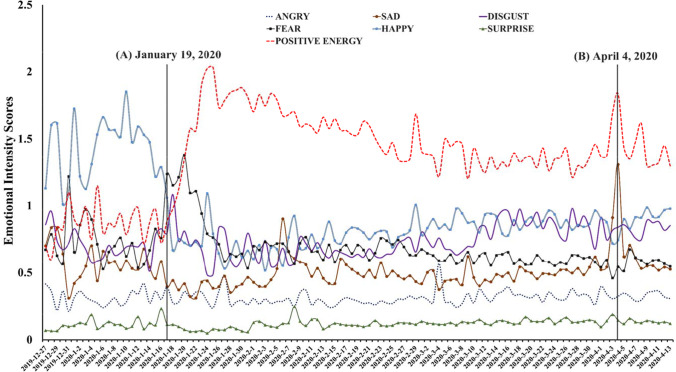
The outbreak of COVID-19 has led to a global health crisis and caused huge emotional swings. However, the positive emotional expressions, like self-confidence, optimism, and praise, that appear in Chinese social networks are rarely explored by researchers. This study aims to analyze the characteristics of netizens' positive energy expressions and the impact of node events on public emotional expression during the COVID-19 pandemic. First, a total of 6,525,249 Chinese texts posted by Sina Weibo users were randomly selected through textual data cleaning and word segmentation for corpus construction. A fine-grained sentiment lexicon that contained POSITIVE ENERGY was built using Word2Vec technology; this lexicon was later used to conduct sentiment category analysis on original posts. Next, through manual labeling and multi-classification machine learning model construction, four mainstream machine learning algorithms were selected to train the emotional intensity model. Finally, the lexicon and optimized emotional intensity model were used to analyze the emotional expressions of Chinese netizens. The results show that POSITIVE ENERGY expression accounted for 40.97% during the COVID-19 pandemic. Over the course of time, POSITIVE ENERGY emotions were displayed at the highest levels and SURPRISES the lowest. The analysis results of the node events showed after the outbreak was confirmed officially, the expressions of POSITIVE ENERGY and FEAR increased simultaneously. After the initial victory in pandemic prevention and control, the expression of POSITIVE ENERGY and SAD reached a peak, while the increase of SAD was the most prominent. The fine-grained sentiment lexicon, which includes a POSITIVE ENERGY category, demonstrated reliable algorithm performance and can be used for sentiment classification of Chinese Internet context. We also found many POSITIVE ENERGY expressions in Chinese online social platforms which are proven to be significantly affected by nod events of different nature.
Keywords: COVID-19 pandemic; Fine-grained sentiment lexicon; Positive energy; Social media analysis.
© The Author(s), under exclusive licence to Springer Science+Business Media, LLC, part of Springer Nature 2022, Springer Nature or its licensor (e.g. a society or other partner) holds exclusive rights to this article under a publishing agreement with the author(s) or other rightsholder(s); author self-archiving of the accepted manuscript version of this article is solely governed by the terms of such publishing agreement and applicable law.
Conflict of interest statement
Conflict of interestThe authors declare that the research was conducted in the absence of any commercial or financial relationships that could be construed as a potential conflict of interest.
Figures
References
-
- Aslam F, Awan TM, Syed JH, Kashif A, Parveen M. Sentiments and emotions evoked by news headlines of coronavirus disease (COVID-19) outbreak. Humanities and Social Sciences Communications. 2020;7(1):23. doi: 10.1057/s41599-020-0523-3. - DOI
-
- An L, Zhou W, Ou M, Li G, Yu C, Wang X. Measuring and profiling the topical influence and sentiment contagion of public event stakeholders. International Journal of Information Management. 2021;58:102327. doi: 10.1016/j.ijinfomgt.2021.102327. - DOI
-
- Bai, X., Chen, F., & Zhan, S. (2014). A study on sentiment computing and classification of Sina Weibo with Word2vec. In Poster at the 2014th IEEE International Congress on Big Data. 10.1109/BigData.Congress.2014.59
-
- Bandhakavi A, Wiratunga N, Massie S, P D. Emotion-aware polarity lexicons for Twitter sentiment analysis. Expert Systems. 2021;38(7):e12332. doi: 10.1111/exsy.12332. - DOI
-
- Barbalet, J. M. (1998). Emotion, social theory, and social structure: A macrosociological approach. Cambridge University Press. 10.1017/CBO9780511488740
LinkOut - more resources
Full Text Sources