


Nutrition in school-age children: a rationale for revisiting priorities
- PMID: 36346900
- PMCID: PMC10251301
- DOI: 10.1093/nutrit/nuac089
Nutrition in school-age children: a rationale for revisiting priorities
Abstract
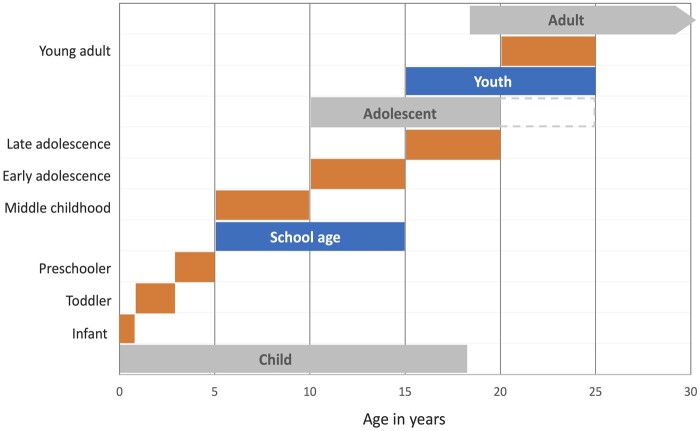
Middle childhood and early adolescence have received disproportionately low levels of scientific attention relative to other life stages, especially as related to nutrition and health. This is partly due to the justified emphasis on the first 1000 days of life, and the idea that early deficits and consequences may not be fully reversible. In addition, these stages of life may superficially appear less "eventful" than infancy or late adolescence. Finally, there has been historical ambiguity and inconsistency in terminology, depending on whether viewing "childhood" through physiologic, social, legal, or other lenses. Nevertheless, this age bracket, which encompasses most of the primary education and basic schooling years for most individuals, is marked by significant changes, inflection points, and sexually driven divergence in somatic and brain growth and development trajectories. These constitute transformative changes, and thus middle childhood and early adolescence represents a major and last opportunity to influence long-term health and productivity. This review highlights the specificities of growth and development in school age, with a focus on middle childhood and early adolescence (5 years-15 years of age, for the purposes of this review), the role of nutrition, the short- and long-term consequences of inadequate nutrition, and the current global status of nutrition in this age group. Adequate attention and emphasis on nutrition in the school-age years is critical: (a) for maintaining an adequate course of somatic and cognitive development, (b) for taking advantage of this last major opportunity to correct deficits of undernutrition and "catch-up" to normal life course development, and (c) for addressing the nutritional inadequacies and mitigating the longer-term consequences of overnutrition. This review summarizes and provides a rationale for prioritizing nutrition in school-age children, and for the need to revisit priorities and focus on this part of the life cycle to maximize individuals' potential and their contribution to society.
Keywords: adolescence; children; growth; malnutrition; middle childhood; nutrition; obesity; school age; stunting.
© The Author(s) 2022. Published by Oxford University Press on behalf of the International Life Sciences Institute.
Figures


References
-
- Bundy DAP, Silva ND, Horton AP, et al. Child and adolescent health and development: realizing neglected potential. In: Bundy DAP, Silva ND, Horton S, Jamison DT, Patton GC, eds. Child and Adolescent Health and Development. 3rd ed. Washington, DC: The International Bank for Reconstruction and Development/the World Bank; 2017:. 1–23. - PubMed
-
- Best C, Neufingerl N, van Geel L, et al. The nutritional status of school-aged children: why should we care? Food Nutr Bull. 2010;31:400–417. - PubMed
-
- Akseer N, Al-Gashm S, Mehta S, et al. Global and regional trends in the nutritional status of young people: a critical and neglected age group [published correction appears in Ann N Y Acad Sci. 2017;1396(1):236]. Ann NY Acad Sci. 2017;1393:3–20. - PubMed
-
- Georgiadis A, Penny ME.. Child undernutrition: opportunities beyond the first 1000 days. Lancet Public Health. 2017;2:e399. - PubMed
Publication types
MeSH terms
Grants and funding
LinkOut - more resources
Full Text Sources
Medical
