


Trends in Intensive Care Admissions and Outcomes of Stroke Patients Over 10 Years in Brazil: Impact of the COVID-19 Pandemic
- PMID: 36347322
- PMCID: PMC9636603
- DOI: 10.1016/j.chest.2022.10.033
Trends in Intensive Care Admissions and Outcomes of Stroke Patients Over 10 Years in Brazil: Impact of the COVID-19 Pandemic
Abstract
Background: The coronavirus 2019 (COVID-19) pandemic affected stroke care worldwide. Data from low- and middle-income countries are limited.
Research question: What was the impact of the pandemic in ICU admissions and outcomes of patients with stroke, in comparison with trends over the last 10 years?
Study design and methods: Retrospective cohort study including prospectively collected data from 165 ICUs in Brazil between 2011 and 2020. We analyzed clinical characteristics and mortality over a period of 10 years and evaluated the impact of the pandemic on stroke outcomes, using the following approach: analyses of admissions for ischemic and hemorrhagic strokes and trends in in-hospital mortality over 10 years; analysis of variable life-adjusted display (VLAD) during 2020; and a mixed-effects multivariable logistic regression model.
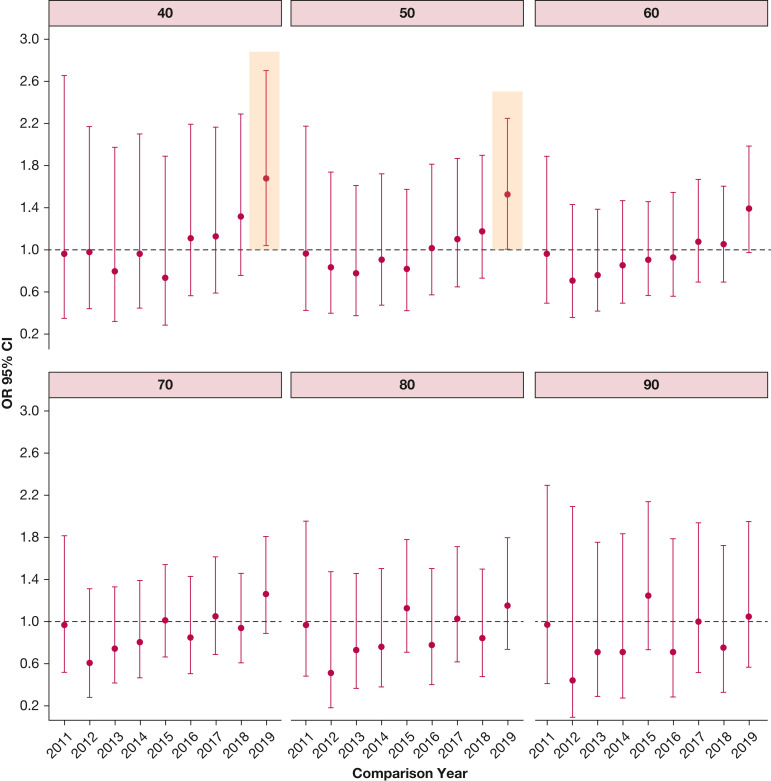
Results: A total of 17,115 stroke admissions were analyzed, from which 13,634 were ischemic and 3,481 were hemorrhagic. In-hospital mortality was lower after ischemic stroke as compared with hemorrhagic (9% vs 24%, respectively). Changes in VLAD across epidemiological weeks of 2020 showed that the rise in COVID-19 cases was accompanied by increased mortality, mainly after ischemic stroke. In logistic regression mixed models, mortality was higher in 2020 compared with 2019, 2018, and 2017 in patients with ischemic stroke, namely, in those without altered mental status. In hemorrhagic stroke, the increased mortality in 2020 was observed in patients 50 years of age or younger, as compared with 2019.
Interpretation: Hospital outcomes of stroke admissions worsened during the COVID-19 pandemic, interrupting a trend of improvements in survival rates over 10 years. This effect was more pronounced during the surge of COVID-19 ICU admissions affecting predominantly patients with ischemic stroke without coma, and young patients with hemorrhagic stroke.
Keywords: COVID-19 pandemic; coronavirus 2019; hemorrhagic; ischemic; outcomes; stroke.
Copyright © 2022 American College of Chest Physicians. Published by Elsevier Inc. All rights reserved.
Figures



Comment in
-
Stroke Is an Emergency, Even During a Pandemic.Chest. 2023 Mar;163(3):471-472. doi: 10.1016/j.chest.2022.11.017. Chest. 2023. PMID: 36894255 Free PMC article. No abstract available.
References
Publication types
MeSH terms
LinkOut - more resources
Full Text Sources
Medical
