Ethics of the algorithmic prediction of goal of care preferences: from theory to practice
- PMID: 36347603
- PMCID: PMC9985740
- DOI: 10.1136/jme-2022-108371
Ethics of the algorithmic prediction of goal of care preferences: from theory to practice
Abstract
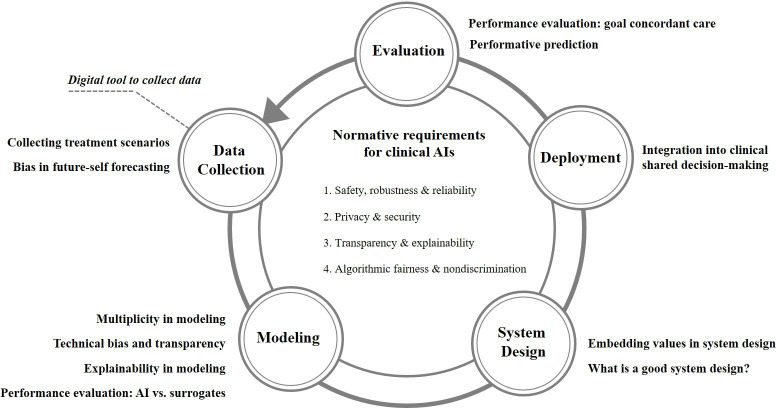
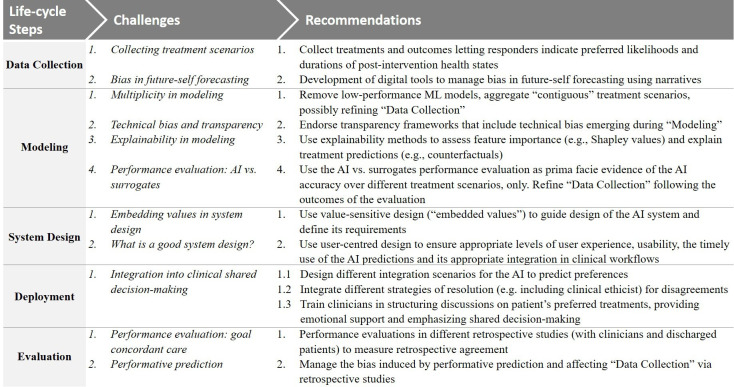
Artificial intelligence (AI) systems are quickly gaining ground in healthcare and clinical decision-making. However, it is still unclear in what way AI can or should support decision-making that is based on incapacitated patients' values and goals of care, which often requires input from clinicians and loved ones. Although the use of algorithms to predict patients' most likely preferred treatment has been discussed in the medical ethics literature, no example has been realised in clinical practice. This is due, arguably, to the lack of a structured approach to the epistemological, ethical and pragmatic challenges arising from the design and use of such algorithms. The present paper offers a new perspective on the problem by suggesting that preference predicting AIs be viewed as sociotechnical systems with distinctive life-cycles. We explore how both known and novel challenges map onto the different stages of development, highlighting interdisciplinary strategies for their resolution.
Keywords: Advance Directives; Clinical Ethics; Decision-making; Ethics; Ethics- Medical.
© Author(s) (or their employer(s)) 2023. Re-use permitted under CC BY-NC. No commercial re-use. See rights and permissions. Published by BMJ.
Conflict of interest statement
Competing interests: None declared.
Figures
Comment in
-
What you believe you want, may not be what the algorithm knows.J Med Ethics. 2023 Mar;49(3):177-178. doi: 10.1136/jme-2022-108778. Epub 2023 Jan 10. J Med Ethics. 2023. PMID: 36627199 No abstract available.
-
For the sake of multifacetedness. Why artificial intelligence patient preference prediction systems shouldn't be for next of kin.J Med Ethics. 2023 Mar;49(3):175-176. doi: 10.1136/jme-2022-108775. Epub 2023 Jan 10. J Med Ethics. 2023. PMID: 36627200 No abstract available.
-
Artificial Intelligence algorithms cannot recommend a best interests decision but could help by improving prognostication.J Med Ethics. 2023 Mar;49(3):179-180. doi: 10.1136/jme-2022-108880. Epub 2023 Jan 11. J Med Ethics. 2023. PMID: 36631246 No abstract available.
-
Artificial intelligence paternalism.J Med Ethics. 2023 Mar;49(3):183-184. doi: 10.1136/jme-2022-108768. Epub 2023 Jan 20. J Med Ethics. 2023. PMID: 36669883 No abstract available.
-
AI knows best? Avoiding the traps of paternalism and other pitfalls of AI-based patient preference prediction.J Med Ethics. 2023 Mar;49(3):185-186. doi: 10.1136/jme-2023-108945. Epub 2023 Feb 14. J Med Ethics. 2023. PMID: 36788037 No abstract available.
References
MeSH terms
LinkOut - more resources
Full Text Sources