. 2023 Feb;14(1):142-156.
doi: 10.1002/jcsm.13115. Epub 2022 Nov 9.

Consensus guidelines for sarcopenia prevention, diagnosis and management in Australia and New Zealand

Affiliations

Consensus guidelines for sarcopenia prevention, diagnosis and management in Australia and New Zealand

Jesse Zanker et al. J Cachexia Sarcopenia Muscle. 2023 Feb.

Abstract

Background: Sarcopenia is an age-associated skeletal muscle condition characterized by low muscle mass, strength, and physical performance. There is no international consensus on a sarcopenia definition and no contemporaneous clinical and research guidelines specific to Australia and New Zealand. The Australian and New Zealand Society for Sarcopenia and Frailty Research (ANZSSFR) Sarcopenia Diagnosis and Management Task Force aimed to develop consensus guidelines for sarcopenia prevention, assessment, management and research, informed by evidence, consumer opinion, and expert consensus, for use by health professionals and researchers in Australia and New Zealand.

Methods: A four-phase modified Delphi process involving topic experts and informed by consumers, was undertaken between July 2020 and August 2021. Phase 1 involved a structured meeting of 29 Task Force members and a systematic literature search from which the Phase 2 online survey was developed (Qualtrics). Topic experts responded to 18 statements, using 11-point Likert scales with agreement threshold set a priori at >80%, and five multiple-choice questions. Statements with moderate agreement (70%-80%) were revised and re-introduced in Phase 3, and statements with low agreement (<70%) were rejected. In Phase 3, topic experts responded to six revised statements and three additional questions, incorporating results from a parallel Consumer Expert Delphi study. Phase 4 involved finalization of consensus statements.

Results: Topic experts from Australia (n = 62, 92.5%) and New Zealand (n = 5, 7.5%) with a mean ± SD age of 45.7 ± 11.8 years participated in Phase 2; 38 (56.7%) were women, 38 (56.7%) were health professionals and 27 (40.3%) were researchers/academics. In Phase 2, 15 of 18 (83.3%) statements on sarcopenia prevention, screening, assessment, management and future research were accepted with strong agreement. The strongest agreement related to encouraging a healthy lifestyle (100%) and offering tailored resistance training to people with sarcopenia (92.5%). Forty-seven experts participated in Phase 3; 5/6 (83.3%) revised statements on prevention, assessment and management were accepted with strong agreement. A majority of experts (87.9%) preferred the revised European Working Group for Sarcopenia in Older Persons (EWGSOP2) definition. Seventeen statements with strong agreement (>80%) were confirmed by the Task Force in Phase 4.

Conclusions: The ANZSSFR Task Force present 17 sarcopenia management and research recommendations for use by health professionals and researchers which includes the recommendation to adopt the EWGSOP2 sarcopenia definition in Australia and New Zealand. This rigorous Delphi process that combined evidence, consumer expert opinion and topic expert consensus can inform similar initiatives in countries/regions lacking consensus on sarcopenia.

Keywords: Aged; Geriatric assessment; Mass screening; Sarcopenia.


Conflict of interest statement

ABM has received speaker and consulting fees from Abbott, Nutricia, AstraZeneca, Novartis. GD is a member of the Scientific Advisory Board of TSI, Abbott and Amgen and has received speaker/consulting fees from Amgen, Abbott and TSI. MG has received research funding from Bayer Pharma, Novartis, Weight Watchers, Lilly, Otsuka and speaker's honoraria from Bayer Pharma, Besins Healthcare, and Amgen. RMD reports a grant form Fonterra Co‐operative Group Ltd, honoraria for presentations from Abbott Australia and Nutricia Research and to serve as a member of an expert advisory committee. RV has previously received education and honorarium from the following Abbott, Nestle and Nutricia. SI has received speaker/consulting fees from Abbott, UK Dairy Council, European Milk Forum, Nestle Health Science and the Israel Milk Board.

Figures
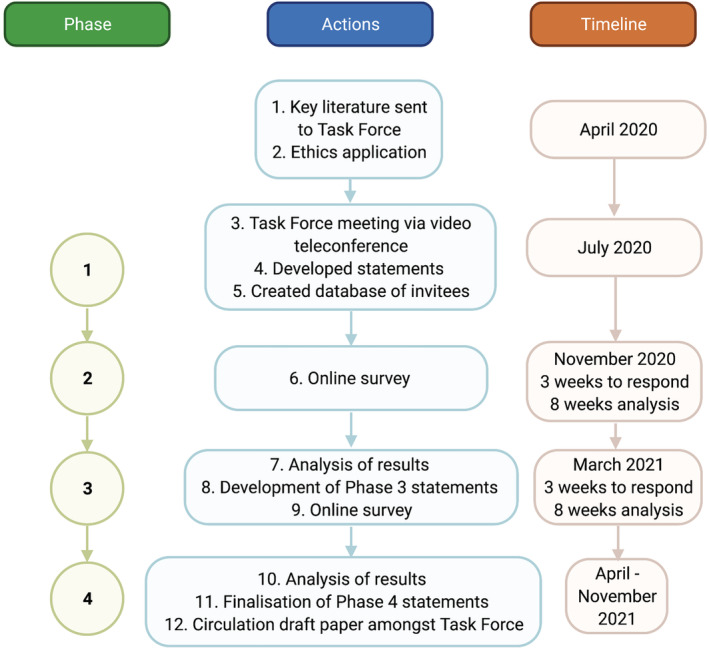
Figure 1
Figure 1
Flow chart of Topic Expert Delphi. Preceding Phase 1, a systematic literature search was undertaken to develop a Supplement of key literature. Phase 1 was a videoconference meeting of the Task Force, including presentations from Task Force members on sarcopenia definition progress and history of the Delphi method. Statements were debated and re‐drafted, and a decision to incorporate consumer feedback through a parallel Consumer Expert Delphi was made. Phase 2 involved a presentation at an ANZSSFR educational event (D. S.), including invitation and promotion of the Delphi study. Those who expressed interest and consented to the study were invited by email link to participate in the Topic Expert Delphi survey. The Phase 3 online survey was developed in response to the results and analysis from both Topic Expert and Consumer Expert Delphi studies in Phase 2. Phase 4 involved analysis of Phase 3 results and the finalization of statements among task force members.
Figure 2
Figure 2
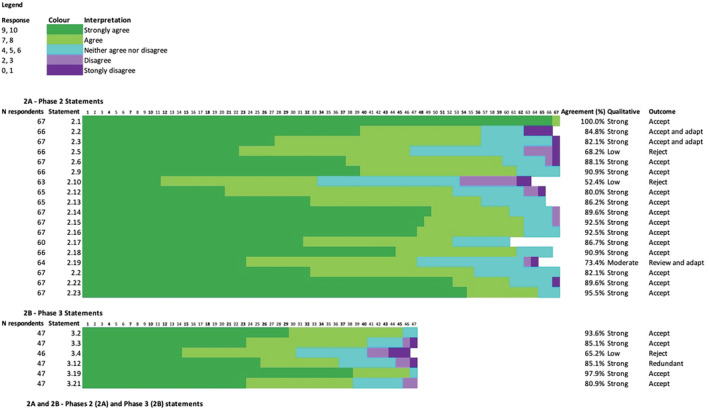
Phases 2 (A) and Phase 3 (B) statements. Graphical representation of level of agreement with each statement in Phases 2 and 3. Strong agreement: >80% respondents answering ≥7 or ≤3; moderate agreement: 70% to 80%; low agreement: <70%. ‘Legend; response’ describes the number out of 10 the respondent selected and the colour this response is represented by in each row. Note that all sequential numbers (2.1 to 2.23 and 3.2 to 3.21) are not present due to questions being imbedded in the survey represented by numbers not contained in Figure 2A,B. Non‐responses to particular questions were not included in calculation of agreement. ‘Redundant’ refers to a statement that while accepted, was included in the case that a definition of sarcopenia did not reach agreement—see 3.12 below. ‘*’ denotes rejected statements. Statements: 2.1: A healthy lifestyle, including balanced diet, adequate protein intake, and regular exercise should be encouraged in adults of all ages; 2.2: Person‐centred physical and dietary interventions, developed with an accredited healthcare professional (or degreed, NZ), are recommended for those with health conditions or states, such as frailty, likely to increase the risk of sarcopenia in adults; 2.3: Adults aged 65 years and older, Aboriginal, Torres Strait Islander, Pacific Islander and Maori Elders aged 55 years and older, or those with conditions or circumstances that may increase the risk of sarcopenia at a younger age, should be screened for sarcopenia annually or after the occurrence of a major health event; 2.5*: Application of diagnostic criteria for sarcopenia should be used instead of any screening tool, where the required equipment and expertise for diagnosis is available, in those meeting the criteria in statement 3; 2.6: Adults screened as positive for possible sarcopenia should be assessed by an accredited health professional (or degreed, NZ) for further assessment to confirm sarcopenia; 2.9: Low muscle mass is an important feature of sarcopenia; 2.10*: DXA should be used to determine low lean mass when diagnosing sarcopenia; 2.12: In the absence of equipment required for sarcopenia diagnosis, or when physical limitations (e.g., hand arthritis) preclude some active testing, the presence of muscle weakness or slowness (low usual gait speed) makes sarcopenia probable; 2.13: Cultural, ethnic and physical ability differences for normal and low muscle strength, physical performance and body composition measures should be considered in the application of diagnostic cut‐points for sarcopenia; 2.14: Accredited healthcare professionals (or degreed, NZ) should provide an accessible explanation of sarcopenia, including provision of informative material, to those diagnosed with sarcopenia to support engagement in self‐determined health behaviours; 2.15: All persons with sarcopenia should be offered resistance‐based training by an accredited healthcare professional (or degreed, NZ), tailored to the individuals' abilities and preferences; 2.16: All adults with sarcopenia should be screened/assessed for malnutrition using validated tools; 2.17: Total protein intake of 1–1.5 g/kg/day should be considered for older adults with sarcopenia, excepting those with significant kidney disease defined by an eGFR of <30 mL/min/1.73 m2; 2.18: Clinicians should consider referring persons with sarcopenia to a dietitian for the development of a dietary and protein optimization plan; 2.19: Optimization of dietary and protein intake may only be beneficial for persons with sarcopenia when combined with a physical activity intervention, such as resistance exercise; 2.20: Persons with sarcopenia should be assessed at least annually following diagnosis, with additional assessment following any major health event; 2.22: The standardization of a sarcopenia definition and cut‐points for diagnosis and management is recommended across Australia and New Zealand; 2.23: Local and international collaborations, laboratory‐based studies, registries, randomized controlled trials and translational studies are recommended to improve management of and outcomes for people living with sarcopenia and translation of evidence into clinical practice; 3.2: Person‐centred physical and dietary interventions, developed with an accredited healthcare professional (or degreed, NZ), are recommended for adults with health conditions known as likely to increase the risk of sarcopenia, such as frailty; 3.3: Provided that adequate resources and training are available and assessment is acceptable to the individual, adults at risk of sarcopenia should be assessed for sarcopenia annually or after the occurrence of a the risk of major health event sarcopenia in adults; 3.4*: SARC‐F, with or without calf circumference measurement, is the preferred screening tool for sarcopenia in Australia and New Zealand; 3.12: The ANZSSFR supports the use of either the revised EWGSOP2 definition, the SDOC definition, or if appropriate based on patient characteristics, the revised AWGS definition. Clinicians and researchers should clearly document the definition applied and aim for consistent application across their organization(s); 3.19: Optimization of energy and protein intake is likely to be beneficial for all persons with sarcopenia, but benefits may be greatest when combined with a physical activity intervention, such as resistance exercise; 3.21: The ANZSSFR recommends clinicians undertake a consultation of 30–60 min duration with persons with or at risk of sarcopenia, which would include assessments described by the BASIC (Basic Assessment Sarcopenia Items for Completion).
Figure 3
Figure 3
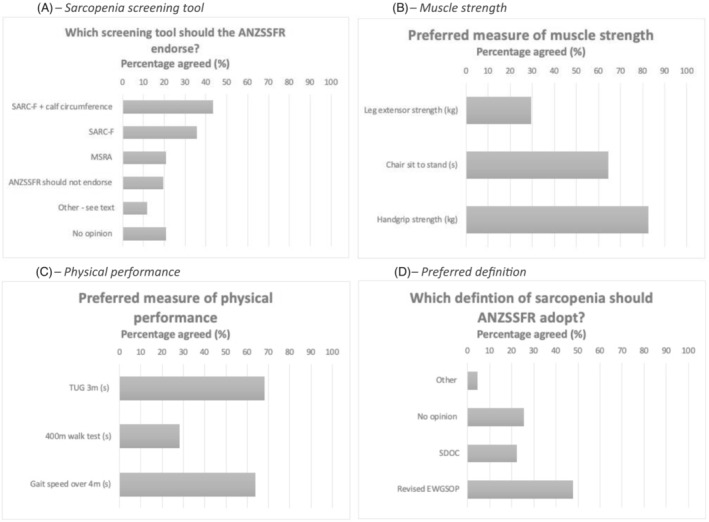
(A–D) Phase 2 question results on screening, muscle strength, physical performance, and sarcopenia definition. N = 67 topic experts. (A–C) Topic experts could select more than one response. (D) Topic experts could select only one response. ANZSSFR = Australian and New Zealand Society for Sarcopenia and Frailty Research. SDOC = Sarcopenia Diagnostic and Outcomes Consortium. EWGSOP2 = Revised European Working Group for Sarcopenia in Older Persons. MSRA = Mini Sarcopenia Risk Assessment. TUG = Timed‐Up‐And‐Go test over 3 m.
Figure 4
Figure 4
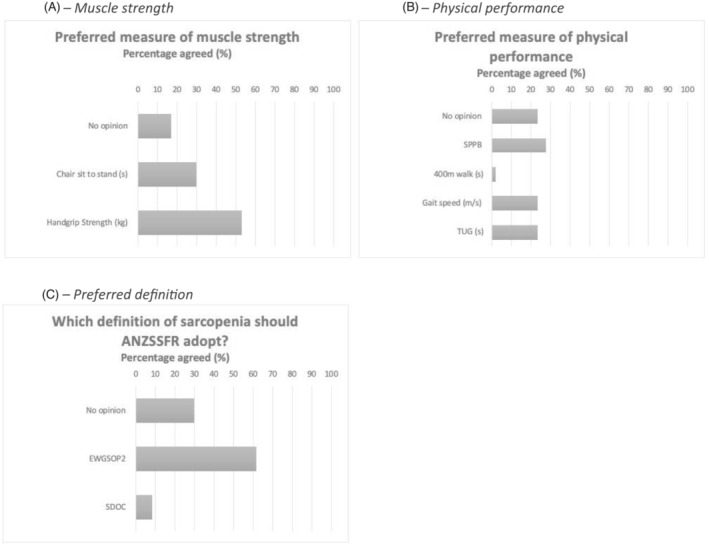
(A–C) Phase 3 question results on screening, muscle strength, physical performance, and sarcopenia definition. n = 47; topic experts could select only one response. ANZSSFR = Australian and New Zealand Society for Sarcopenia and Frailty Research. EWGSOP2 = Revised European Working Group for Sarcopenia in Older Persons. SDOC = Sarcopenia Diagnostic and Outcomes Consortium. SPPB = Short Physical Performance Battery. TUG = Timed‐Up‐And‐Go test over 3 m.
Figure 5
Figure 5
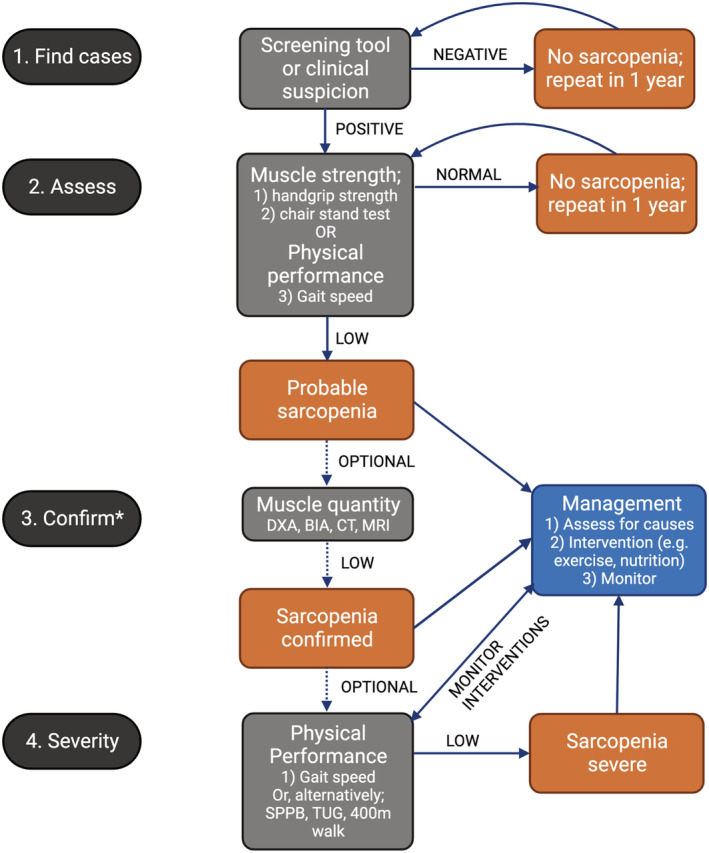
Modified EWGSOP2 diagnostic algorithm based on Delphi findings. *Step ‘3. Confirm’ is an optional step which may be limited by access to imaging resources. BIA = bioelectrical impedance analysis. CT = computed tomography. DXA = dual energy X‐ray absorptiometry. MRI = magnetic resonance imaging. SPPB = Short Physical Performance Battery. TUG = Timed‐Up‐And‐Go test over 3 m. The recommendations for management of sarcopenia do not vary across sarcopenia categories (e.g., probable/confirmed/severe).

References

    1. Cruz‐Jentoft AJ, Bahat G, Bauer J, Boirie Y, Bruyere O, Cederholm T, et al. Sarcopenia: revised European consensus on definition and diagnosis. Age Ageing 2019;48:16–31. - PMC - PubMed
    1. Cruz‐Jentoft AJ, Sayer AA. Sarcopenia. Lancet 2019;393:2636–2646. - PubMed
    1. Dennison EM, Sayer AA, Cooper C. Epidemiology of sarcopenia and insight into possible therapeutic targets. Nat Rev Rheumatol 2017;13:340–347. - PMC - PubMed
    1. Pacifico J, Geerlings MAJ, Reijnierse EM, Phassouliotis C, Lim WK, Maier AB. Prevalence of sarcopenia as a comorbid disease: A systematic review and meta‐analysis. Exp Gerontol 2019;131:110801. - PubMed
    1. Papadopoulou SK, Tsintavis P, Potsaki G, Papandreou D. Differences in the Prevalence of Sarcopenia in Community‐Dwelling, Nursing Home and Hospitalized Individuals. A Systematic Review and Meta‐Analysis. J Nutr Health Aging 2020;24:83–90. - PubMed

Publication types