. 2023 Jan 6;51(D1):D977-D985.
doi: 10.1093/nar/gkac1010.

The NHGRI-EBI GWAS Catalog: knowledgebase and deposition resource

Affiliations

The NHGRI-EBI GWAS Catalog: knowledgebase and deposition resource

Elliot Sollis et al. Nucleic Acids Res. .

Abstract

The NHGRI-EBI GWAS Catalog (www.ebi.ac.uk/gwas) is a FAIR knowledgebase providing detailed, structured, standardised and interoperable genome-wide association study (GWAS) data to >200 000 users per year from academic research, healthcare and industry. The Catalog contains variant-trait associations and supporting metadata for >45 000 published GWAS across >5000 human traits, and >40 000 full P-value summary statistics datasets. Content is curated from publications or acquired via author submission of prepublication summary statistics through a new submission portal and validation tool. GWAS data volume has vastly increased in recent years. We have updated our software to meet this scaling challenge and to enable rapid release of submitted summary statistics. The scope of the repository has expanded to include additional data types of high interest to the community, including sequencing-based GWAS, gene-based analyses and copy number variation analyses. Community outreach has increased the number of shared datasets from under-represented traits, e.g. cancer, and we continue to contribute to awareness of the lack of population diversity in GWAS. Interoperability of the Catalog has been enhanced through links to other resources including the Polygenic Score Catalog and the International Mouse Phenotyping Consortium, refinements to GWAS trait annotation, and the development of a standard format for GWAS data.


Figures

Figure 1.
Figure 1.
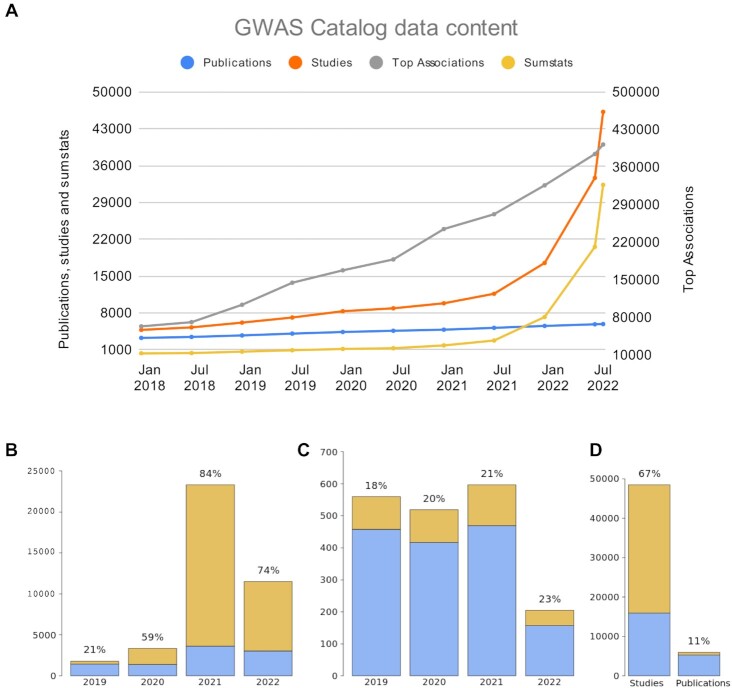
The increase in GWAS Catalog data content since 2018. (A) Cumulative numbers of publications, studies, studies with summary statistics, and associations over the period, by publication year. (B–D) Summary statistics sharing by publication year for (B) GWA studies (C) publications and in the Catalog overall (D).
Figure 2.
Figure 2.
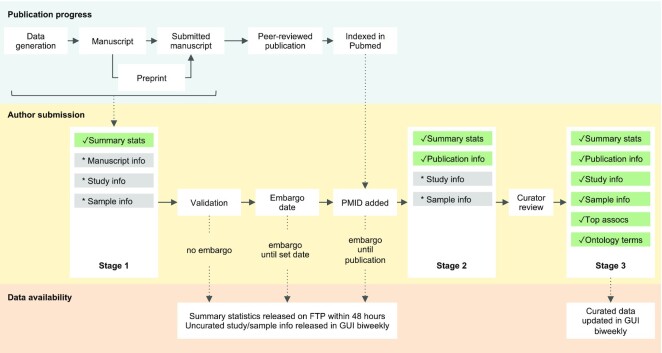
The submission and review process for unpublished data submissions. This workflow covers the majority of submissions to date (74%), and shows the progress from uncurated submitted data (*), to validated/curated data (✓). Authors submit at any point before journal publication, by providing summary statistics and supporting metadata (Stage 1), and receive a persistent identifier for each study. Summary statistics are validated upon submission. Metadata may be made available upon submission, or embargoed by the author until journal publication or a specific date. Final publication details are confirmed once an article is indexed in PubMed (Stage 2). Study and sample information are confirmed and updated after review by a curator, who also adds top associations, ontology annotations and any replication information for each study (Stage 3). Curated data are released biweekly.
Figure 3.
Figure 3.
Example screenshots of study landing pages in the GWAS Catalog GUI. (A) The landing page for an unpublished study shows provisional publication information such as author names, titles and links to preprints [1]; basic study and sample information [2]; and a link to the full summary statistics [3]. (B) The landing page for a published study additionally provides the final journal citation [4], more detailed study and sample information [5], ontology annotations [6] and curated top associations [7].
Figure 4.
Figure 4.
Background trait filter in GUI. When viewing a trait (e.g. hepatitis B virus infection), users can choose whether to display only direct associations with hepatitis B virus infection (left panel, default view), or to additionally display associations with other traits in a background of hepatitis B virus infection (e.g. ‘Liver disease in chronic hepatitis B virus infection’) (right panel). Toggling the filter updates the count of associations and studies for the trait (upper), as well as the plots of associations for the trait across the genome (lower).

References

    1. Buniello A., MacArthur J.A.L., Cerezo M., Harris L.W., Hayhurst J., Malangone C., McMahon A., Morales J., Mountjoy E., Sollis E.et al. .. The NHGRI-EBI GWAS Catalog of published genome-wide association studies, targeted arrays and summary statistics 2019. Nucleic Acids Res. 2019; 47:D1005–D1012. - PMC - PubMed
    1. Cunningham F., Allen J.E., Allen J., Alvarez-Jarreta J., Amode M.R., Armean I.M., Austine-Orimoloye O., Azov A.G., Barnes I., Bennett R.et al. .. Ensembl 2022. Nucleic Acids Res. 2022; 50:D988–D995. - PMC - PubMed
    1. Ramos E.M., Hoffman D., Junkins H.A., Maglott D., Phan L., Sherry S.T., Feolo M., Hindorff L.A.. Phenotype-Genotype Integrator (PheGenI): synthesizing genome-wide association study (GWAS) data with existing genomic resources. Eur. J. Hum. Genet. EJHG. 2014; 22:144–147. - PMC - PubMed
    1. Ghoussaini M., Mountjoy E., Carmona M., Peat G., Schmidt E.M., Hercules A., Fumis L., Miranda A., Carvalho-Silva D., Buniello A.et al. .. Open Targets Genetics: systematic identification of trait-associated genes using large-scale genetics and functional genomics. Nucleic Acids Res. 2021; 49:D1311–D1320. - PMC - PubMed
    1. Staley J.R., Blackshaw J., Kamat M.A., Ellis S., Surendran P., Sun B.B., Paul D.S., Freitag D., Burgess S., Danesh J.et al. .. PhenoScanner: a database of human genotype-phenotype associations. Bioinforma. Oxf. Engl. 2016; 32:3207–3209. - PMC - PubMed

Publication types