


Bilateral lysis of aortic saddle thrombus with early tissue plasminogen activator (BLASTT): a prospective, randomized, placebo-controlled study in feline acute aortic thromboembolism
- PMID: 36350753
- PMCID: PMC10812363
- DOI: 10.1177/1098612X221135105
Bilateral lysis of aortic saddle thrombus with early tissue plasminogen activator (BLASTT): a prospective, randomized, placebo-controlled study in feline acute aortic thromboembolism
Abstract
Objectives: The aim of this study was to investigate the impact of tissue plasminogen activator (TPA) on the treatment of feline aortic thromboembolism (FATE).
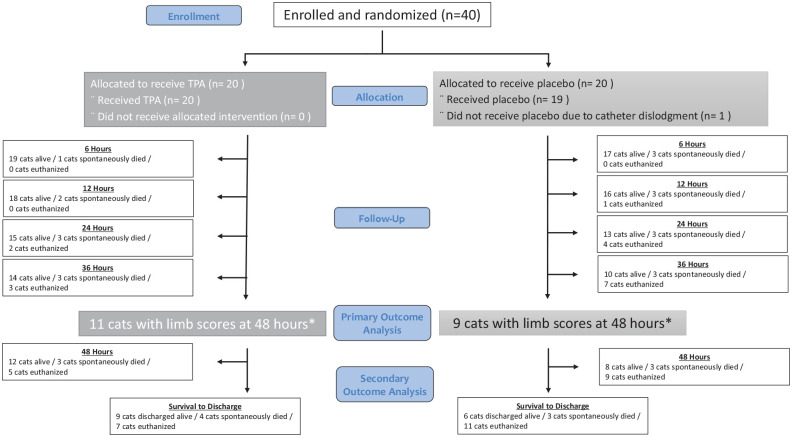
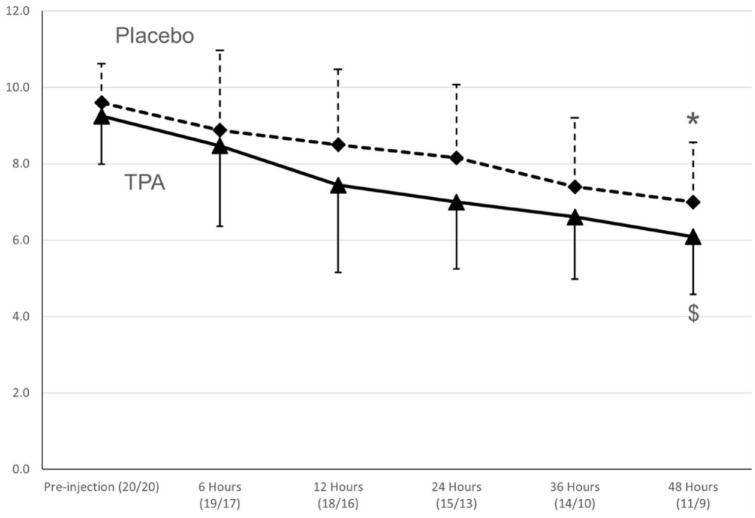
Methods: Cats diagnosed with FATE involving ⩾2 limbs were enrolled in a prospective, multicenter, double-blinded, randomized, placebo-controlled study within 6 h of an event. Diagnosis was made by clinical findings and one confirmatory criterion. Cats received placebo or TPA (1 mg/kg/h with the first 10% by bolus). All cats received pain control and thromboprophylaxis. The primary outcome was a change from baseline in a published limb score at 48 h. Secondary outcomes included 48 h survival, survival to discharge and complication proportions. Statistical analyses included pattern-mixture models, logistic regression and Fisher's exact, Student's t- and Mann-Whitney-Wilcoxon tests.
Results: Based on a power analysis, 40 cats were enrolled; however, only 20 survived to 48 h (TPA, n = 12; placebo, n = 8 [P = 0.34]). There was a statistically significant improvement in limb scores compared with baseline for both groups (P <0.001). Limb score at 48 h was 1 point lower (better) in the TPA group (P = 0.19). Thrombolysis had no statistically significant effect on 48 h survival (P = 0.22). Lower affected limb lactate was associated with better 48 h survival (odds ratio 1.53, 95% confidence interval 1.08-2.17; P = 0.02). The survival to discharge rates were 45% (TPA) and 30% (placebo; P = 0.51). Complications in the TPA and placebo groups included acute kidney injury (22% and 19%, respectively; P = 1.00) and/or reperfusion injuries (33% and 19%, respectively; P = 0.45).
Conclusions and relevance: Survival and complication rates of acute FATE were not different with or without thrombolysis. High in-hospital mortality decreased the statistical power to detect a statistically significant difference between treatments with regard to our primary outcome.
Keywords: Thrombolysis; alteplase; embolism; ischemic neuropathy; rTPA; thrombosis.
Conflict of interest statement
The authors declared no potential conflicts of interest with respect to the research, authorship, and/or publication of this article.
Figures
References
Publication types
MeSH terms
Substances
LinkOut - more resources
Full Text Sources
Miscellaneous
