. 2022 Nov 9;15(1):120.
doi: 10.1186/s13068-022-02219-6.

Characterization of an Entner-Doudoroff pathway-activated Escherichia coli

Affiliations

Characterization of an Entner-Doudoroff pathway-activated Escherichia coli

Ye Eun Kim et al. Biotechnol Biofuels Bioprod. .

Abstract

Background: Escherichia coli have both the Embden-Meyerhof-Parnas pathway (EMPP) and Entner-Doudoroff pathway (EDP) for glucose breakdown, while the EDP primarily remains inactive for glucose metabolism. However, EDP is a more favorable route than EMPP for the production of certain products.

Results: EDP was activated by deleting the pfkAB genes in conjunction with subsequent adaptive laboratory evolution (ALE). The evolved strains acquired mutations in transcriptional regulatory genes for glycolytic process (crp, galR, and gntR) and in glycolysis-related genes (gnd, ptsG, and talB). The genotypic, transcriptomic and phenotypic analyses of those mutations deepen our understanding of their beneficial effects on cellulosic biomass bio-conversion. On top of these scientific understandings, we further engineered the strain to produce higher level of lycopene and 3-hydroxypropionic acid.

Conclusions: These results indicate that the E. coli strain has innate capability to use EDP in lieu of EMPP for glucose metabolism, and this versatility can be harnessed to further engineer E. coli for specific biotechnological applications.

Keywords: 3-Hydroxypropionic acid; Adaptive laboratory evolution; Entner–Doudoroff pathway; Escherichia coli; Glucose metabolism; Phosphofructokinase.


Conflict of interest statement

The authors declare that there is no conflict of interest.

Figures
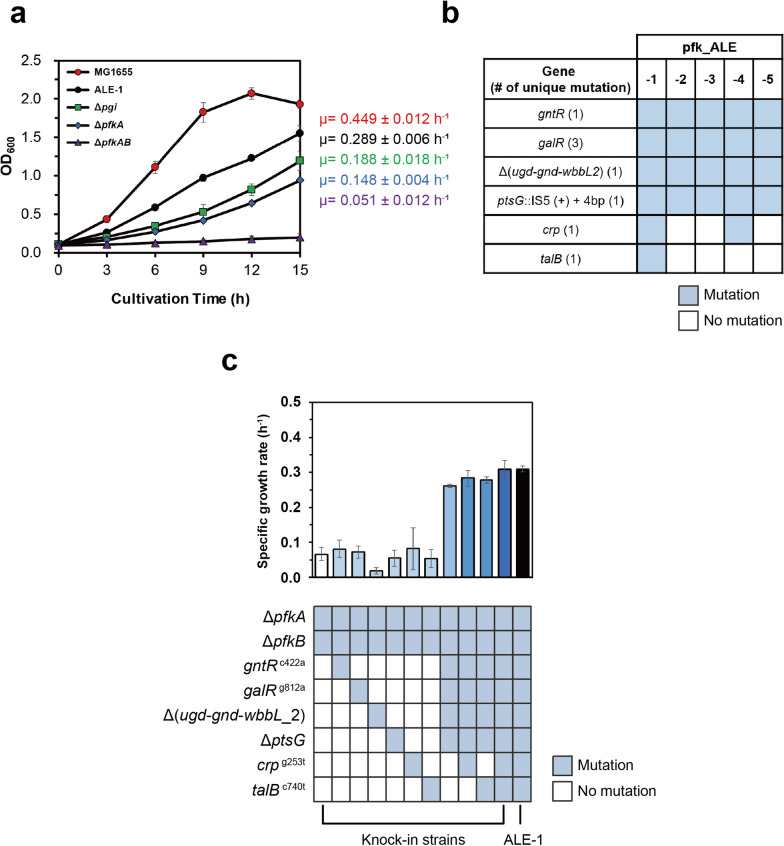
Fig. 1
Fig. 1
Comparison of cell growth on glucose among EMPP-disrupted strains and the effect of mutations on cell growth of the evolved strains and their background strains. a Growth rate profiles (OD600) were compared for three groups of E. coli strains: wild type with MG1655, complete disruption of EMPP with background strain (∆pfkAB), and evolved strain (ALE-1), and partial disruption of EMPP with the phosphofructokinase I step (∆pfkA) and phosphoglucose isomerase step (∆pgi). Error bars indicate standard deviations of measurements for three independent biological replicates. b Genetic characterization of five independent evolved ∆pfkAB isolate strains with genome resequencing analysis. The number of unique mutations per gene is noted within brackets. c The effect of mutations on cell growth were determined by introducing single or multiple mutations in the background strain ∆pfkAB. For the mutation in ptsG, the IS5 insertion disrupted the protein, and consequently, PtsG would lose its functionality. Thus, we knocked out the ptsG gene instead of knocking-in the IS element. Error bars indicate standard deviations of growth measurements for three independent biological replicates
Fig. 2
Fig. 2
Functional analysis of major mutations found in the evolved strains. a RNA-seq transcriptome analysis illustrated the expression level of genes involved in glucose uptake system, glycolytic pathway, TCA cycle and transcriptional regulons including gntR and galR, crp regulons and sugar phosphate stress. Expression change (log2 fold change) of pfkA and gnd genes was unable to be calculated due to loss of expression and it was marked with an asterisk (*). Unexpected expression level of the pfkB gene of ALE-1 was affected by a remained coding sequence of pfkB (Additional file 1: Figure S8). b Functional validation experiments identified effective target genes among mutated genes from ALE-1: lacking the Gnd function, and loss of function for GntR and de-repression of its target genes, edd and eda. Error bars indicate standard deviations of growth measurements for three independent biological replicates. c Combined fluorescence histograms of MG1655, ALE-1, MG1655 Δpgi ΔgntR strains carrying pHexR-GFP. d The schematic diagram illustrates altered glucose metabolism in ALE-1 through the EDP, via enzymes encoded by edd and eda. Transcriptional repression by GntR is indicated with red marks
Fig. 3
Fig. 3
The effect of the redistribution of metabolic flux between PPP and EDP on cell growth and the NADPH/NADP ratio. a Schematic diagrams for possible glycolytic flux redistribution in ALE-1 pRFP (active EDP), ALE-1 pGnd (active both PPP and EDP), and ALE-1 pGnd-GntR (more active PPP and weaker EDP). The effect of gradually increasing glycolytic flux redistribution from the EDP to the PPP in the evolved ALE-1 strain on (d) cell growth and e [NADPH]/[NADP+] ratio. Error bars indicate standard deviations of growth measurements for three independant biological replicates. An asterisk (*) indicates a significant difference compared to the ALE-1 pRFP (p < 0.05)
Fig. 4
Fig. 4
Rebalancing carbon flux through the PPP and EDP for enhanced 3-HP production. a A diagram for genetic strategy for the efficient production of 3-HP. A heterologous 3-HP synthetic pathway was introduced by expressing two dissected subparts, N-terminus and C-terminus ones, from the mutant malonyl-CoA reductase gene (mcr) derived from C. aurantiacus. ACC was overexpressed for malonyl-CoA accumulation while fatty acid synthesis was reduced by expressing a temperature-sensitive FabI at 37 °C. b 3-HP production titer at 48 h post-induction. Error bars indicate standard deviations of 3-HP titer for three independent biological replicates, respectively

References

    1. Romano AH, Conway T. Evolution of carbohydrate metabolic pathways. Res Microbiol. 1996;147(6):448–455. - PubMed
    1. Nikel PI, Chavarria M, Fuhrer T, Sauer U, de Lorenzo V. Pseudomonas putida KT2440 strain metabolizes glucose through a cycle formed by enzymes of the Entner-Doudoroff, Embden-Meyerhof-Parnas, and Pentose Phosphate pathways. J Biol Chem. 2015;290(43):25920–25932. - PMC - PubMed
    1. Fraenkel DG, Vinopal RT. Carbohydrate metabolism in bacteria. Annu Rev Microbiol. 1973;27(1):69–100.
    1. Müller M, Mentel M, van Hellemond JJ, Henze K, Woehle C, Gould SB, et al. Biochemistry and evolution of anaerobic energy metabolism in eukaryotes. Microbiol Mol Biol Rev. 2012;76(2):444–495. - PMC - PubMed
    1. Ponce E, Garcia M, Munoz ME. Participation of the Entner-Doudoroff pathway in Escherichia coli strains with an inactive phosphotransferase system (PTS – Glc +) in gluconate and glucose batch cultures. Can J Microbiol. 2005;51(11):975–982. - PubMed