Review
. 2022 Oct 14;3(6):100340.
doi: 10.1016/j.xinn.2022.100340. eCollection 2022 Nov 8.

Fabric computing: Concepts, opportunities, and challenges

Affiliations
Review

Fabric computing: Concepts, opportunities, and challenges

Min Chen et al. Innovation (Camb). .

Abstract

With the advent of the Internet of Everything, people can easily interact with their environments immersively. The idea of pervasive computing is becoming a reality, but due to the inconvenience of carrying silicon-based entities and a lack of fine-grained sensing capabilities for human-computer interaction, it is difficult to ensure comfort, esthetics, and privacy in smart spaces. Motivated by the rapid developments in intelligent fabric technology in the post-Moore era, we propose a novel computing approach that creates a paradigm shift driven by fabric computing and advocate a new concept of non-chip sensing in living spaces. We discuss the core notion and benefits of fabric computing, including its implementation, challenges, and future research opportunities.


Conflict of interest statement

The authors declare no competing interests.

Figures
None
Graphical abstract
Figure 1
Figure 1
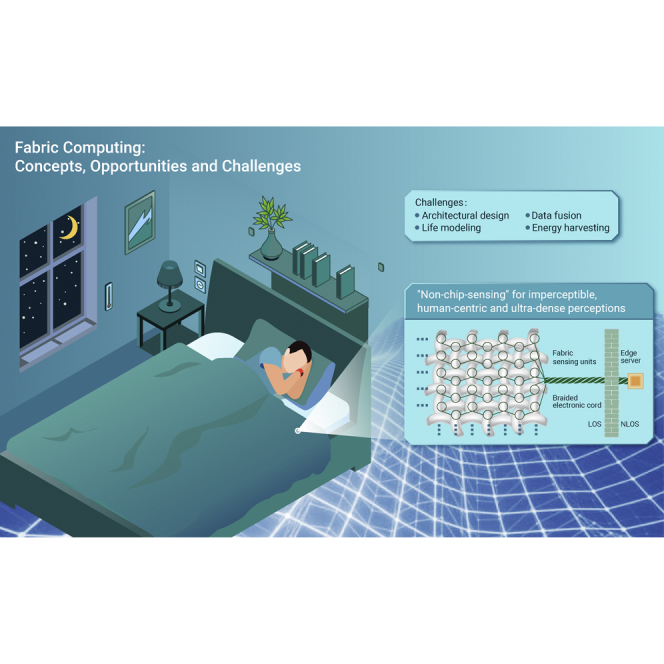
A new fabric-driven computational paradigm: fabric computing for living spaces Multimaterial and multifunctional fibers can be woven or knitted together with traditional fibers into flexible fabrics to create fabric computers that can sense, cache, store, analyze, alert, and act, while retaining their traditional qualities. This means the perception and interaction are imperceptible in the fabrics, which we call the multifunctional fiber agent.
Figure 2
Figure 2
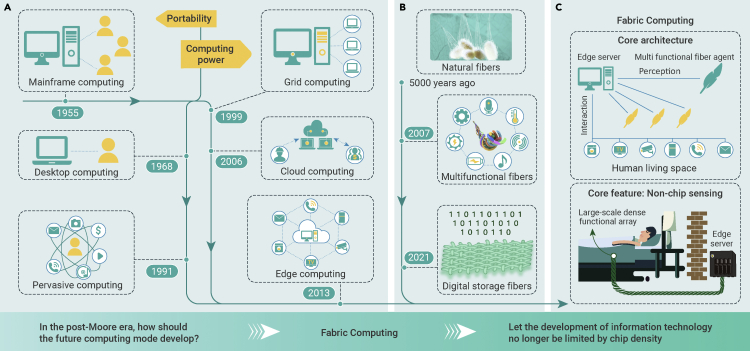
The future development direction of the computing paradigm (A) The two main development directions of the computing paradigm are portable computing mode and shared cluster computing mode. They are compensating each other in terms of computation intensity and user mobility. (B) A revolutionary computing paradigm driven by multimaterial fibers. A wide range of material was combined to expand the basic function of fibers, such as sensing, actuation, color changing, energy storage, thermal management, and antibacterial, which can be woven or knitted together with traditional fibers into flexible fabrics to enable near-human sensing. (C) An illustration of fabric computing.
Figure 3
Figure 3
Communications between sensing units and edge servers (A) Conventional IoT-sensing-based chip computing with a local processor. (B) Intelligent fabric-enabled non-chip computing with a local processor. Each fabric sensing unit has a “tentacle.” Multiple tentacles of the fabric sensing units directly connect to a local processor, which then forwards the processed data to the edge server either through a wired or a wireless communication. (C) Conventional IoT-sensing-based chip computing without a local processor. (D) Intelligent fabric-enabled, non-chip computing without a local processor. Each fabric sensing unit has a “tentacle.” Multiple tentacles of fabric sensing units form a braided electronic cord, which connects to the edge server with a wire.
Figure 4
Figure 4
Comparison between pervasive computing and fabric computing (A) Smart space in pervasive computing. It cannot eliminate the interference of hardware devices for users, and it is also difficult to solve security and privacy issues. (B) The intelligent fabric space. This refers to a typical fabric computing environment built around human centricity using a variety of heterogeneous intelligent fabric agents in the living space and can meet people’s requirements for esthetics and comfort to the greatest extent, while meeting the functional requirements of information services.
Figure 5
Figure 5
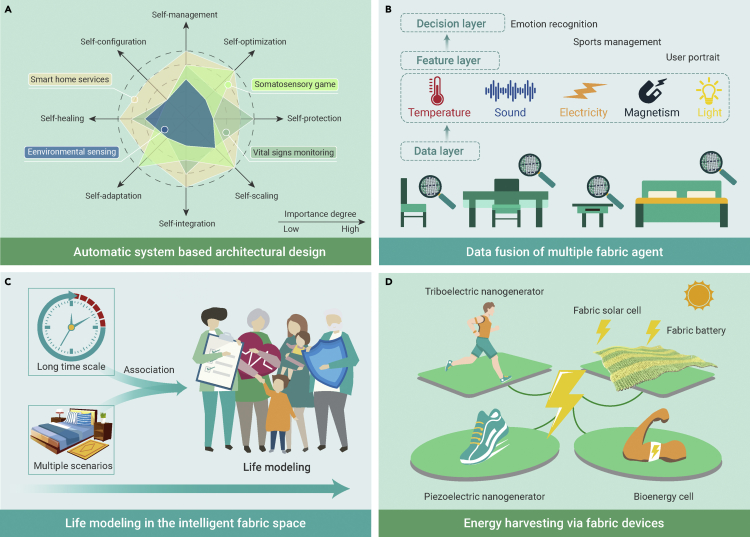
Challenges arise when the computing mode changes (A) Automatic system-based architectural design. The different requirements for the eight features of the autonomic system in the four scenarios of smart home service, somatosensory game, environmental sensing, and vital signs monitoring were exemplified. (B) Data fusion of multiple fabric agents. The perception of human activities, behavior, life, health, etc., by intelligent fibers, requires the use of large-scale and multimodal data for fine-grained and all-around perception and interaction. (C) Life modeling in the intelligent fabric space. An intelligent fabric space should have the ability to analyze the relationship between the contexts of multiple objects (devices, users, physical environment) in real time and respond in a timely manner. (D) Energy harvesting via fabric devices. Power supply issues of tiny sensing devices cannot be ignored, and the use of fabric devices to harvest energy is an approach to ensure battery power.
Figure 6
Figure 6
Application scenarios Potential application scenarios, such as health protection, behavior analysis, sleep monitoring, and mental health, can be enhanced by focusing on the fundamental changes that can be brought by the fabric computing framework.

References

    1. Wiser M. The computer for the 21st century. Sci. Am. 1991;265:66–74.
    1. Satyanarayanan M. Pervasive computing: vision and challenges. IEEE Pers. Commun. 2001;8:10–17.
    1. Shalf J. The future of computing beyond Moore’s law. Philos. Trans. A Math. Phys. Eng. Sci. 2020;378:20190061. - PubMed
    1. Leiserson C.E., Thompson N.C., Emer J.S., et al. There’s plenty of room at the Top: what will drive computer performance after Moore’s law? Science. 2020;368:eaam9744. - PubMed
    1. Abouraddy A.F., Bayindir M., Benoit G., et al. Towards multimaterial multifunctional fibres that see, hear, sense and communicate. Nat. Mater. 2007;6:336–347. - PubMed

LinkOut - more resources