


Supplemental Nutrition Assistance Program as a health intervention
- PMID: 36354297
- PMCID: PMC9803386
- DOI: 10.1097/MOP.0000000000001192
Supplemental Nutrition Assistance Program as a health intervention
Abstract
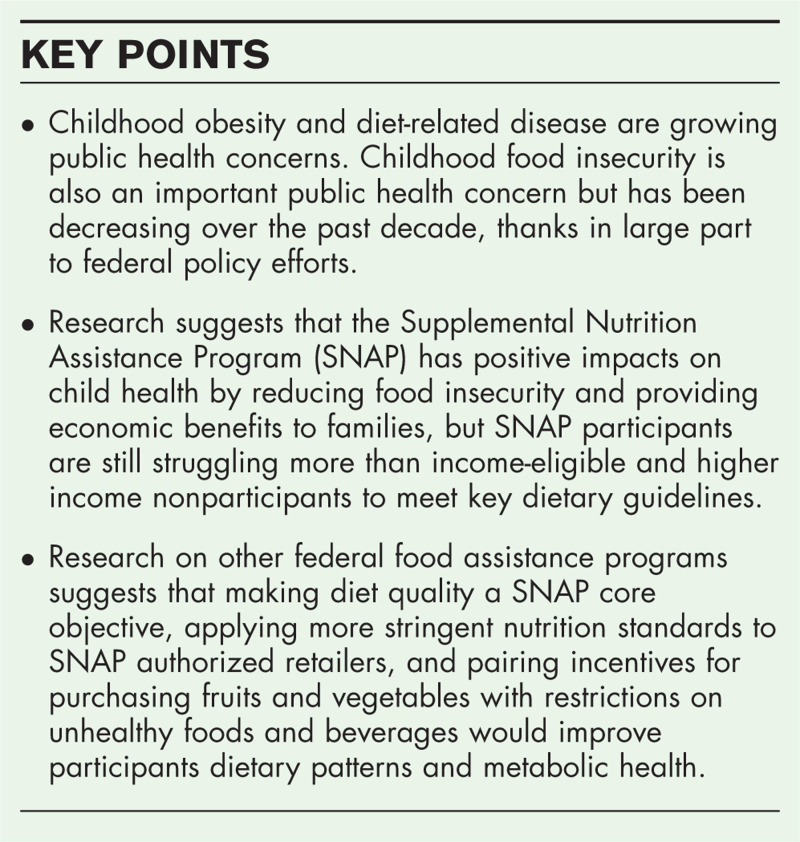
Purpose of review: In 2020, obesity prevalence among US children reached 19.7%, impacting about 14.7 million children and adolescents. Food insecurity among children is also a public health concern but has largely decreased or remained stable over the past decade, reaching 6.2% of US households with children in 2021. Given food insecurity and obesity's interconnected nature and their negative consequences on children's health, it is of interest to assess the Supplemental Nutrition Assistance Program's (SNAP's) impact on childhood food security, dietary quality, disease risk, and health outcomes.
Recent findings: Evidence suggests that SNAP participants, including children, struggle to meet key dietary guidelines and perform poorly on key health indicators when compared with income-eligible and higher income nonparticipants. Children participating in SNAP were more likely to have elevated disease risk and consume more sugar-sweetened beverages (SSBs), more high-fat dairy, and more processed meats than income-eligible nonparticipants. However, research suggests that federal food assistance programs with more stringent nutrition standards - the Special Supplemental Nutrition Program for Women, Infants and Children (WIC) and the National School Lunch Program (NSLP) and School Breakfast Program (SBP) - improve dietary quality, increase birth weight and gestation periods, and reduce childhood obesity, infant mortality and healthcare costs.
Summary: After reviewing the evidence on SNAP's impacts on food insecurity, dietary quality, and health as well as research on the health impacts of other more successful federal food assistance programs, we provide three policy recommendations to strengthen SNAP's effectiveness as a health intervention for children and families.
Copyright © 2022 The Author(s). Published by Wolters Kluwer Health, Inc.
Conflict of interest statement
References
-
- Bryan S, Afful J, Carroll MD, et al. NHSR 158. National Health and Nutrition Examination Survey 2017–March 2020 Pre-pandemic Data Files. Hyattsville, MD, 2021.
-
This report presents prevalence estimates for child and adult obesity from the NHANES from 2017 to March 2020.
-
- Centers for Disease Control and Prevention. Adult Obesity Facts | Overweight & Obesity. Available at: https://www.cdc.gov/obesity/data/adult.html. [Accessed 02 September 2022]
-
- O’Hearn M, Liu J, Cudhea F, et al. Coronavirus disease 2019 hospitalizations attributable to cardiometabolic conditions in the United States: a comparative risk assessment analysis. J Am Heart Assoc 2021; 10:1–27. - PMC - PubMed
-
This study estimates the absolute and proportional COVID-19 hospitalizations in US adults attributable to four major US cardiometabolic conditions, separately and jointly, and by race/ethnicity, age, and sex.
Publication types
MeSH terms
LinkOut - more resources
Full Text Sources
Medical
Research Materials
Miscellaneous
