


Development of Folate-Group Impedimetric Biosensor Based on Polypyrrole Nanotubes Decorated with Gold Nanoparticles
- PMID: 36354479
- PMCID: PMC9688042
- DOI: 10.3390/bios12110970
Development of Folate-Group Impedimetric Biosensor Based on Polypyrrole Nanotubes Decorated with Gold Nanoparticles
Abstract
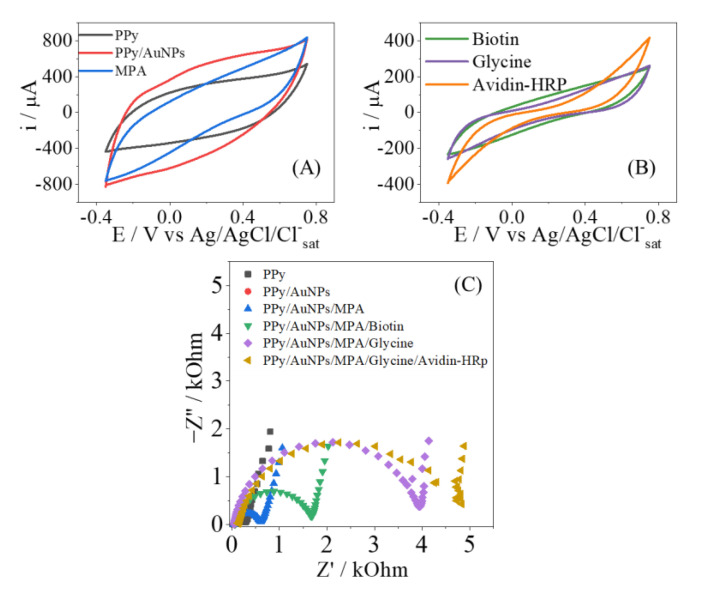
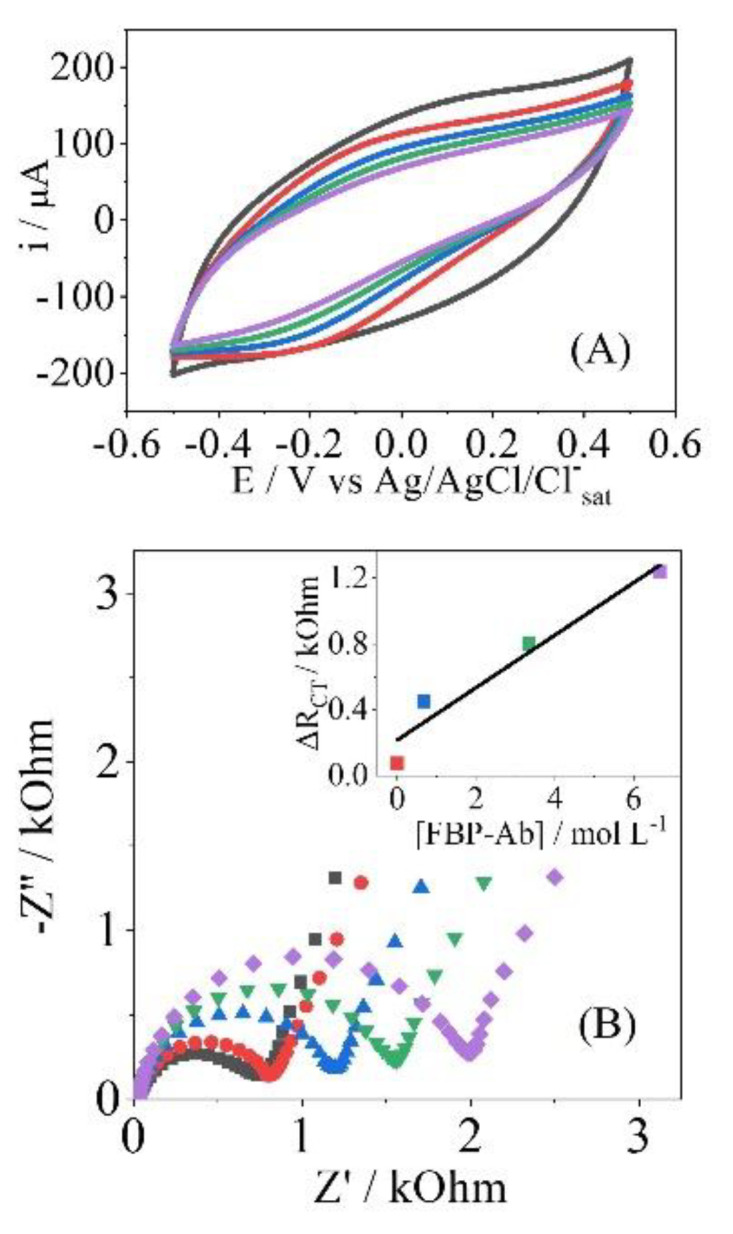
In this study, polypyrrole nanotubes (PPy-NT) and gold nanoparticles (AuNPs) were electrochemically synthesized to form a hybrid material and used as an electroactive layer for the attachment of proteins for the construction of a high-performance biosensor. Besides the enhancement of intrinsic conductivity of the PPy-NT, the AuNPs act as an anchor group for the formation of self-assembly monolayers (SAMs) from the gold-sulfur covalent interaction between gold and Mercaptopropionic acid (MPA). This material was used to evaluate the viability and performance of the platform developed for biosensing, and three different biological approaches were tested: first, the Avidin-HRP/Biotin couple and characterizations were made by using cyclic voltammetry (CV) and electrochemical impedance spectroscopy (EIS), wherein we detected Biotin in a linear range of 100-900 fmol L-1. The studies continued with folate group biomolecules, using the folate receptor α (FR-α) as a bioreceptor. Tests with anti-FR antibody detection were performed, and the results obtained indicate a linear range of detection from 0.001 to 6.70 pmol L-1. The same FR-α receptor was used for Folic Acid detection, and the results showed a limit of detection of 0.030 nmol L-1 and a limit of quantification of 90 pmol L-1. The results indicate that the proposed biosensor is sensitive and capable of operating in a range of clinical interests.
Keywords: folate; impedimetric biosensor; modified electrode.
Conflict of interest statement
The funders had no role in the design of the study; in the collection, analyses, or interpretation of data; in the writing of the manuscript; or in the decision to publish the results.
Figures

References
-
- Islam M.N., Channon R.B. Electrochemical sensors. In: Ladame S., Chang J.Y.H., editors. Bioengineering Innovative Solutions for Cancer. Elsevier; Amsterdam, The Netherlands: 2020. pp. 47–71.
-
- Abdul Ghani M.A., Nordin A.N., Zulhairee M., Che Mohamad Nor A., Shihabuddin Ahmad Noorden M., Muhamad Atan M.K.F., Ab Rahim R., Mohd Zain Z. Portable Electrochemical Biosensors Based on Microcontrollers for Detection of Viruses: A Review. Biosensors. 2022;12:666. doi: 10.3390/bios12080666. - DOI - PMC - PubMed
-
- Adarakatti P.S., Kempahanumakkagari S.K. Electrochemistry. The Royal Society of Chemistry; London, UK: 2019. Modified electrodes for sensing; pp. 58–95.
-
- Baig N., Rana A., Kawde A.-N. Modified Electrodes for Selective Voltammetric Detection of Biomolecules. Electroanalysis. 2018;30:2551–2574. doi: 10.1002/elan.201800468. - DOI
-
- Sandhyarani N. Surface modification methods for electrochemical biosensors. In: Ensafi A.A., editor. Electrochemical Biosensors. Elsevier; Amsterdam, The Netherlands: 2019. pp. 45–75.
MeSH terms
Substances
Grants and funding
LinkOut - more resources
Full Text Sources
Research Materials
