


Comparative Studies on Thickeners as Hydraulic Fracturing Fluids: Suspension versus Powder
- PMID: 36354629
- PMCID: PMC9689377
- DOI: 10.3390/gels8110722
Comparative Studies on Thickeners as Hydraulic Fracturing Fluids: Suspension versus Powder
Abstract
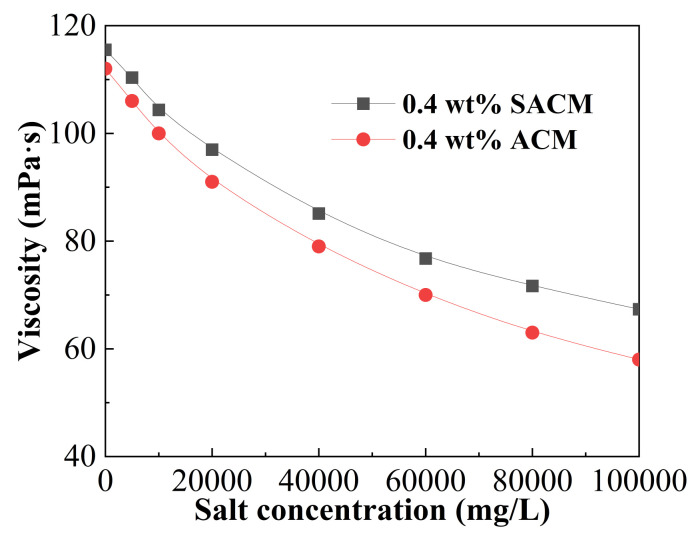
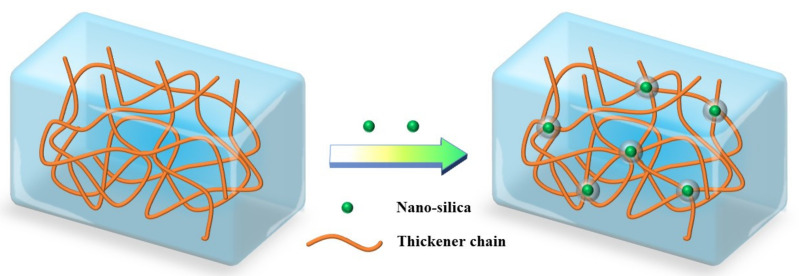
To overcome the problems of long dissolution time and high investment in surface facilities of powder thickeners in hydraulic fracturing, a novel suspension of a thickener as a fracturing fluid was prepared using powder polyacrylamide, nano-silica, and polyethylene glycol by high-speed mixing. The suspension and powder were compared in terms of properties of solubility, rheological behavior, sand carrying, drag reduction, and gel breaking. The results showed that the suspension could be quickly diluted in brine within 5 min, whereas the dissolution time of powder was 120 min. The suspension exhibited better performance in salt resistance, temperature resistance, shear resistance, viscoelasticity, sand carrying, and drag reduction than powder. The powder solution was broken more easily and had a lower viscosity than suspension diluent. These improvements in properties of the suspension were due to the dispersion of nano-silica in the polymer matrix; the mobility of thickener chains was inhibited by the steric hindrance of the nano-silica. Nano-silica particles acted as crosslinkers by attaching thickener chains, which strengthened the network structure of the thickener solution. The presence of hydrogen bonds between the thickener matrix and the nano-silica restricted the local movement of thickener chains, leading to a stronger spatial network. Therefore, this novel suspension showed good potential for fracturing applications.
Keywords: hydraulic fracturing; nano-silica; network structure; powder thickener; suspension.
Conflict of interest statement
The authors declare no conflict of interest.
Figures





References
-
- Yekeen N., Padmanabhan E., Idris A.K. A review of recent advances in foam-based fracturing fluid application in unconventional reservoirs. J. Ind. Eng. Chem. 2018;66:45–71. doi: 10.1016/j.jiec.2018.05.039. - DOI
-
- Yang B., Zhao J., Mao J., Tan H., Zhang Y., Song Z. Review of friction reducers used in slickwater fracturing fluids for shale gas reservoirs. J. Nat. Gas Sci. Eng. 2019;62:302–313. doi: 10.1016/j.jngse.2018.12.016. - DOI
-
- Gu M., Dao E., Mohanty K.K. Investigation of ultra-light weight proppant application in shale fracturing. Fuel. 2015;150:191–201. doi: 10.1016/j.fuel.2015.02.019. - DOI
-
- Chen X., Zhao L.Q., Liu L.P., Du J., Wang Q., An Q., Chang B., Luo Z.F., Zhang N.L. Experimental study and field verification of fracturing technique using a thermo-responsive diverting agent. J. Nat. Gas Sci. Eng. 2021;92:103993. doi: 10.1016/j.jngse.2021.103993. - DOI
-
- Reinicke A., Rybacki E., Stanchits S., Huenges E., Dresen G. Hydraulic fracturing stimulation techniques and formation damage mechanisms-implications from laboratory testing of tight sandstone–proppant systems. Geochemistry. 2010;70:107–117. doi: 10.1016/j.chemer.2010.05.016. - DOI
Grants and funding
LinkOut - more resources
Full Text Sources
Other Literature Sources
