


#COVID19 and #Breastcancer: A Qualitative Analysis of Tweets
- PMID: 36354729
- PMCID: PMC9689212
- DOI: 10.3390/curroncol29110669
#COVID19 and #Breastcancer: A Qualitative Analysis of Tweets
Abstract
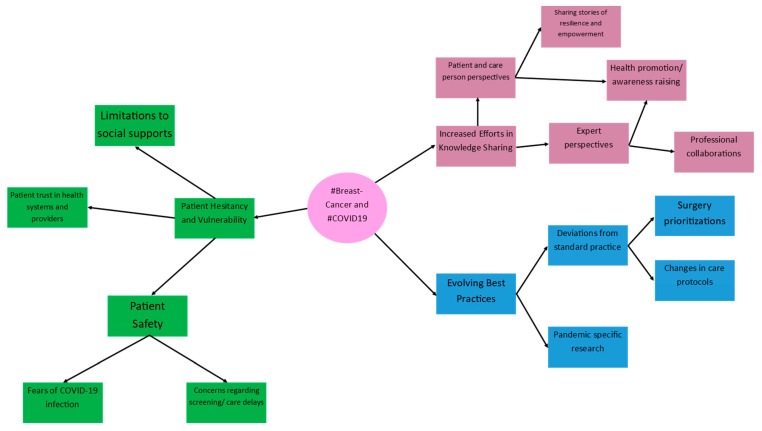
Rapid and efficient communication regarding quickly evolving medical information was paramount for healthcare providers and patients throughout the COVID-19 pandemic. Over the last several years, social media platforms such as Twitter have emerged as important tools for health promotion, virtual learning among healthcare providers, and patient support. We conducted a qualitative thematic content analysis on tweets using the hashtags #BreastSurgery, #BreastCancer, #BreastOncology, #Pandemic, and #COVID19. Advocacy organizations were the most frequent authors of tweets captured in this dataset, and most tweets came from the United States of America (64%). Seventy-three codes were generated from the data, and, through iterative, inductive analysis, three major themes were developed: patient hesitancy and vulnerability, increased efforts in knowledge sharing, and evolving best practices. We found that Twitter was an effective way to share evolving best practices, education, and collective experiences among key stakeholders. As Twitter is increasingly used as a tool for health promotion and knowledge translation, a better understanding of how key stakeholders engage with healthcare-related topics on the platform can help optimize the use of this powerful tool.
Keywords: COVID-19; Twitter; breast cancer; health; pandemic.
Conflict of interest statement
The authors declare no conflict of interest.
Figures
References
-
- WHO Director-General’s Opening Remarks at the Media Briefing on COVID-19—11 March 2020. [(accessed on 7 September 2022)]. Available online: https://www.who.int/director-general/speeches/detail/who-director-genera....
-
- Government of Canada Canada’s COVID-19 Vaccine Supply and Donation Strategy. [(accessed on 8 September 2022)]. Available online: https://www.canada.ca/en/public-health/services/diseases/coronavirus-dis....
-
- Breast Cancer. [(accessed on 7 September 2022)]. Available online: https://www.who.int/news-room/fact-sheets/detail/breast-cancer.
-
- Alagoz O., Lowry K.P., Kurian A.W., Mandelblatt J.S., Ergun M.A., Huang H., Lee S.J., Schechter C.B., Tosteson A.N.A., Miglioretti D.L., et al. Impact of the COVID-19 Pandemic on Breast Cancer Mortality in the US: Estimates From Collaborative Simulation Modeling. JNCI J. Natl. Cancer Inst. 2021;113:1484–1494. doi: 10.1093/jnci/djab097. - DOI - PMC - PubMed
-
- Dietz J.R., Moran M.S., Isakoff S.J., Kurtzman S.H., Willey S.C., Burstein H.J., Bleicher R.J., Lyons J.A., Sarantou T., Baron P.L., et al. Recommendations for Prioritization, Treatment, and Triage of Breast Cancer Patients during the COVID-19 Pandemic. the COVID-19 Pandemic Breast Cancer Consortium. Breast Cancer Res. Treat. 2020;181:487–497. doi: 10.1007/s10549-020-05644-z. - DOI - PMC - PubMed
Publication types
MeSH terms
LinkOut - more resources
Full Text Sources
Medical
Research Materials
