


Association of Serum Adiponectin Biomarker with Metabolic Syndrome Components in Koreans with Extremely High HDL Cholesterol Levels in General Health Checkup
- PMID: 36355169
- PMCID: PMC9694422
- DOI: 10.3390/metabo12111086
Association of Serum Adiponectin Biomarker with Metabolic Syndrome Components in Koreans with Extremely High HDL Cholesterol Levels in General Health Checkup
Abstract
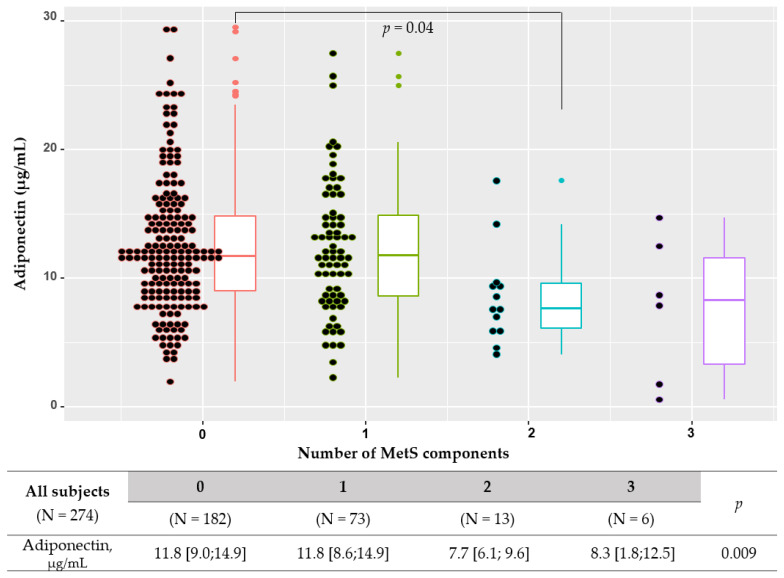
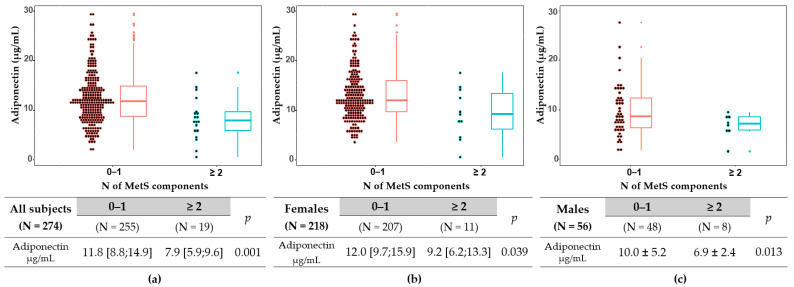
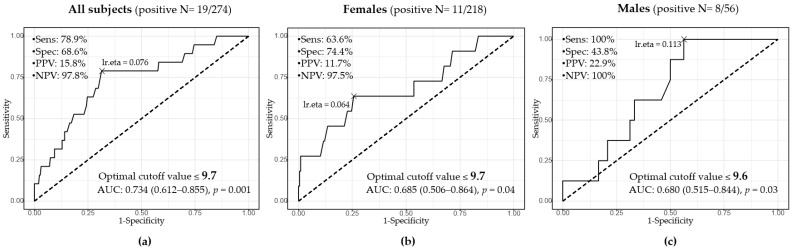
Adiponectin and high-density lipoprotein cholesterol (HDL-C) are negative predictors for cardio-metabolic disorders. This study explored adiponectin's role in predicting multiple metabolic syndrome components (multi-MetSC) in subjects with extremely high HDL-C levels overall and by sex. We enrolled adults with extremely high HDL-C levels (≥90 mg/dL) in general health checkups and compared adiponectin levels in subjects with and without multi-MetSC. Among 274 subjects (median 44 years, female 79.6%), 19 (6.9%) had a multi-MetSC. The adiponectin level was significantly lower in subjects with multi-MetSC than without (females: 9.2 [6.2-13.3] vs. 12.0 [9.7-15.9] µg/mL, p = 0.039; males: 6.9 ± 2.4 vs. 10.0 ± 5.2 µg/mL, p = 0.013). The optimal cutoff values to predict multi-MetSC were 9.7 µg/mL (sensitivity 64%, specificity 74%) in females and 9.6 µg/mL (sensitivity 100%, specificity 44%) in males. Compared with the high adiponectin group, the low group revealed higher fasting glucose in females and higher waist circumference, visceral fat area, and HDL-C levels in males. Multiple logistic regression analysis confirmed adiponectin as an independent predictor of multi-MetSC (OR 0.85, 95% CI 0.71-0.97). Adiponectin could be a potential biomarker for multi-MetSC in general health checkup subjects with extremely high HDL-C levels. There were sex differences in the metabolic risk factors between low and high adiponectin groups.
Keywords: adiponectin; biomarkers; metabolic syndrome.
Conflict of interest statement
The authors declare no conflict of interest.
Figures
References
-
- Alberti K.G., Zimmet P.Z. Definition, diagnosis and classification of diabetes mellitus and its complications. Part 1: Diagnosis and classification of diabetes mellitus provisional report of a WHO consultation. Diabet. Med. 1998;15:539–553. doi: 10.1002/(SICI)1096-9136(199807)15:7<539::AID-DIA668>3.0.CO;2-S. - DOI - PubMed
-
- Balkau B., Charles M.A., Drivsholm T., Borch-Johnsen K., Wareham N., Yudkin J.S., Morris R., Zavaroni I., van Dam R., Feskins E., et al. Frequency of the WHO metabolic syndrome in European cohorts, and an alternative definition of an insulin resistance syndrome. Diabetes Metab. 2002;28:364–376. - PubMed
-
- Alberti K.G., Eckel R.H., Grundy S.M., Zimmet P.Z., Cleeman J.I., Donato K.A., Fruchart J.C., James W.P., Loria C.M., Smith S.C., Jr. Harmonizing the metabolic syndrome: A joint interim statement of the International Diabetes Federation Task Force on Epidemiology and Prevention; National Heart, Lung, and Blood Institute; American Heart Association; World Heart Federation; International Atherosclerosis Society; and International Association for the Study of Obesity. Circulation. 2009;120:1640–1645. - PubMed
Grants and funding
LinkOut - more resources
Full Text Sources
