


Dietary Effect of Clostridium autoethanogenum Protein on Growth, Intestinal Histology and Flesh Lipid Metabolism of Largemouth Bass (Micropterus salmoides) Based on Metabolomics
- PMID: 36355171
- PMCID: PMC9695463
- DOI: 10.3390/metabo12111088
Dietary Effect of Clostridium autoethanogenum Protein on Growth, Intestinal Histology and Flesh Lipid Metabolism of Largemouth Bass (Micropterus salmoides) Based on Metabolomics
Abstract
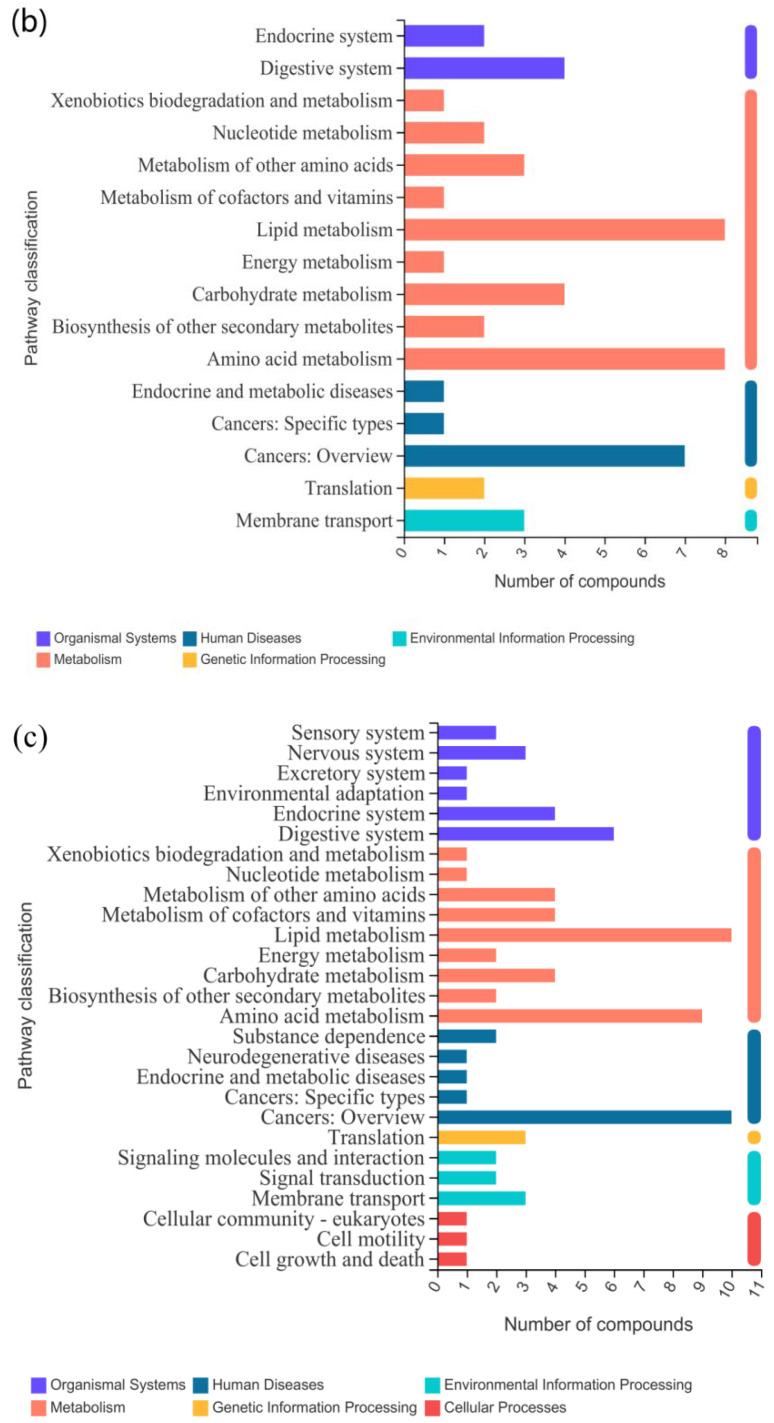
Clostridium autoethanogenum protein (CAP) is a new single-cell protein explored in aquatic feeds in recent years. This study investigated the dietary effects of CAP replacing fishmeal (FM) on the growth, intestinal histology and flesh metabolism of largemouth bass (Micropterus salmoides). In a basal diet containing 700 g/kg of FM, CAP was used to substitute 0%, 15%, 30%, 45%, 70% and 100% of dietary FM to form six isonitrogenous diets (Con, CAP-15, CAP-30, CAP-45, CAP-70, CAP-100) to feed largemouth bass (80.0 g) for 12 weeks. Only the CAP-100 group showed significantly lower weight gain (WG) and a higher feed conversion ratio (FCR) than the control (p < 0.05). A broken-line analysis based on WG and FCR showed that the suitable replacement of FM with CAP was 67.1−68.0%. The flesh n-3/n-6 polyunsaturated fatty acid, intestinal protease activity, villi width and height in the CAP-100 group were significantly lower than those in the control group (p < 0.05). The Kyoto Encyclopedia of Genes and Genomes analysis showed that the metabolic pathway in flesh was mainly enriched in the “lipid metabolic pathway”, “amino acid metabolism”, “endocrine system” and “carbohydrate metabolism”. In conclusion, CAP could successfully replace 67.1−68.0% of dietary FM, while the complete substitution decreased the growth, damaged the intestinal morphology and down-regulated the lipid metabolites.
Keywords: Clostridium autoethanogenum; growth; intestinal healthy; largemouth bass; lipid metabolomics.
Conflict of interest statement
The authors declare no conflict of interest.
Figures


References
-
- Xu T., Peng X., Chen Y., Lin S., Huang X., Li Y. Effects of replacing fish meal with fermented mulberry leaves on the growth, lipid metabolism and antioxidant capacity in largemouth bass (Micropterus salmoides) J. Fish. China. 2016;40:1408–1415. doi: 10.11964/jfc.20150609909. - DOI
-
- He M., Li X.Q., Poolsawa L., Guo Z.H., Yao W.X., Zhang C.Y., Leng X.J. Effects of fish meal replaced by fermented soybean meal on growth performance, intestinal histology and microbiota of largemouth bass (Micropterus salmoides) Aquac. Nutr. 2020;26:1058–1071. doi: 10.1111/anu.13064. - DOI
-
- Zheng Y., Peng C., Wu X., Han F., Xue M., Wang J., Hu L. Effects of hydrolyzed yeast on growth performance, lipids metabolism and intestinal structure of largemouth bass (Micropterus salmoides) Chin. J. Anim. Nutr. 2015;27:1605–1612. doi: 10.3969/j.issn.1006-267x.2015.05.000. - DOI
-
- Ren X., Wang Y., Chen J., Wu Y.B., Huang D., Jiang D.L., Li P. Replacement of fishmeal with a blend of poultry by-product meal and soybean meal in diets for largemouth bass, Micropterus salmoides. J. World Aquac. Soc. 2018;49:155–164. doi: 10.1111/jwas.12415. - DOI
-
- Aas T.S., Grisdale-Helland B., Terjesen B.F., Helland S.J. Improved growth and nutrient utilisation in Atlantic salmon (Salmo salar) fed diets containing a bacterial protein meal. Aquaculture. 2006;259:365–376. doi: 10.1016/j.aquaculture.2006.05.032. - DOI
Grants and funding
LinkOut - more resources
Full Text Sources
Miscellaneous
