


Association of Multidrug Resistance Bacteria and Clinical Outcomes of Adult Patients with Sepsis in the Intensive Care Unit
- PMID: 36355907
- PMCID: PMC9692934
- DOI: 10.3390/tropicalmed7110365
Association of Multidrug Resistance Bacteria and Clinical Outcomes of Adult Patients with Sepsis in the Intensive Care Unit
Abstract
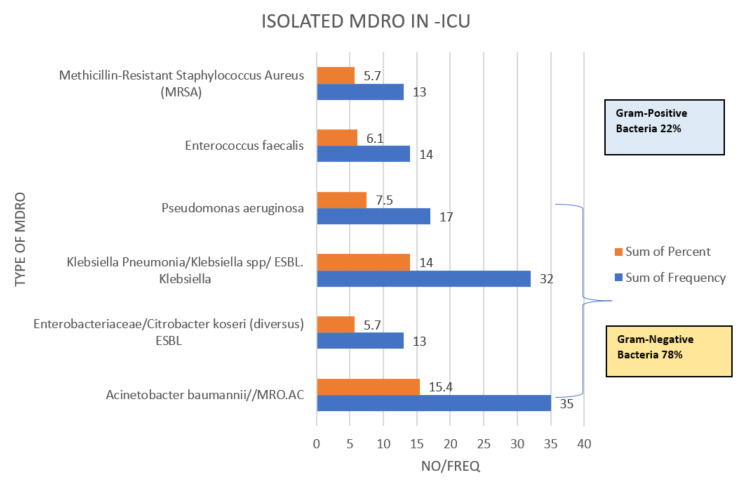
Background: Multi-drug resistance organisms (MDRO) often cause increased morbidity, mortality, and length of stays (LOS). However, there is uncertainty whether the infection of MDRO increase the morbidity, mortality, and ICU-LOS. Objective: This study was performed to determine the prevalence of MDRO in the ICU, the site of infection, and the association of MDRO or site of infection with mortality. The secondary outcome was determined by ascertaining the association of MDRO or site of infection with ICU-LOS. Methods: A retrospective cohort study was performed with adult sepsis patients in the ICU. Univariate and multivariate (MVA) logistic regression with cox regression modeling were performed to compute the association of MDRO with ICU mortality. MVA modelling was performed for ICU-LOS predictors. Results: Out of 228 patients, the isolated MDRO was 97 (42.5%), of which 78% were Gram-negative bacteria. The mortality rate among those with MDRO was 85 (37.3%). The hospital acquired infection (HAI) was a significant predictor for ICU-LOS in univariate linear regression (R2 = 0.034, p = 0.005). In MVA linear regression, both Enterococcus faecalis infection and Acinetobacter baumannii (AC)-MDRO were predictors for ICU-LOS with (R2 = 0.478, p < 0.05). In the univariate cox regression, only the infection with AC-MDRO was a risk factor for ICU-mortality with [HR = 1.802 (95% CI: 1.2−2.706; p = 0.005)]. Conclusions: Identifying risk factors for MDRO addresses the appropriate administration of empirical antibiotics and allows to effectively control the source of infection, which would reduce mortality and ICU-LOS. The usage of broad-spectrum antibiotics should be limited to those with substantial risk factors for acquiring MDRO.
Keywords: APACHE II; ICU length of stay; adequate empirical antibiotics; mortality; multidrug resistance organism; predictors; risk factors; sepsis; source of infection.
Conflict of interest statement
The authors declare no conflict of interest.
Figures
References
-
- Busani S., Serafini G., Mantovani E., Venturelli C., Giannella M., Viale P., Mussini C., Cossarizza A., Girardis M. Mortality in Patients with Septic Shock by Multidrug Resistant Bacteria: Risk Factors and Impact of Sepsis Treatments. J. Intensive Care Med. 2017;34:48–54. doi: 10.1177/0885066616688165. - DOI - PubMed
-
- McConville T.H., Sullivan S.B., Gomez-Simmonds A., Whittier S., Uhlemann A.C. Carbapenem-resistant Enterobacteriaceae colonization (CRE) and subsequent risk of infection and 90-day mortality in critically ill patients, an observational study. PLoS ONE. 2017;12:e0186195. doi: 10.1371/journal.pone.0186195. - DOI - PMC - PubMed
-
- Dat V.Q., Vu H.N., Nguyen H.T., Hoang L.B., Vu Tien Viet D., Bui C.L., Van Nguyen K., Nguyen T.V., Trinh D.T., Torre A., et al. Bacterial bloodstream infections in a tertiary infectious diseases hospital in Northern Vietnam: Aetiology, drug resistance, and treatment outcome. BMC Infect. Dis. 2017;17:493. doi: 10.1186/s12879-017-2582-7. - DOI - PMC - PubMed
LinkOut - more resources
Full Text Sources
