


Developmental aspects of fear generalization - A MEG study on neurocognitive correlates in adolescents versus adults
- PMID: 36356485
- PMCID: PMC9649997
- DOI: 10.1016/j.dcn.2022.101169
Developmental aspects of fear generalization - A MEG study on neurocognitive correlates in adolescents versus adults
Abstract
Background: Fear generalization is pivotal for the survival-promoting avoidance of potential danger, but, if too pronounced, it promotes pathological anxiety. Similar to adult patients with anxiety disorders, healthy children tend to show overgeneralized fear responses.
Objective: This study aims to investigate neuro-developmental aspects of fear generalization in adolescence - a critical age for the development of anxiety disorders.
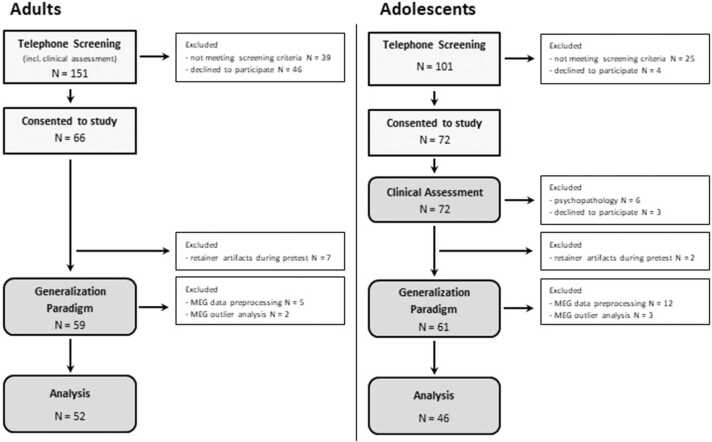
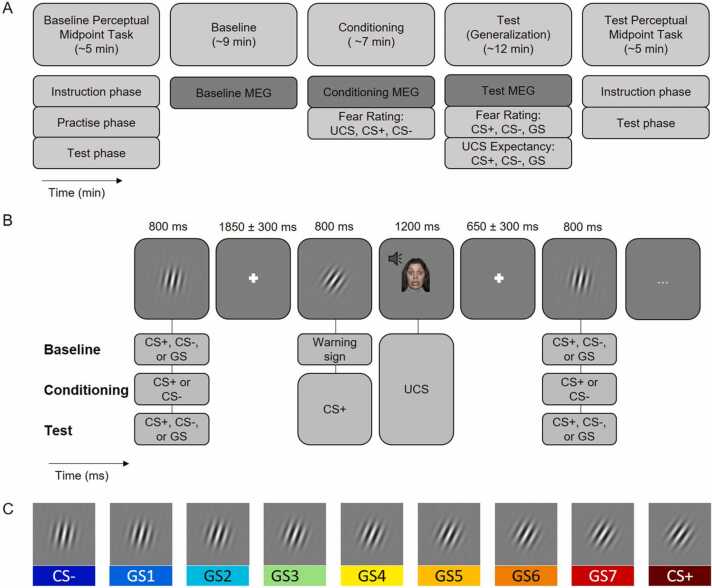
Methods: We compared healthy adolescents (14-17 years) with healthy adults (19-34 years) regarding their fear responses towards tilted Gabor gratings (conditioned stimuli, CS; and slightly differently titled generalization stimuli, GS). In the conditioning phase, CS were paired (CS+) or remained unpaired (CS-) with an aversive stimulus (unconditioned stimuli, US). In the test phase, behavioral, peripheral and neural responses to CS and GS were captured by fear- and UCS expectancy ratings, a perceptual discrimination task, pupil dilation and source estimations of event-related magnetic fields.
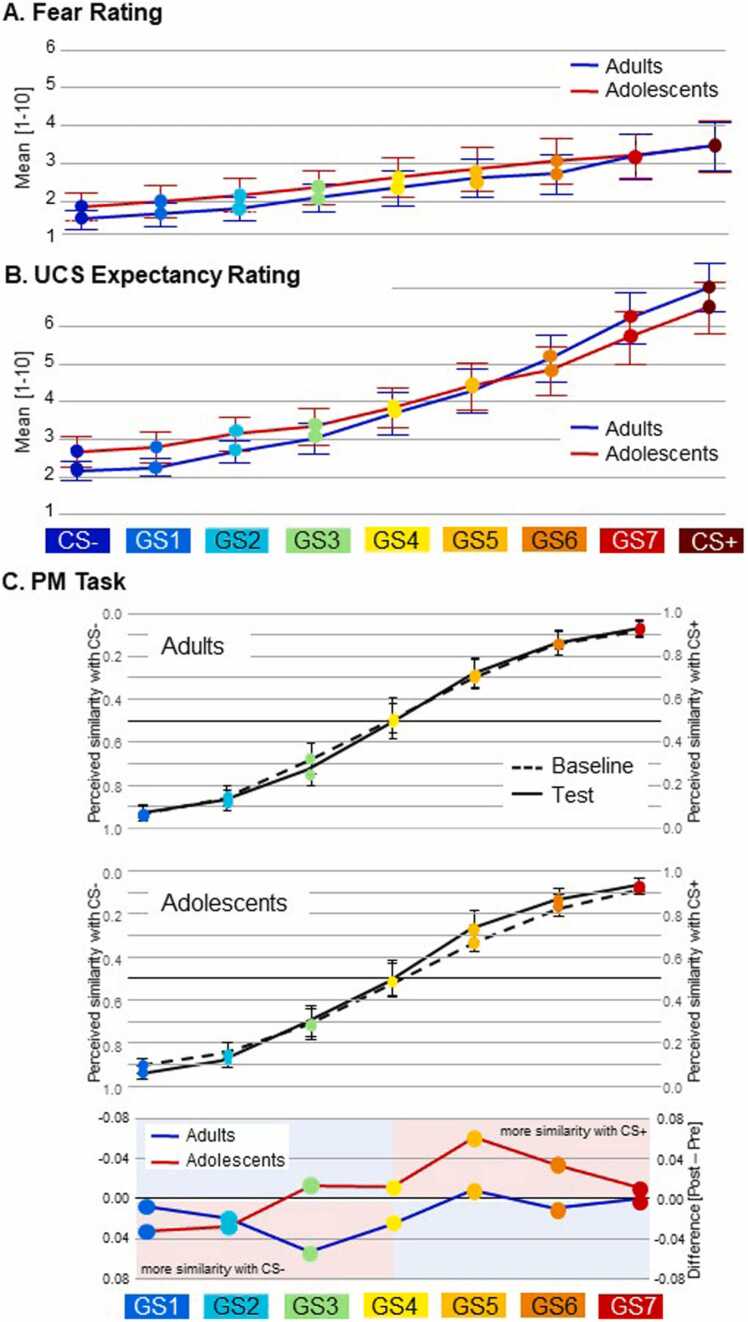
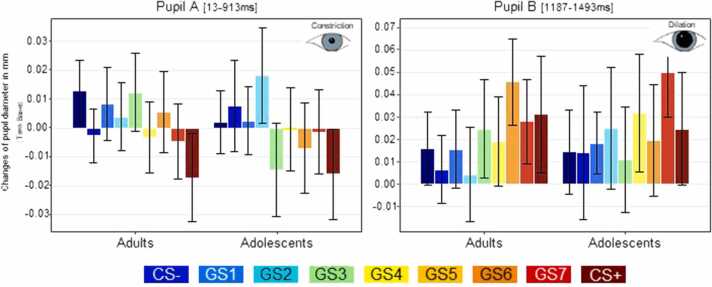
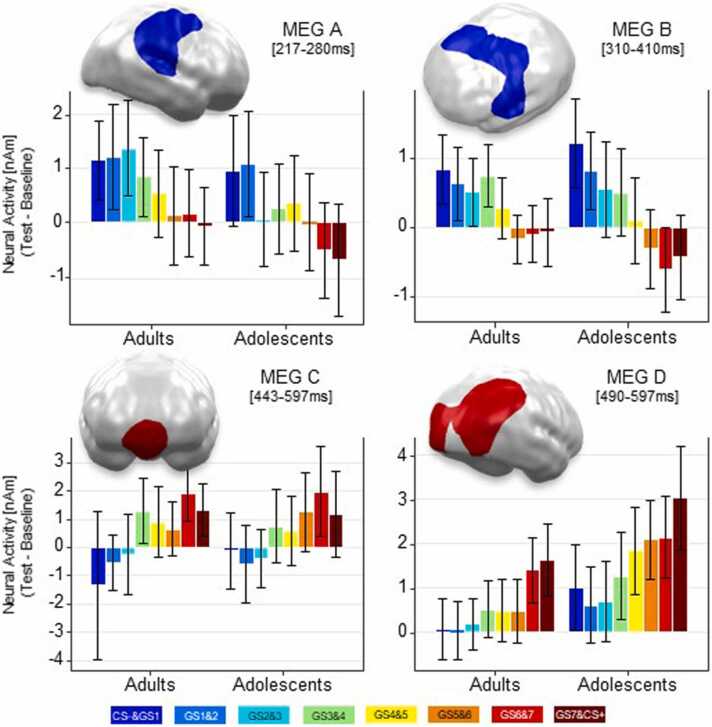
Results: Closely resembling adults, adolescents showed robust generalization gradients of fear ratings, pupil dilation, and estimated neural source activity. However, in the UCS expectancy ratings, adolescents revealed shallower generalization gradients indicating overgeneralization. Moreover, adolescents showed stronger visual cortical activity after as compared to before conditioning to all stimuli.
Conclusion: Various aspects of fear learning and generalization appear to be mature in healthy adolescents. Yet, cognitive aspects might show a slower course of development.
Keywords: Adolescence; Brain development; EEG; Event-related fields; Fear conditioning; Fear generalization; MEG.
Copyright © 2022 The Authors. Published by Elsevier Ltd.. All rights reserved.
Conflict of interest statement
Disclosure statement The authors have no conflicts of interest to declare.
Figures
References
-
- Bradley M.M., Lang P.J. Technical Report B-2. Gainesville, FL: The Center for Research in Psy- Chophysiology. University of Florida; 1999. International affective digitized sounds (IADS): Stimuli, instruction manual and affective ratings.
-
- Bradley M.M., Sabatinelli D., Lang P.J., Fitzsimmons J.R., King W., Desai P. Activation of the visual cortex in motivated attention. Behav. Neurosci. 2003;117(2):369–380. doi: 10.1037/0735-7044.117.2.369. (Retrieved from http://doi.apa.org/getdoi.cfm?doi=) - DOI - PubMed
Publication types
MeSH terms
LinkOut - more resources
Full Text Sources
