


Low serological rate of SARS-CoV-2 in cats from military bases in Israel
- PMID: 36356507
- PMCID: PMC9632235
- DOI: 10.1016/j.cimid.2022.101905
Low serological rate of SARS-CoV-2 in cats from military bases in Israel
Abstract
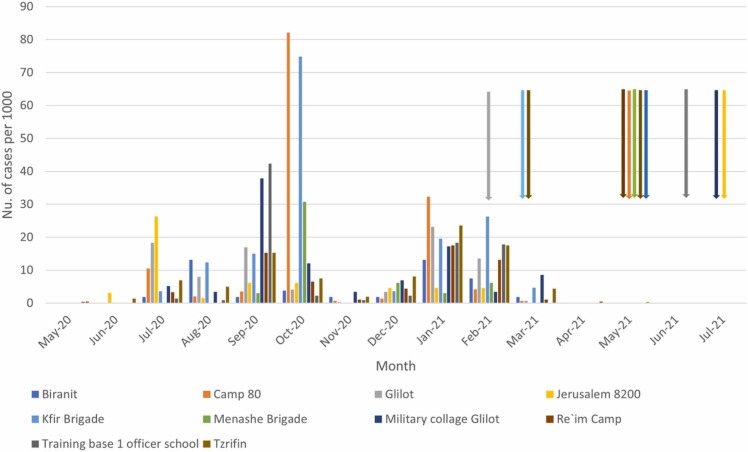
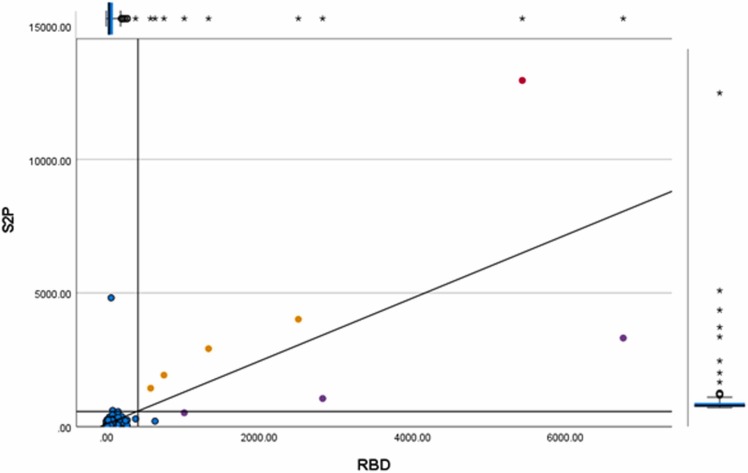
Domestic cats are susceptible to SARS-CoV-2 infection and can transmit the virus to other felines. A high number of COVID-19 human cases within the military personnel and a high density of stray cats living close to soldiers raised the need to perform active animal surveillance. We validated a novel quantitative serological microarray for use in cats, that enables simultaneous detection of IgG and IgM responses; in addition, molecular genetic SARS-CoV-2 detection was performed. Three out of 131 cats analyzed, showed IgG antibodies against SARS-CoV-2 RBD and S2P (2.3 %). None of cats were positive for SARS-CoV-2 RNA by RT-PCR. SARS-CoV-2 infection rate in soldiers ranged from 4.7 % to 16 % (average rate=8.9 %). Further investigations on a larger cohort are necessary, in the light of the emerging new viral variants in other animal species and in humans.
Keywords: COVID-19; Military; One health; SARS-CoV-2; Stray cats.
Copyright © 2022 Elsevier Ltd. All rights reserved.
Conflict of interest statement
Conflict of Interest The J.A.R laboratory received support from Tonix Pharmaceuticals, Genus plc, Xing Technologies and Zoetis, outside of the reported work. J.A.R is inventor of patents and patent applications on the use of antivirals and vaccines for the treatment and prevention of virus infections, owned by Kansas State University, KS.
Figures
References
-
- W.H.O.. Coronavirus (COVID-19), global situation. available online: https:// covid19.who.int/ (accessed on 3th April 2022).
-
- Zhou P., Xing-Lou Y., Xian-Guang W., Ben H., Lei Z., Wei S., Hao-Rui Y., Zhu L., Bei H., Chao-Lin H.D., Chen J., Luo Y., Guo H., Jiang R.D., Liu M.Q., Chen Y., Shen X.R., Wang X., Xiao-Shuang Zheng X.S.X.S., Zhao K., Chen Qj, Deng F., Liu L.L., Yan B., Zhan F.X., Wang Y.Y., Xiao G.F., Shi Z.L. A pneumonia outbreak associated with a new coronavirus of probable bat origin. Nature. 2020;579:270–273. doi: 10.1038/s41586-020-2012-7. - DOI - PMC - PubMed
-
- Barrs V.R., Peiris M., Tam K.W.S., Law P.Y.T., Brackman C.J., To E.M.W., Yu V.Y.T., Chu D.K.W., Perera R.A.P.M., Sit T.H.C. SARS-CoV-2 in quarantined domestic cats from covid-19 households or close contacts, Hong Kong, China. Emerg. Infect. Dis. 2020;26:3071–3074. doi: 10.3201/eid2612.202786. - DOI - PMC - PubMed
-
- Patterson E.I., Elia G., Grassi A., Giordano A., Desario C., Medardo M., Smith S.L., Anderson E.R., Prince T., Patterson G.T., Lorusso E., Lucente M.S., Lanave G., Lauzi S., Bonfanti U., Stranieri A., Martella V., Solari Basano F., Barrs V.R., Radford A.D., Agrimi U., Hughes G.L., Paltrinieri S., Decaro N. Evidence of exposure to SARS-CoV-2 in cats and dogs from households in Italy. Nat. Commun. 2020 doi: 10.1038/s41467-020-20097-0. - DOI - PMC - PubMed
MeSH terms
Substances
Grants and funding
LinkOut - more resources
Full Text Sources
Medical
Miscellaneous
