. 2022 Nov 10;12(1):19229.
doi: 10.1038/s41598-022-22033-2.

Corneal elastic property investigated by terahertz technology

Affiliations

Corneal elastic property investigated by terahertz technology

Lin Ke et al. Sci Rep. .

Abstract

Terahertz (THz) spectroscopy technique has been applied in ex vivo biomechanical properties analysis of human corneas. Upon the application of light pressure on the cornea, the photo elastic birefringent effect, anisotropic deformation, thickness changes and hydration levels will contribute to the sudden phase changes of terahertz time domain signal. The shelf lifetime study shows that the phase shift is reduced and cornea loose the biomechanical properties with the increase of hydration level. Mechanical behaviors have been further studied based on the "fresh" cut corneas with the similar hydration levels. THz signal was collected by focusing inside of the cornea to avoid the phase shift due to light stress caused movement of the corneal surface. By this way, the amount of THz signal refractive index variation is correlated to the elastic property of the corneas. The correlation between the THz signal phase shift and refractive index shift due to the corneal strain can be used to derive the elastic Young's modulus. Our results demonstrated the THz spectroscopy, as a non-contact and non-invasive detection method, could be potential for understanding the mechanism of corneal deformation under the action of intraocular pressure in the physiological environment in future.


Conflict of interest statement

The authors declare no competing interests.

Figures
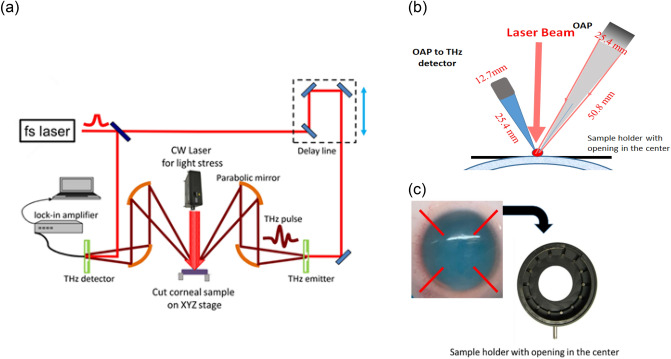
Figure 1
Figure 1
(a) Schematic THz spectroscopy measurement setup and light stress executed on top of the corneal sample. (b) Detailed information of parabolic focusing setup. (c) Sample has been flattened on holder with opening on the XYZ stage.
Figure 2
Figure 2
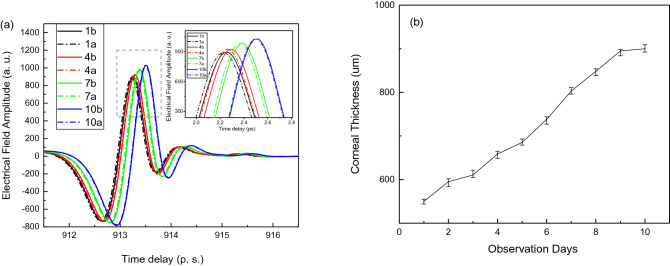
(a) Time domain spectra obtained at day 1, day 4, day 7 and day 10. Inset figure: enlarged peak information (b): thickness data with error bar indication versus observation days.
Figure 3
Figure 3
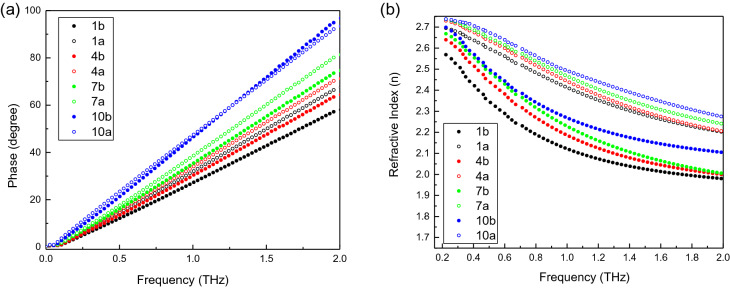
(a) Phase versus frequency; (b) Refractive index value versus frequency for cornea sample No. 1 at day 1, day 4, day 7 and day 10.
Figure 4
Figure 4
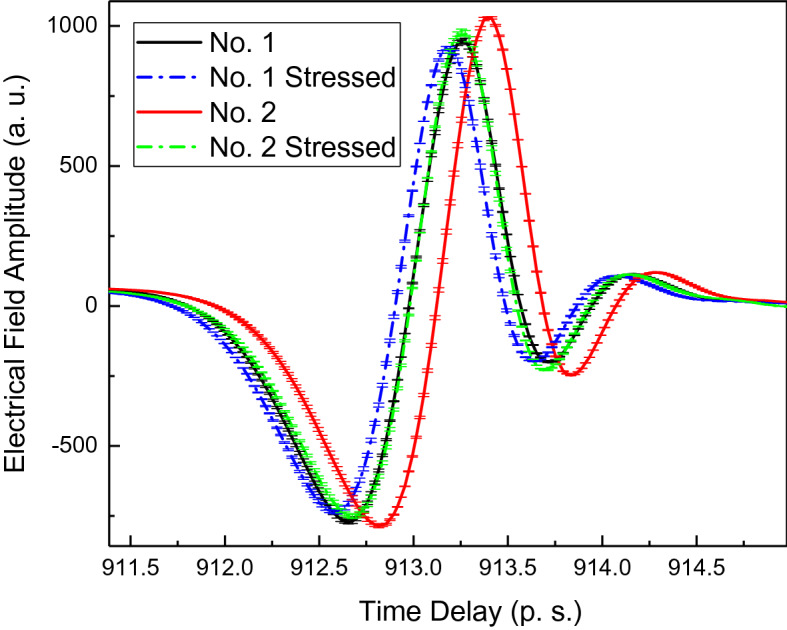
THz time domain spectra collected on the surface of corneas with the indication of data error bar.
Figure 5
Figure 5
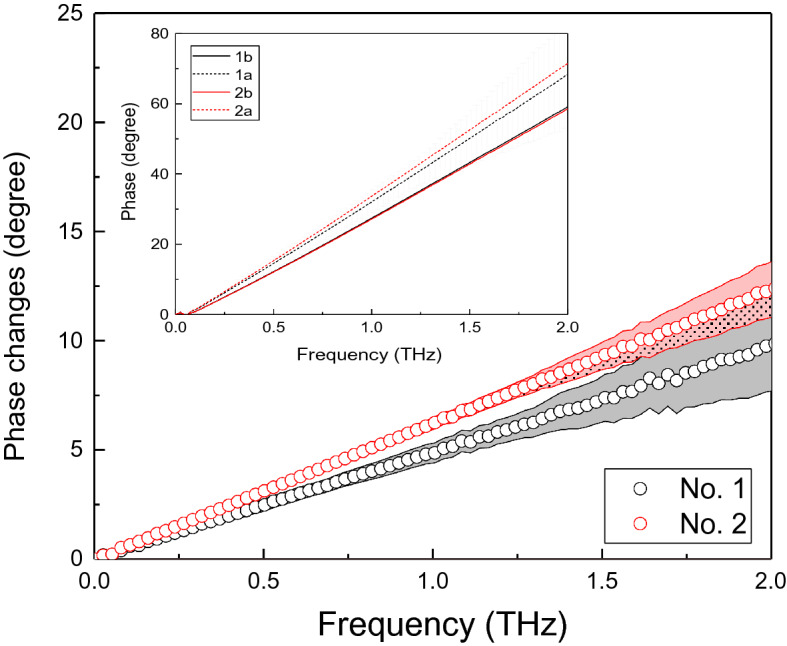
The phase difference versus frequency for corneal samples No 1. and No. 2, data with error bar indicated. Insert figure: Phase versus frequency for cornea No. 1 and No.2. 1a and 2a indicate the curves after the light stress, while the 1b and 2bindicate the curves before the light stress.
Figure 6
Figure 6
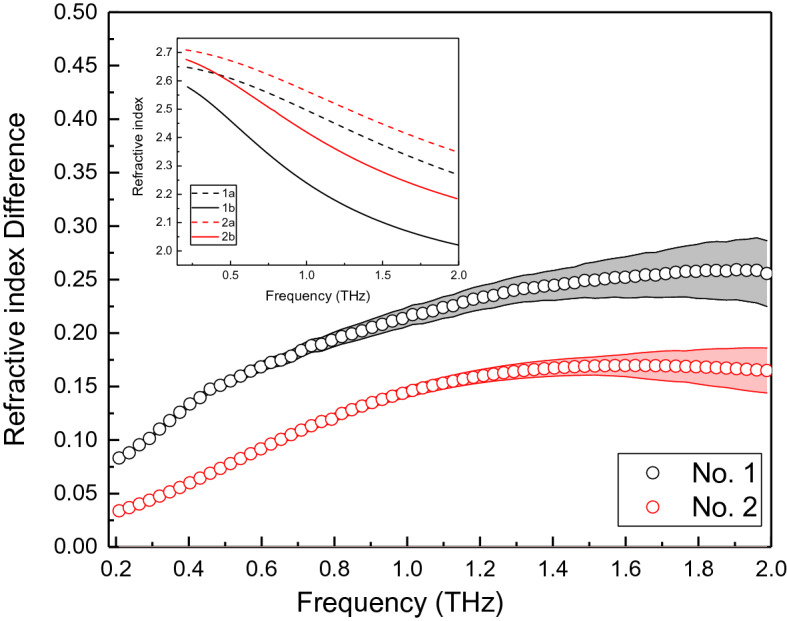
Refractive index versus frequency for the cornea No. 1 and No. 2. Insert Figure: refractive index of cornea No. 1 and No. 2. 1a and 2a indicate the curves after the light stress, while the 1b and 2b indicate the curves before the light stress.
Figure 7
Figure 7
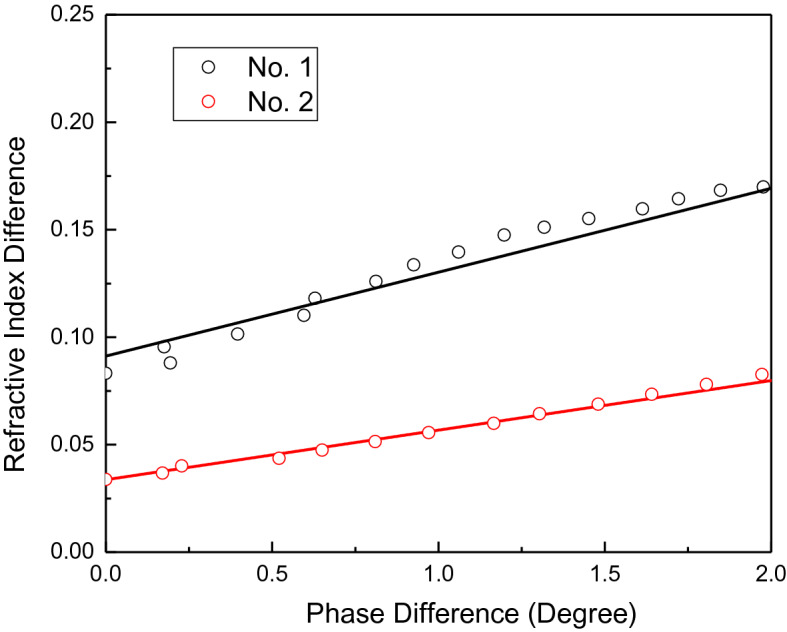
The refractive index difference versus phase shift curves for corneal sample No. 1 and No. 2 at stress duration of 10 s.

References

    1. Hay JG. The Biomechanics of Sports Techniques. 4. Prentice-Hall; 1993.
    1. Gouveia RM, Lepert G, Gupta S, Mohan RR, Paterson C, Connon CJ. Assessment of corneal substrate biomechanics and its effect on epithelial stem cell maintenance and differentiation. Nat. Commun. 2019;10:1496. doi: 10.1038/s41467-019-09331-6. - DOI - PMC - PubMed
    1. Porta NG, et al. Corneal biomechanical properties in different ocular conditions and new measurement techniques. ISRN Ophthalmol. 2014;2014:1–19. - PMC - PubMed
    1. Ryan DS, et al. Corneal biomechanics following Epi-LASIK. J. Refract. Surg. 2011;27(6):458–464. - PubMed
    1. Chen S, et al. Changes in ocular response analyzer parameters after LASI. J. Refract. Surg. 2010;26(4):279–288. - PubMed

Publication types